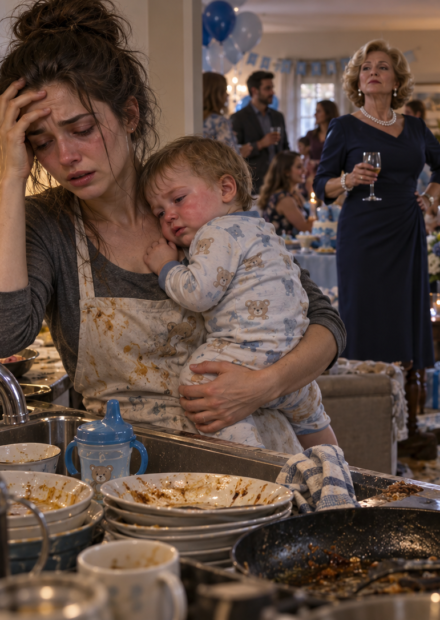
THE DAY MY FAMILY TRIED TO SILENCE MY DAUGHTER
Chapter 1 – FIFTEEN MINUTES
Fifteen minutes was all it took for my sister to decide my two-year-old daughter should be drugged into silence.
And for the rest of my life, I would remember every single one of those minutes.
The backyard smelled like buttercream frosting, sunscreen, damp grass, and white wine going sour in the June heat.
Pink streamers snapped against the patio rail whenever the wind came through, and the little speaker on the food table kept playing cheerful songs that suddenly felt too bright for the kind of family we really were.
From the curb, my sister Natalie’s house looked normal.
Balloons tied to the mailbox.
Cupcakes lined up on a folding table.
A small American flag clipped near the porch.
A family SUV parked crooked in the driveway because someone had pulled in late and still wanted a good spot.
My family had always been good at decorating around cruelty.
My daughter Rosie was two years old, wearing a yellow sundress and tiny white sandals, one sticky hand wrapped around my fingers.
She was shy around noise.
Shy around strangers.
Shy around adults who smiled too hard and talked too loud.
When people crowded her, she pressed her face into my leg.
When someone demanded a hug, she looked at me first.
When the other children screamed while running through the sprinkler, she stood beside me watching them with huge brown eyes, needing another few minutes before deciding whether the fun was worth the noise.
To everyone else, Rosie was sensitive.
To me, she was my whole life.
Five years of losses came before her.
Blood tests.
Clinic bills.
Paper coffee cups in waiting rooms.
Bathroom stalls where I cried before work, then washed my face and walked back out like nothing had happened.
Months when I couldn’t walk past the baby aisle at Target without feeling something close inside my throat.
Friends learned to tell me about their pregnancies gently.
Some stopped telling me at all.
Then Rosie came.
Seven pounds, four ounces.
A furious little cry.
Ten fingers.
Ten toes.
A head of dark curls stuck damply against her skull.
The nurse placed her against my chest, and I remember thinking that everything I had survived suddenly had a face.
I promised her something that morning.
Not that nothing bad would ever happen to her.
I wasn’t foolish enough to believe I could control the whole world.
I promised she would never have to face the bad parts alone.
And I promised no one would convince her that she was too much.
But Natalie and my mother had another word for her.
Difficult.
Natalie’s daughter Autumn was turning six that Saturday.
Autumn wasn’t difficult.
At least, that was what my mother had been announcing to everyone for most of the afternoon.
“Autumn slept through the night at six weeks.”
“Autumn never threw tantrums.”
“Autumn ate anything you put in front of her.”
“Autumn could sit quietly in a restaurant when she was two.”
Every story seemed to end with my mother’s eyes flicking toward Rosie.
Rosie had spent most of the party gripping my fingers.
The first time someone popped a balloon, she cried.
My mother sighed.
When she refused cake because too many people were standing around the table, Natalie rolled her eyes.
When Rosie wanted me to pick her up during the birthday song, my mother leaned over and whispered, “You’re encouraging this.”
I knew what she meant.
Dependence.
Neediness.
Weakness.
In our family, children were supposed to make adults comfortable.
I had spent thirty-three years learning that rule.
Rosie had spent two years breaking it without even knowing it existed.
At 2:17 p.m., my mother leaned close enough that her smile stayed pretty for the guests while her voice went cold for me.
“Go get Autumn’s gift from your car before everyone starts opening presents.”
“I’ll take Rosie.”
My mother’s eyes sharpened.
“Stop acting so neurotic.”
“I’m not being neurotic.”
“You’ve been carrying that child around all afternoon.”
“She’s two.”
“She has legs.”
Rosie tightened her arms around my neck.
My mother noticed.
Of course she noticed.
She noticed vulnerability the way a shark noticed blood.
“Natalie will watch her,” she said. “You’re embarrassing yourself.”
That was the trick in my family.
They never called neglect neglect.
They called it me being dramatic.
They never called cruelty cruelty.
They called it discipline.
They never admitted that my mother’s favorite weapon was humiliation.
She called it honesty.
Natalie sat back in a white lawn chair with a glass of Pinot Grigio in one hand.
Her sunglasses were pushed onto her head.
She had spent forty minutes arranging Autumn’s gifts in perfect rows beneath a banner that said SIX IS SWEET.
Now she raised one hand in a lazy wave.
“Go,” she said. “I’ve got her.”
I should have listened to the feeling in my stomach.
That’s the part people never understand afterward.
They ask whether you sensed something.
Whether there was a warning.
Whether some instinct told you not to walk away.
There was.
But when you’ve spent your entire life being told your instincts are overreactions, you learn to argue with them.
I crouched in front of Rosie.
“Mommy’s going to the car and right back, okay?”
Her bottom lip trembled.
“You stay with Aunt Natalie.”
She looked toward Natalie.
Then toward me.
“Mommy back?”
“Mommy always comes back.”
She thought about that.
Then she nodded because she trusted me.
That was the worst part.
I had taught my daughter that Mommy came back.
And then I let go of her hand.
The gift was in my car, but my car wasn’t in front of Natalie’s house.
The driveway and curb had been full when I’d arrived, so I’d parked around the corner.
I walked quickly.
I remember every stupid thing I noticed.
A sprinkler ticking across somebody’s lawn.
A man washing a pickup truck.
A little girl drawing a blue sun with sidewalk chalk.
My phone vibrating in my bag with a promotional text I didn’t read.
I reached my car, unlocked it, grabbed the large gift bag from the back seat, and started back.
Nothing felt wrong yet.
Not consciously.
But I was walking faster.
By the time I reached the side gate, my chest had tightened.
Exactly fifteen minutes had passed.
My phone screen said 2:32 p.m.
I came through the gate carrying Autumn’s gift in one hand.
Rosie was gone.
At first my mind tried to build a normal explanation around it.
Maybe she was by the cake.
Maybe she had followed the bubbles toward the play set.
Maybe one of my cousins had taken her inside for water.
Maybe she needed a diaper change.
Maybe she had finally warmed up and was sitting with the other children.
I scanned the yard.
No yellow sundress.
No white sandals.
No dark curls.
“Rosie?”
Nobody answered.
The children kept moving.
Adults did not.
That was the first thing that really frightened me.
My cousin Leah looked toward the kitchen door.
Then quickly looked away.
My aunt lowered her cup.
One of Natalie’s neighbors suddenly became very interested in cleaning frosting from her son’s face.
“Where’s Rosie?”
Nobody answered fast enough.
Natalie was still sitting in the same lawn chair.
Ankle crossed over knee.
Wine glass in one hand.
She looked almost bored.
“Relax,” she said.
My hand tightened around the gift bag until the tissue paper crushed.
“Where is my daughter?”
“She was crying.”
“Where is she?”
“She was ruining Autumn’s day.”
The sentence didn’t fit inside my head.
“What?”
Natalie took another drink.
“Everything doesn’t have to revolve around Rosie.”
“I asked where she is.”
“She needed to calm down.”
My entire body went cold.
“What did you do?”
“I handled it.”
The backyard went quiet in pieces.
A fork stopped scraping a paper plate.
Somebody’s laugh broke off.
A red plastic cup rolled against the leg of a folding chair.
One little boy froze with blue frosting on his chin.
Every adult suddenly found the grass easier to look at than me.
“What does that mean?”
Natalie smiled.
Not warmly.
Not nervously.
The smile she used whenever she wanted me to understand that she thought she was smarter than I was.
“I gave her some Benadryl.”
For half a second, I was certain I’d misunderstood.
“You gave my daughter what?”
“Oh, don’t start.”
“How much?”
“She was screaming.”
“How much, Natalie?”
“She wouldn’t stop crying.”
“How much did you give her?”
My mother stepped between us.
“Keep your voice down.”
I stared at her.
“What?”
“There are children here.”
“My child is here.”
“She’s sleeping,” Natalie said.
Something inside me split open.
“Where?”
“She’s fine.”
“Where is she?”
Natalie set down her glass.
“Upstairs. Guest room.”
I dropped Autumn’s present.
The bag hit the patio.
A corner of the wrapped toy tore through the tissue paper.
Natalie made a disgusted sound.
“Honestly, she’d ruin the party anyway. That girl should learn to stay quiet.”
I ran.
The kitchen tile was cold under my sandals.
Dish soap and white wine hung in the air.
The hallway light flickered over framed family photographs where we all smiled like people who had never learned how to betray one another in broad daylight.
I hit the stairs so hard my shin cracked against the first step.
Pain shot up my leg.
I didn’t slow down.
I didn’t turn around to scream at Natalie.
I didn’t waste one breath telling my mother what she had allowed.
Rage could wait.
Rosie could not.
The guest-room door stood open two inches.
I shoved it hard enough that it struck the wall.
Inside, the curtains were drawn.
The room smelled stuffy.
Powder detergent.
Old perfume.
And something medicinal.
Rosie lay in the middle of the big white comforter.
Too small for that much bed.
Her yellow dress was wrinkled around her knees.
One sandal had come off.
Her head tipped backward at an angle no sleeping child should hold.
“Rosie?”
Nothing.
I reached her in two steps.
“Baby?”
I touched her cheek.
Cool.
Too cool.
I shook her gently.
“Rosie. Mommy’s here.”
Nothing.
I pulled her toward the strip of hallway light.
Her body felt heavy in a way that frightened me more than anything I had ever touched.
There is a difference between a sleeping child and a child who will not wake.
Every parent knows it without being taught.
The sound that came out of me tore straight through my chest.
Her lips had gone blue around the edges.
“No.”
I pressed my ear to her chest.
“Come on, baby.”
I couldn’t tell whether I was hearing her or my own blood pounding inside my head.
“Rosie.”
I put my hand against her ribs.
A breath.
Shallow.
Then nothing long enough to make me panic.
Then another.
Downstairs, the house was still full of balloons.
Cake.
Paper plates.
People who had spent years calling me dramatic for being afraid.
At 2:36 p.m., I screamed.
“CALL 911!”
Footsteps pounded up the staircase.
My mother appeared first.
One hand clamped over her mouth.
Natalie came behind her.
She was carrying the green wine bottle now instead of the glass.
“Call 911!” I screamed again. “She’s not breathing right!”
My mother stared at the bed.
And did nothing.
Natalie’s face changed.
But not into guilt.
Not fear.
Rage.
She wasn’t looking at Rosie.
She was looking at me.
At my voice.
At the relatives gathering behind her.
At her perfect birthday party splitting open where everyone could finally see inside.
“Stop screaming,” she snapped.
“Call 911!”
“She’s sleeping.”
“She is BLUE!”
“You’re hysterical.”
I reached for my phone.
It had fallen beside the bed when I’d grabbed Rosie.
My fingers closed around it.
Natalie crossed the room.
Fast.
“Natalie, don’t—”
My mother’s warning came too late.
I looked up.
The green bottle flashed in the hallway light.
Then Natalie swung it at my head.