THE DAY MY FAMILY TRIED TO SILENCE MY DAUGHTER
Chapter 3 – THE ROOM WITH NO BALLOONS
Hospitals have their own kind of time.
Minutes can stretch until they feel cruel.
Hours can disappear while you’re looking at a closed door.
The emergency department smelled like antiseptic, plastic, and burnt coffee.
There were no balloons.
No frosting.
No music.
Nothing cheerful enough to disguise what had happened.
They took Rosie through a set of double doors.
I tried to follow.
A nurse blocked me gently.
“They need room to work.”
“I’m her mother.”
“I know.”
“She doesn’t like strangers.”
“I know.”
“She wakes up scared if she doesn’t see me.”
The nurse’s eyes softened.
“We’ll get you to her as soon as we can.”
I hated her for being kind.
Kindness made me understand how frightened I was.
I sat in a treatment room while someone cleaned the cut above my ear.
The doctor said the wound needed staples.
He said I likely had a concussion.
He asked whether I’d lost consciousness.
“I don’t know.”
“Any vomiting?”
“No.”
“Blurred vision?”
“Yes.”
“Dizziness?”
“Yes.”
“When did that start?”
“When my sister hit me with a wine bottle.”
His hands stopped for half a second.
He looked at the nurse.
She looked back.
Then he continued working.
I realized they already knew.
The ambulance crew had told them.
Maybe the police had too.
What happened to Rosie was no longer a family story.
It belonged to records now.
Times.
Statements.
Blood work.
Photographs.
People outside my mother’s control.
That should have comforted me.
Instead, I started shaking.
“What if I hadn’t left?”
The nurse was cleaning dried blood from my neck.
She paused.
“You came back.”
“Fifteen minutes.”
“You came back.”
“I left her.”
“You left her with family at a birthday party.”
I closed my eyes.
That sentence hurt more than if she’d blamed me.
Because it sounded so normal.
People did that every day.
Mothers went to cars.
Bathrooms.
Kitchens.
They handed children to sisters and grandmothers.
They expected family not to drug them.
I had treated Natalie like a normal person for fifteen minutes.
Rosie had paid for it.
A woman from the hospital social-work team came in.
She introduced herself.
I forgot her name immediately.
She sat down across from me.
“I know this is overwhelming.”
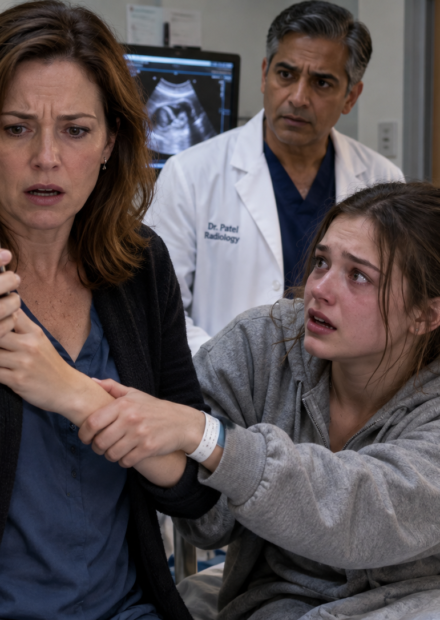
“Where is Rosie?”
“She’s being treated.”
“Is she alive?”
“Yes.”
The word hit me so hard I sobbed.
Not gracefully.
Not quietly.
I bent forward with both hands over my mouth and shook.
Alive.
Rosie was alive.
The woman waited.
When I could breathe again, she asked what had happened.
I told her.
Every ugly piece.
The party.
My mother’s comments.
Leaving for the present.
Natalie’s words.
The guest room.
Rosie’s lips.
The wine bottle.
I didn’t minimize anything.
That was new for me.
My entire childhood had trained me to edit pain before describing it.
Don’t say Natalie shoved you.
Say you were both fighting.
Don’t say Mom humiliated you.
Say she was stressed.
Don’t say they excluded you.
Say schedules didn’t work out.
Don’t say you’re hurt.
Say everyone has problems.
Sitting in that hospital room with blood stiffening my hair, I finally understood that every softened word had protected the wrong person.
So I stopped softening them.
“My sister deliberately gave my daughter medication because she wanted her to stop crying.”
The social worker wrote something down.
“She admitted that?”
“In front of everyone.”
“And then assaulted you?”
“When I tried to call 911.”
She wrote again.
My voice began to shake.
“My mother was there.”
“Did she participate in giving Rosie the medication?”
“I don’t know.”
That was the truth.
And I wouldn’t become Natalie by replacing facts with whatever made me angriest.
“She told me to leave Rosie with Natalie. She knew they both thought Rosie was difficult. But I didn’t see her give Rosie anything.”
“Did your mother call for help when you found Rosie?”
“No.”
“Did she try to prevent you from calling?”
“She kept telling everyone to calm down. Natalie was the one who hit me.”
The woman nodded.
“Thank you.”
“What happens now?”
“First, Rosie’s medical team focuses on getting her stable.”
“And after?”
“There will be an investigation.”
My stomach tightened.
“Am I going to lose her?”
The question came out before I could stop it.
The woman looked startled.
“No one has said that.”
“I left her.”
“You arranged for an adult family member to supervise her while you briefly stepped away. From what you’re describing, the harm happened because another adult made a deliberate choice without your permission.”
I stared at my hands.
There was dried blood beneath one thumbnail.
“I should have known.”
“Did you know your sister intended to medicate Rosie?”
“No.”
“Did you authorize her to?”
“No.”
“Did you delay seeking help?”
“No.”
I looked up.
“I screamed until someone called.”
“I understand.”
A knock came at the door.
A doctor stepped in.
Not the one treating my head.
This one wore pediatric emergency identification on her badge.
I stood too fast.
The room tipped.
“How is she?”
“Sit if you need to.”
“Tell me.”
“Rosie is stable.”
I stopped breathing.
Stable.
Not safe.
Not fine.
But stable.
“She’s breathing adequately with support, and we’re monitoring her heart and neurological status closely. Her lab work and presentation are consistent with significant antihistamine exposure.”
“Is she going to wake up?”
“We expect her level of consciousness to improve as the medication clears, but we need to continue observing her. With a child this young, we take it very seriously.”
“Brain damage?”
“We don’t have evidence of that right now.”
“Right now?”
“I don’t want to promise what we can’t know yet.”
My knees weakened.
The social worker guided me back into the chair.
The doctor continued.
“The important thing is that she got medical attention.”
“How much did Natalie give her?”
“We can’t determine an exact amount from Rosie’s condition alone.”
“Could a normal amount make her like this?”
The doctor hesitated.
“I can’t comment on what another person intended. What I can tell you is that this is not a reaction we dismiss as ordinary sleepiness. Rosie required emergency care.”
Not ordinary sleepiness.
I held onto those words.
Someone had spent the last hour trying to turn what happened into a misunderstanding.
The doctor’s voice cut through that.
This was an emergency.
I asked to see Rosie.
They let me in a few minutes later.
She looked smaller in the hospital bed than she had upstairs.
Wires attached to her chest.
A monitor glowed beside her.
A soft cuff wrapped around one little arm.
Her curls had been pushed away from her forehead.
Her yellow dress was gone.
Someone had put her in a tiny hospital gown.
I sat beside her.
“Mommy’s here.”
Her eyelids didn’t move.
I took her hand.
“Mommy came back.”
That sentence still hurt.
I didn’t let go.
An hour passed.
Maybe two.
At some point Leah appeared in the doorway.
She had changed nothing.
Same floral blouse.
Same ponytail.
A streak of frosting still marked one sleeve.
But her face looked ten years older.
I stood.
“What happened?”
She came inside and hugged me.
Carefully.
“Aunt Denise is with the kids. Uncle Ray stayed to talk to police.”
“And Natalie?”
Leah looked at Rosie.
Then at me.
“The police took her away.”
I stared.
“Arrested?”
“Yes.”
“For hitting me?”
“And what happened to Rosie. They’re still sorting out charges.”
My first emotion was relief.
The second was guilt for feeling relief.
Natalie was my sister.
We had shared a bedroom for nine years.
She once slept beside me on the floor when I had the flu because I was afraid to be alone.
She taught me to drive in an empty high-school parking lot.
She was the first person I called when my college boyfriend left me.
People weren’t one thing.
That was why family cruelty could take so long to name.
You remembered the good version every time the bad version hurt you.
I looked down at Rosie.
Then I remembered Natalie saying:
She’d ruin the party anyway.
Whatever sister I had loved once had been standing ten feet from my unconscious child when she said those words.
“What about Mom?”
Leah looked uncomfortable.
“She went to the station.”
“With Natalie.”
“Yes.”
Of course.
“Did she ask about Rosie?”
Leah’s silence answered me.
I sat down.
Leah moved closer.
“I need to tell you something.”
My chest tightened again.
“What?”
“When the police separated everybody, your mom kept saying nobody should exaggerate.”
I laughed.
A broken, humorless sound.
“Of course she did.”
“She told me Natalie panicked because you were screaming at her.”
I looked up.
“Panicked?”
“She was trying to make the bottle sound like… like a reflex.”
“She crossed the room with it.”
“I know.”
“You saw?”
Leah nodded.
“I saw everything after you screamed.”
For years, Leah had stayed quiet.
This time she reached into her purse and pulled out a folded piece of paper.
“The officer gave me the incident number. I gave a statement.”
My throat tightened.
“You did?”
“Yes.”
“What did you say?”
“The truth.”
Three words.
They shouldn’t have felt revolutionary.
But they did.
“The dispatcher also heard part of it,” Leah continued. “My phone was on speaker. Natalie was yelling.”
“What did she say?”
Leah looked at Rosie.
“That she gave her medicine. That she just wanted her to sleep.”
I closed my eyes.
There it was.
Not hidden evidence.
Not a secret camera.
Not somebody’s interpretation.
Natalie’s own voice.
She had been so certain she was justified that she’d confessed while arguing.
Leah sat beside me.
“Everyone heard her.”
“Everyone also heard Mom spend thirty-three years telling them not to get involved.”
“This was different.”
“Why?”
Leah’s eyes filled.
“Because Rosie couldn’t defend herself.”
That sentence broke through the last of my anger.
I cried quietly.
Leah held my hand.
At 7:14 that evening, Rosie moved.
It was tiny.
One finger.
If I hadn’t been holding her hand, I might have missed it.
I stood so fast the chair struck the wall.
“Rosie?”
Her eyebrows pulled together.
“Baby?”
Her eyelids fluttered.
Then stopped.
A nurse came in.
“She’s moving.”
The nurse checked her.
“That’s encouraging.”
“Rosie, it’s Mommy.”
Another flutter.
A soft sound escaped her.
Barely more than a breath.
But it was her.
I bent over her hand.
“I’m here.”
Her eyes opened halfway.
Unfocused.
Confused.
Then closed again.
I started sobbing.
The nurse rested a hand against my shoulder.
“That’s good.”
I kissed Rosie’s fingers.
“I’m here.”
For the first time since 2:32 that afternoon, I believed she might really come back to me.
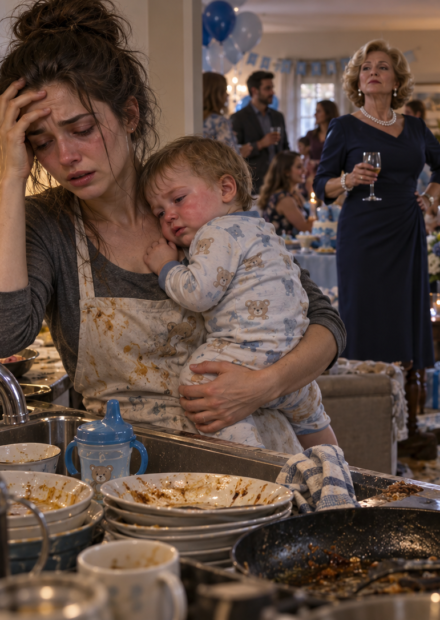
At 8:03 p.m., my mother arrived.
She walked into the room carrying her purse and wearing the same pale-blue blouse she’d worn at the party.
No blood.
No frosting.
No wine.
She looked almost untouched.
Until I saw her face.
“Thank God,” she whispered when she saw Rosie.
I stood between her and the bed.
My mother stopped.
“I want to see my granddaughter.”
“No.”
Her mouth opened.
“Excuse me?”
“You heard me.”
“She is my granddaughter.”
“And Natalie is your daughter.”
“That isn’t fair.”
“Which one did you choose today?”
Her expression hardened.
“I came here to make sure Rosie was okay.”
“After you went to the police station with Natalie.”
“She needed someone.”
I laughed once.
“So did Rosie.”
My mother’s eyes flicked toward Leah.
“This is a private family conversation.”
Leah stood.
“No,” I said.
My mother looked at me.
“She stays.”
“This family has enough problems without outsiders listening.”
“Leah is family.”
“You know what I mean.”
Yes.
I did.
People who agreed with my mother were family.
People who contradicted her were outsiders.
My mother lowered her voice.
“Natalie could go to jail.”
I stared at her.
Rosie had been awake for less than an hour.
And that was what my mother had come to say.
“Then Natalie should have thought about that before drugging a toddler and hitting me with a bottle.”
“She didn’t drug her.”
“What would you call it?”
“She made a terrible mistake.”
“She gave Rosie medicine specifically to make her unconscious.”
“She was overwhelmed.”
“She wasn’t babysitting five children alone. She was sitting in a lawn chair drinking wine.”
My mother’s mouth tightened.
“You aren’t helping anything by talking like this.”
“I am done helping.”
Her face changed.
“What does that mean?”
“It means I’m done translating what this family does into nicer language.”
My heart was pounding.
But my voice stayed quiet.
“Natalie didn’t ‘lose patience.’ She drugged Rosie.”
My mother flinched.
“She didn’t ‘panic.’ She hit me.”
“Stop.”
“You didn’t ‘try to keep everyone calm.’ You tried to keep everyone quiet.”
“I said stop.”
“No.”
It was the first time in my life I had said that word to my mother and meant that nothing she did afterward could make me take it back.
“No.”
The monitor beside Rosie beeped steadily.
My mother looked past me toward the bed.
Then back.
“You could destroy your sister’s life.”
I felt something inside me become very still.
“My daughter almost stopped breathing.”
“She didn’t.”
The room went silent.
Even my mother seemed to hear what she’d said only after it was out.
She tried again.
“I mean, she’s okay now.”
I walked to the door.
Opened it.
“Leave.”
“Honey—”
“Leave before I call security.”
She stared at me.
“You’re choosing anger over family.”
I looked at Rosie.
Then I looked back at the woman who had taught me that family meant swallowing every injury quietly enough to preserve appearances.
“No,” I said.
“For the first time in my life, I’m choosing my child.”
My mother left.
I shut the door behind her.
But an hour later, a detective walked into Rosie’s room carrying a notebook.
She introduced herself, pulled a chair beside mine, and said something that made every hair on my arms rise.
“Your mother gave us a statement.”
I looked at her.
“So?”
The detective’s expression stayed neutral.
“It doesn’t match what the other witnesses told us.”