THE DAY MY FAMILY TRIED TO SILENCE MY DAUGHTER
Chapter 5 – WHAT SILENCE COST THEM
The final hearing happened in winter.
I almost didn’t go.
By then, Rosie had recovered physically.
My scar had faded.
The photographs from Autumn’s birthday no longer appeared every time I closed my eyes.
Almost.
But I wanted to hear Natalie take responsibility in a room where my mother could not rewrite the words afterward.
So I went.
I left Rosie with Leah.
It was the first time since June that I’d voluntarily left her with anyone for more than an hour.
I stood in Leah’s doorway longer than necessary.
Rosie was wearing purple leggings and holding a plastic dinosaur.
“Mommy go?”
“For a little while.”
“Mommy back?”
My chest tightened.
That sentence would probably always hurt.
I crouched.
“Mommy always comes back.”
Rosie smiled.
This time, I believed myself.
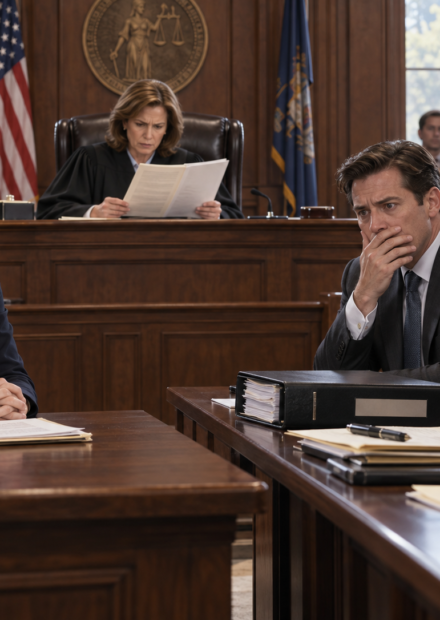
The courthouse was gray and overheated.
No balloons.
No family photographs.
No polished dining table where my mother could change the subject.
Just benches, fluorescent lights, documents, and people required to answer direct questions.
Natalie looked smaller than I remembered.
That surprised me.
For years, she had taken up enormous emotional space.
She could change the mood of a room by entering it.
She could ruin dinner with one look.
She could make me feel twelve years old with half a sentence.
Now she sat beside her attorney wearing a plain dark jacket.
No wine glass.
No sunglasses.
No audience she controlled.
My mother sat behind her.
Of course she did.
She saw me.
I saw the instinct cross her face.
Stand.
Come over.
Manage.
Then she noticed the advocate sitting beside me.
She stayed where she was.
Good.
I won’t pretend the legal language mattered to me as much as it probably should have.
Terms were read.
Conditions explained.
Consequences recorded.
What mattered was hearing my sister say yes when asked whether she understood what she had admitted.
Yes.
Yes.
Yes.
Each one loosened something inside me.
Then came a sentence describing the basic conduct.
Natalie had knowingly administered medication to a child who was not hers without parental authorization, for the purpose of making that child sleep or become easier to manage.
There it was.
No “sensitive.”
No “difficult.”
No “hysterical mother.”
No “family misunderstanding.”
No “she was only trying to help.”
Words could hurt.
But words could also pin reality in place.
Natalie was also held accountable for assaulting me.
The final outcome included incarceration, supervised conditions after release, mandatory treatment requirements, and a strict no-contact order involving Rosie and me.
I didn’t smile.
I didn’t feel triumphant.
I felt tired.
Justice was quieter than revenge stories made it seem.
Nobody cheered.
Nothing inside me magically healed.
Rosie didn’t get those hours back.
I didn’t get to erase the memory of her blue lips.
Autumn didn’t get another sixth birthday.
But a line had been drawn.
And for once, the person who crossed it had been told that family was not an exemption.
Outside the courtroom, my mother followed me into the hall.
“Can we talk?”
I kept walking.
“Please.”
I stopped.
Not because she deserved it.
Because I wanted to know whether hearing Natalie admit what she’d done had changed anything.
My mother stood several feet away.
She looked older.
Maybe she was.
Maybe I had simply stopped seeing her through the eyes of a daughter desperate for approval.
“I never wanted this,” she said.
I nearly walked away.
Then she added, “I know that doesn’t matter.”
That made me stay.
She twisted the strap of her purse.
“I thought if everyone calmed down, we could fix it.”
“You mean hide it.”
Her eyes lowered.
“Yes.”
The admission was so unexpected I said nothing.
She swallowed.
“When you were growing up, my mother always said family problems stayed inside the family.”
“And how did that work out?”
A sad laugh escaped her.
“Apparently not very well.”
I waited.
She looked toward the courtroom doors.
“I kept thinking if Natalie had a record, it would ruin her life.”
I said nothing.
“And I didn’t think about what could have happened to Rosie’s.”
There.
Finally.
Not enough.
But true.
My mother wiped at one eye.
“I failed you.”
I had imagined hearing those words since childhood.
I thought they would feel like water after years of thirst.
They didn’t.
They felt like an invoice delivered after the building burned down.
Accurate.
Late.
“I failed Rosie,” she continued.
“Yes.”
She flinched.
The old version of me would have rescued her from that discomfort.
I didn’t.
“I don’t know how to fix it.”
“You can’t.”
She looked at me.
“Then what am I supposed to do?”
“That isn’t my job anymore.”
Her face crumpled slightly.
I wasn’t cruel.
I wasn’t kind.
I was simply finished carrying emotions that belonged to other adults.
“You can tell the truth,” I said. “Even when Natalie hates you for it.”
My mother nodded.
“You can stop calling cruelty discipline.”
Another nod.
“You can stop telling people they’re dramatic when they’re hurt.”
She looked down.
“And you can understand that saying sorry doesn’t mean you get access to Rosie.”
That one hurt her.
I saw it.
“I love her.”
“Then love her from far away.”
Tears slid down her cheeks.
“For how long?”
“I don’t know.”
That was the truth.
Maybe someday I would allow a supervised conversation.
Maybe I wouldn’t.
Healing wasn’t a contract.
I did not owe anyone a schedule.
My mother nodded.
I turned away.
Then she spoke.
“Tell Rosie I’m sorry.”
I looked over my shoulder.
“No.”
She stared at me.
“When she’s older, if she asks what happened, I’ll tell her the truth. But I’m not giving a two-year-old your guilt to carry.”
My mother closed her eyes.
I left.
Outside, winter air hit my face.
Cold.
Sharp.
Clean.
I stood on the courthouse steps and breathed.
For most of my life, I thought standing up to my family would feel like losing them.
Instead, it felt like finally finding myself.
Six months after Autumn’s birthday, Rosie and I went to a different birthday party.
A little boy from her daycare was turning three.
For two days beforehand, I considered canceling.
The invitation sat on my refrigerator beneath a magnet shaped like a strawberry.
Party.
Backyard.
Children.
Cake.
My stomach turned every time I looked at it.
But trauma has a greedy appetite.
If you let it, it eats places.
Songs.
Smells.
Dates.
Whole parts of your life.
I didn’t want that afternoon in June to own every birthday Rosie would ever attend.
So we went.
I stayed beside her.
Nobody complained.
When she didn’t want to join the children immediately, nobody called her difficult.
The birthday boy’s mother crouched beside her.
“You can watch until you’re ready.”
Rosie looked up at me.
I nodded.
Ten minutes later, she joined them.
There was a bubble machine.
At first she covered her ears when the children screamed.
Then a bubble landed on her nose.
She froze.
Her eyes crossed trying to see it.
It popped.
Rosie laughed.
The sound went through me like sunlight.
She chased the next one.
Then another.
Soon she was running across the grass with five other toddlers, yellow bubbles reflecting in her eyes.
I stood by the patio.
My hands were empty.
That mattered.
I wasn’t gripping her.
Wasn’t hovering over her shoulder.
Wasn’t proving anything to anybody.
I was simply watching.
At one point the birthday boy began crying because his balloon escaped.
His mother picked him up.
No one sighed.
No one called him dramatic.
No one told him he was ruining his birthday.
They let him cry.
Then he stopped.
That simple moment almost brought me to tears.
Children cried.
Adults were supposed to make the world safer, not punish them for reacting to it.
That shouldn’t have been a revelation.
For me, it was.
A few months later, I found Autumn’s birthday gift in my garage.
The same bag I’d dropped on Natalie’s patio had eventually been returned through my uncle.
I had shoved it onto a shelf without opening it.
The tissue paper was still crushed.
The corner of the package still torn.
I stood there looking at it for a long time.
I thought about Autumn.
She was innocent too.
I wondered what story she’d been told.
I wondered whether she remembered the sirens more clearly than the cake.
I wondered whether one day she’d understand why her aunt disappeared from family gatherings.
I didn’t send the gift.
Not then.
Contact with Natalie’s household was complicated, and I wasn’t going to create a new doorway without professional advice and boundaries.
But I didn’t throw it away either.
I placed it in a storage bin.
Some things didn’t need immediate endings.
The important ending was already happening.
Rosie was growing.
She became louder.
Thank God.
At three, she developed opinions about everything.
She hated peas.
Loved blueberries.
Insisted that every dog she saw was named Charlie.
Sang made-up songs in grocery-store aisles.
Asked “why?” until I ran out of answers.
Sometimes strangers smiled at her.
Sometimes they looked annoyed.
I stopped caring.
At four, she started preschool.
The first morning, she clung to my leg.
My old fear rose instantly.
Maybe she wasn’t ready.
Maybe I shouldn’t leave.
Maybe—
Then her teacher crouched beside her.
“You can be nervous,” she said. “Mom will come back.”
Rosie looked up at me.
“Mommy always comes back?”
I smiled.
“Always.”
She released my leg.
Not because someone shamed her.
Because someone gave her time.
I walked back to my car and cried for twenty minutes.
Not from sadness.
Not entirely.
Sometimes healing looks ridiculous from the outside.
A grown woman sobbing in a parking lot because her daughter walked into preschool.
But I knew what that moment meant.
Rosie trusted the world enough to release my hand.
And I trusted myself enough to let her.
My mother kept her distance.
Every few months, a card arrived addressed to me.
Never Rosie.
That boundary mattered.
The messages became shorter over time.
No excuses.
No requests.
Once, more than a year after the party, she wrote only:
I understand now that silence protected the person causing harm, not the family.
I kept that card.
Not because everything was forgiven.
Because it was the first true thing she’d ever written about us.
Natalie and I did not speak.
For a long time, people asked whether that was painful.
Of course it was.
Loving someone does not make separation painless.
Sometimes it makes separation necessary.
There were nights I remembered the sister who taught me to drive.
The teenager who once climbed into bed beside me during a thunderstorm.
The woman who brought soup when I had pneumonia.
Then another memory always followed.
A green bottle.
A white comforter.
Rosie’s blue lips.
I learned to hold both truths.
Natalie had loved me in some moments.
Natalie had nearly killed something inside me in another.
One truth did not erase the other.
Neither did childhood.
Neither did blood.
Years passed.
The scar above my ear became hard to find unless I knew exactly where to touch.
I always knew.
Sometimes after washing my hair, my finger would brush the small raised line.
For a second I would be back in the guest room.
Wine.
Glass.
Rosie on the bed.
Then I’d hear her somewhere else in the house.
Laughing.
Singing.
Complaining.
Living.
And the memory would loosen.
People sometimes ask what shocked everyone most that day.
They assume it was Natalie hitting me with the bottle.
Or the ambulance.
Or the police taking her away while pink balloons floated over the backyard.
Those things shocked people.
But they were not what changed my family.
What changed us was what happened afterward.
People told the truth.
Leah told it.
My uncle told it.
My aunt told it.
Eventually, even my mother stopped changing it.
Natalie had spent her whole life depending on silence.
So had my mother.
So had I.
That afternoon was the first time silence stopped protecting them.
Because once people saw a two-year-old child lying unconscious in a dark bedroom while her mother bled beside her, “keeping the peace” finally looked like what it had always been.
Helping the wrong person.
I used to think peace meant everyone staying calm.
Now I know better.
Sometimes peace sounds like a siren.
Sometimes it sounds like a witness saying, “Yes, I saw it.”
Sometimes it sounds like a mother saying no.
Sometimes it sounds like a little girl crying as loudly as she needs to because nobody is going to punish her for having feelings.
And sometimes it sounds like laughter in a backyard where no one is trying to make her smaller.
Last June, Rosie turned six.
The same age Autumn had been on the day everything changed.
Rosie asked for a yellow cake covered in strawberries.
No complicated theme.
No perfect decorations.
No coordinated gift table.
We held it in our backyard.
The streamers didn’t match.
One balloon popped before the guests arrived.
I forgot to put out the napkins until someone asked.
It was imperfect.
It was wonderful.
At one point Rosie became overwhelmed by everyone singing.
She covered her ears.
The entire room saw.
My heart stopped for half a second.
Old memories.
Old fear.
Then Rosie looked at me.
I walked over.
“You want everyone to stop?”
She nodded.
So I raised my hand.
“Hey, guys. Pause the song.”
Everyone stopped.
Just like that.
No sighing.
No eye rolling.
No embarrassment.
Rosie leaned against me.
I waited.
Thirty seconds.
Maybe forty.
Then she whispered, “I’m ready.”
“You sure?”
She nodded.
I looked at the guests.
“From the top?”
Everyone laughed.
Rosie laughed too.
The song started again.
This time she sang with them.
Afterward, she blew out six candles in one breath.
Everyone cheered.
I didn’t.
I just looked at her.
My daughter.
Loud when she wanted to be.
Quiet when she needed to be.
Never required to earn tenderness by making herself convenient.
She caught me staring.
“What?”
“Nothing.”
“You’re crying.”
“I know.”
“Why?”
I wiped my cheek.
“Because I’m happy.”
She considered that.
Then handed me a frosting-covered strawberry.
“You’re weird, Mom.”
I laughed.
“Probably.”
She ran back toward her friends.
I watched her go.
Six years old.
Safe.
Alive.
Free to take up space.
Years earlier, my sister had looked at that same child and decided she needed to learn how to stay quiet.
Natalie had been wrong about one thing more than all the others.
Rosie never needed to learn silence.
I did.
I needed to learn what silence cost.
And then I needed to learn when to break it.
So I did.
For my daughter.
For myself.
For every frightened version of me that had once believed keeping a family together mattered more than telling the truth.
And if Rosie remembers nothing else about the way I raised her, I hope she remembers this:
She was never too loud.
Never too sensitive.
Never too difficult.
Never something to be managed until adults felt comfortable.
She was a child who deserved to be heard.
And when the people I once trusted tried to silence her, I finally found my own voice.
This time, I never gave it back.