





















Chapter 3 – THE STORY I HAD BEEN FED
I did not sleep that night.
Sophia stayed downstairs.
I stayed in the guest room.
Dad’s bedroom remained empty because he had gone home with Laura.
Calling it an empty bedroom sounds simple.
It was not.
Every time I passed the doorway, I remembered being ten years old and climbing into Dad’s bed during thunderstorms.
I remembered being nineteen and waking him at two in the morning because my car had broken down forty miles away.
I remembered being thirty-one, sitting beside him in a hospital waiting room while Laura underwent an emergency appendectomy, both of us pretending not to be frightened.
Memory became cruel when mixed with shame.
At three in the morning, I stood in the bathroom and studied my right hand.
Nothing about it looked different.
The same small scar across my knuckle.
The same wedding band.
The same fingers.
Yet all I could see was Dad’s head turning from the force of my palm.
I ran cold water over my hand until my fingers went numb.
It did not help.
Around four, I opened the recording again.
I watched Sophia enter the sunroom.
I watched her tear the buttons.
I watched her call Dad.
I watched her scream.
Then I stopped before the slap.
I could not watch that part again.
What I noticed the second time was how deliberate everything looked.
Not rehearsed.
But chosen.
One decision followed another.
Tear the blouse.
Disorder the hair.
Call Richard.
Listen for Ethan.
Scream.
Sophia had said she planned it for only a few minutes.
Maybe that was true.
But cruelty did not become harmless because it was improvised.
I closed the tablet and stared at the ceiling.
Then memories began returning.
Small ones.
Harmless ones, I had believed.
Sophia saying, “Your father never really looks at me when I speak.”
Sophia telling me Dad had made her uncomfortable by asking why she had skipped Laura’s birthday dinner.
Sophia saying, “Sometimes he looks at me like he’s waiting for me to do something wrong.”
Each statement had seemed minor by itself.
Whenever I defended Dad, Sophia would tell me I was proving her point.
Whenever I defended Sophia to Dad, he would go quiet.
I had been standing between them for years, translating one person to the other, believing I was keeping peace.
Maybe all I had really done was allow resentment to grow without demanding honesty from either side.
At seven, I heard footsteps downstairs.
Sophia was in the kitchen when I entered.
She had changed clothes.
The torn blouse sat folded on the counter.
Folded.
Seeing it that way made something twist inside me.
The night before, those missing buttons had made the blouse look like evidence of violence.
Now it was only fabric.
Sophia saw me looking.
“I didn’t know what to do with it.”
“Throw it away.”
She looked hurt.
I hated that I still reacted to that expression.
Even after everything, some part of me wanted to comfort her.
Five years of loving someone does not disappear because the truth changes.
That would have been easier.
The cruel reality was that I still loved Sophia.
I simply no longer trusted her.
She poured coffee into a mug.
“Did you sleep?”
“No.”
“Neither did I.”
I said nothing.
She gripped the counter.
“I know you think I’m a monster.”
“I don’t know what I think.”
“I’m not.”
“I didn’t say you were.”
“But you’re looking at me like you don’t know me.”
“I don’t.”
Her face crumpled.
“Ethan.”
“What do you want me to say?”
“That you remember who I am.”
“I remember who I thought you were.”
She turned away.
I immediately regretted the cruelty of the sentence.
But I did not take it back.
Sophia whispered, “I was desperate.”
“For what?”
“For you to hear me.”
“You could have talked to me.”
“I did.”
Her answer came quickly.
“You always told me Dad was old-fashioned. Or blunt. Or that he didn’t mean things the way they sounded.”
“That doesn’t justify this.”
“I know.”
“Then stop using it to explain what you did as if one leads naturally to the other.”
“I’m trying to make you understand.”
“No. You’re trying to make it understandable.”
She looked at me.
There was a difference.
We both knew it.
I continued.
“If Dad made you feel unwelcome, we could have dealt with that. If I dismissed you, then I was wrong. If Laura was cold to you, we could have talked about it. But you created an accusation that could have destroyed a seventy-five-year-old man’s life.”
“I wasn’t going to the police.”
“You think that makes it better?”
“No.”
“You think Dad would have needed police involved for his life to be destroyed?”
Sophia fell silent.
“If there had been no camera, I would have thrown him out of his own house.”
She looked down.
“I probably would have stopped speaking to him.”
My voice shook.
“Laura might have believed me because she saw the same scene I did. Dad would have spent the rest of his life knowing his son thought he attacked his wife.”
“I know.”
“No, I don’t think you do.”
I grabbed my keys.
Sophia looked at me sharply.
“Where are you going?”
“To Laura’s.”
“Ethan, please don’t tell everyone.”
I stopped.
That sentence almost made me laugh.
“Everyone?”
“My family. Our friends.”
“I’m going to see my father.”
“I know, I just—”
“You are worried about what people will think of you?”
“I’m ashamed.”
“Good.”
The word came out harder than I intended.
Sophia’s face went still.
I closed my eyes.
“I’m sorry. That was cruel.”
“No. It was honest.”
She hugged herself.
“Are you coming back?”
I did not answer immediately.
“I don’t know.”
That frightened both of us.
Laura lived twenty minutes away.
I spent the entire drive trying to decide what I would say.
No apology sounded sufficient.
Sorry I hit you.
Sorry I believed her.
Sorry I did not ask.
Sorry I knew you for forty-four years and distrusted your character in four seconds.
When Laura opened her front door, she did not greet me.
She simply stepped aside.
Dad was sitting at her kitchen table.
A cup of coffee rested untouched in front of him.
The mark on his cheek had faded to a dull reddish shadow.
It looked worse in daylight.
I stopped several feet away.
“Dad.”
He nodded.
Laura remained near the doorway.
I understood why.
She did not trust the conversation.
Maybe she did not trust me.
I deserved that.
“I’m sorry,” I said.
Dad stared at his coffee.
“I know.”
“No. I need to say it properly.”
He looked up.
I forced myself not to look away.
“I hit you before you could speak. I believed something terrible about you without asking what happened. I embarrassed you, hurt you, and treated you like a stranger.”
My throat tightened.
“You didn’t deserve any of it.”
Dad remained quiet.
“I don’t expect you to forgive me because I apologized.”
His expression changed slightly.
“Good.”
I nodded.
“I just needed you to hear me say I was wrong.”
Laura crossed her arms.
Dad gestured toward the chair opposite him.
I sat.
For several seconds we listened to the refrigerator humming.
Finally Dad said, “Do you know why I didn’t defend myself?”
“No.”
“Because I looked at your face and realized you had already convicted me.”
I swallowed.
“There was nothing I could say in that moment that you would have heard.”
“I would have—”
“No.”
He did not raise his voice.
“You wouldn’t.”
I looked down.
He was right.
If Dad had protested innocence, I would have called it denial.
If he had become angry, I would have called it aggression.
If he had blamed Sophia, I would have said he was attacking a victim.
I had already built a cage around him in my mind.
Every possible reaction would have become proof.
“The camera saved me,” Dad said.
I looked at him.
“But your first reaction told me something too.”
“What?”
He hesitated.
“That Sophia had been preparing you to believe something was wrong with me.”
I stared at him.
Laura pulled out the chair beside us.
Dad continued.
“Maybe not that specific thing. I don’t think she had been planning that accusation for months.”
“Then what do you mean?”
“She has been making every disagreement into a loyalty test.”
I thought of Sophia saying the same thing about my family.
Dad rubbed his hands together.
“If I asked why you missed dinner, she heard criticism. If Laura invited you somewhere without checking with Sophia first, it became disrespect. If you and I spoke privately, she wanted to know why.”
Laura nodded.
“This has been happening for a while.”
I looked at her.
“Why didn’t either of you tell me?”
Laura gave me a tired look.
“We did.”
“No, you didn’t.”
“Not directly enough, maybe.”
“That matters.”
Dad nodded.
“Yes. It does.”
His willingness to admit that stopped me.
He continued.
“I should have spoken plainly sooner. Instead, I kept telling myself it was your marriage and none of my business.”
“What happened yesterday afternoon?”
Dad looked toward the window.
“Sophia and I argued.”
“About me?”
“Yes.”
“What did you say?”
He took a breath.
“I asked whether you were happy.”
“That’s it?”
“At first.”
I waited.
Dad did not try to make himself look innocent.
That was one thing about my father. Even at his most stubborn, he rarely edited himself to appear kinder than he had been.
“I told her you seemed anxious whenever the family asked you for anything,” he said. “I said you had started looking at your phone before answering simple invitations, like you needed permission to say yes.”
My face warmed.
Because it was true.
Not permission exactly.
But calculation.
Was Sophia tired?
Did we already have plans?
Would saying yes create an argument later?
I had begun avoiding spontaneous family commitments because it was easier.
Dad continued.
“I told her I missed you.”
I stared at him.
He looked embarrassed by the admission.
“I told her I wasn’t trying to interfere with your marriage. But if something was wrong, I wanted you to know you could talk to me.”
“What did she say?”
“That I wanted to control you.”
Dad gave a small, sad smile.
“Maybe sometimes I have.”
Laura glanced at him.
He shrugged.
“I’m seventy-five, not perfect.”
Despite everything, a breath of laughter escaped me.
Dad almost smiled.
Then the moment disappeared.
“She told me you and I were too close,” he continued. “That you cared more about my approval than her feelings.”
“And what did you say?”
“I said that was something she needed to discuss with you.”
“That’s when she said you were trying to turn me against her?”
“Yes.”
“What did you say?”
Dad looked at me.
“I told her I didn’t need to.”
The room went still.
I frowned.
“What does that mean?”
“I said if she believed your marriage could be destroyed simply because your father asked whether you were happy, then the problem was not me.”
I leaned back.
It was exactly the kind of sentence Dad would say.
Blunt.
Accurate enough to hurt.
And entirely incapable of making an already angry person calmer.
“You really said that?”
“Yes.”
“Dad.”
“I told you I wasn’t perfect.”
Laura sighed.
“So basically the two of you threw gasoline at each other.”
Dad nodded.
“More or less.”
For the first time, I could see the shape of what had happened without reducing it to saints and villains.
Dad had been intrusive.
Sophia had felt judged.
I had avoided confronting the tension.
Laura had never hidden her distrust of Sophia.
We had all contributed to an unhealthy family dynamic.
But only one person had torn her clothing and fabricated an assault scene.
Understanding the road to an act did not erase responsibility for reaching the destination.
Dad looked at me carefully.
“There’s something else you need to understand.”
“What?”
“I never wanted you to choose me over your wife.”
I lowered my eyes.
“I wanted your marriage to work.”
“I know.”
“No, Ethan. I’m not sure you did.”
I looked up.
“If Sophia believed I was competing with her, maybe I gave her reasons to feel that way. Maybe you did too.”
He leaned forward.
“But a healthy marriage doesn’t require you to destroy every other relationship so your spouse can feel secure.”
The sentence stayed with me.
Laura reached across the table and placed her hand over Dad’s.
I suddenly saw my family differently.
Not as people competing for pieces of me.
As people who had been afraid to say what they saw because they thought saying it would force me to choose.
And by avoiding the choice, I had allowed the pressure to build until Sophia created one.
I stayed with Dad for almost four hours.
We talked about things we should have discussed years earlier.
His tendency to criticize.
My tendency to avoid conflict.
Laura’s coldness toward Sophia.
Sophia’s resentment.
My habit of acting as translator instead of demanding direct communication.
None of it excused what happened.
But if I was going to understand how my marriage reached the sunroom, I needed more than a villain and a victim.
When I finally stood to leave, Dad walked me to the door.
“Are you going back to the house?” he asked.
“Yes.”
He nodded.
“To end it?”
I hesitated.
“I don’t know yet.”
Dad surprised me.
“Then don’t decide because of me.”
I stared at him.
“How can you say that?”
“Because I won’t let her turn this into the choice she wanted.”
“What do you mean?”
“If you leave her, leave because you decide you cannot remain married to her after what she did.”
He placed one hand on my shoulder.
“Don’t leave because you think choosing me repairs the fact that you hit me.”
My eyes burned.
“Dad.”
“I mean it.”
He squeezed my shoulder once.
“I don’t need you to prove you love me by destroying your marriage.”
I drove home carrying those words.
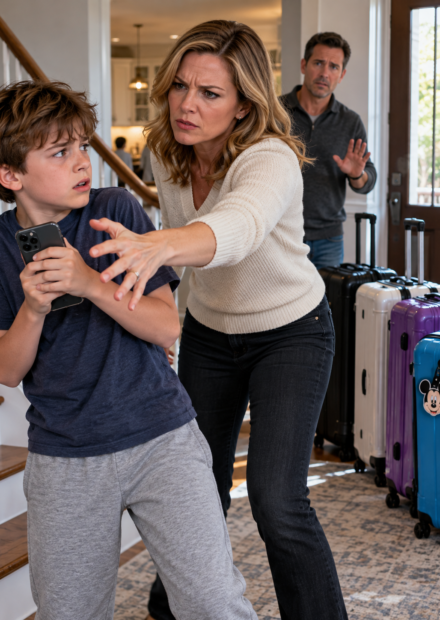
When I opened the front door, the house was quiet.
Sophia was sitting on the bottom stair.
A suitcase stood beside her.
For a moment neither of us spoke.
Then she said the sentence I would remember almost as clearly as the scream.
“I only wanted you to choose me without hesitation.”
My chest tightened.
Sophia looked up at me through swollen eyes.
“And you did.”