




















Chapter 4 – THE CHOICE SHE FORCED
I stood inside the doorway with my keys still in my hand.
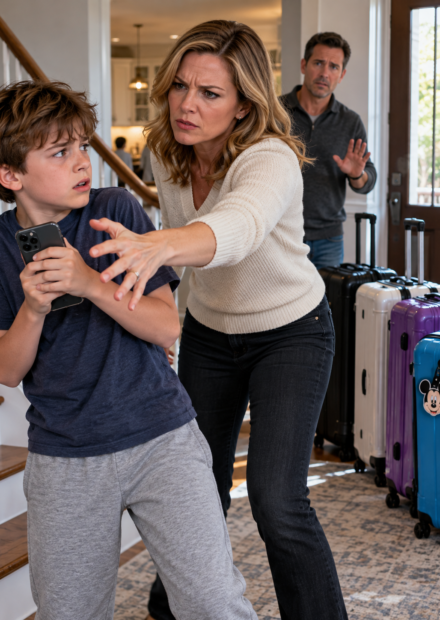
Sophia’s suitcase waited beside her.
The house was silent.
She looked exhausted.
So was I.
“What do you mean?” I asked.
She gave a hollow laugh.
“You know what I mean.”
“No. I want you to say it.”
Sophia looked down.
“I wanted to know that if it came down to me or him, you would choose me.”
I stared at her.
“You created a fake assault to test my loyalty?”
“When you say it like that—”
“How else should I say it?”
She closed her eyes.
“I didn’t start the night planning to do that.”
“I believe you.”
Sophia seemed surprised.
“I think you were angry. I think you believed Dad was going to tell me things you didn’t want me to hear. And I think you found the ugliest possible way to make sure anything he said afterward would sound like retaliation.”
Tears filled her eyes.
“I wasn’t thinking that clearly.”
“You were thinking clearly enough to throw a button toward him.”
She flinched.
I hated remembering that detail.
Of everything in the footage, the button disturbed me almost most.
It was so small.
So calculated.
A piece of white plastic rolled across the floor so that when I entered, my mind would connect it to the nearest man.
Sophia rubbed her hands together.
“I kept feeling like no one believed me.”
“About what?”
“That your family doesn’t want me.”
“That isn’t true.”
“It felt true.”
I almost argued.
Then I stopped.
Dad’s words returned.
Understanding was not absolution.
I could acknowledge Sophia’s pain without allowing her pain to rewrite reality.
“Tell me,” I said.
She looked at me.
“Everything. Not the version that makes what you did sound reasonable. Tell me what you were feeling.”
She was quiet for a long time.
Then she began.
“When we first got married, I thought your relationship with your family was one of the things I loved about you.”
Her voice was softer now.
“You called your dad. You checked on Laura. You remembered birthdays. You showed up.”
I sat in the chair across from the staircase.
Sophia continued.
“Then I realized showing up wasn’t optional.”
“What does that mean?”
“It means if Richard invited us to dinner, saying no required a reason. If Laura called because she needed help, you went. If your dad made some rude comment and I got upset, you told me that was just how he talked.”
I looked away.
She was not wrong about that.
“I felt like I had married three people,” she said.
“You never told me that.”
“I did.”
“Not like this.”
“Because every time I tried, you defended them.”
Her voice tightened.
“So eventually I stopped trying to explain how it felt. I just started getting angry.”
“And then you started wanting me away from them.”
“Yes.”
The honesty surprised me.
“At first I just wanted distance. One weekend where we didn’t have to answer anyone. One holiday where nobody commented if we left early.”
She wiped her cheeks.
“But then every time your father looked at me, I felt like he was judging me.”
“Was he?”
“Sometimes.”
I nodded.
“He admitted he can be critical.”
Sophia laughed bitterly.
“Of course he did. Now that he’s the victim, he gets to be generous.”
“That isn’t fair.”
“No. Probably not.”
She stared at the floor.
“Do you know what the worst part is?”
“What?”
“I know he didn’t deserve what I did.”
Her voice broke.
“I knew it while I was doing it.”
That confession hurt more than another excuse would have.
“Then why didn’t you stop?”
“Because I heard you and Laura coming down the hall.”
Sophia looked at me.
“And suddenly I knew if I screamed, you would come running.”
I said nothing.
“I knew you would believe me.”
She began crying harder.
“I knew you loved me that much.”
The sentence filled me with grief.
“That wasn’t love you were testing.”
“I know.”
“No. You weaponized it.”
She covered her mouth.
“You knew exactly what part of me to use. You knew I would see you hurt and stop thinking.”
“I know.”
“You made my love for you dangerous to my father.”
“I know.”
I stood.
She flinched.
I paced toward the window.
Outside, the street looked painfully normal.
A woman walked a dog.
A delivery truck stopped two houses down.
Somewhere, someone started a lawn mower.
My entire life had changed, and the world had not noticed.
Sophia spoke behind me.
“Are you going to leave me?”
I closed my eyes.
“I don’t know how to be married to someone whose reality I have to verify with a camera.”
Silence.
Then a quiet sob.
I turned.
Sophia sat with her face in her hands.
I loved her.
That fact remained.
It was almost unbearable.
If I had hated her, the decision would have been easy.
But love is not the same as trust, and marriage cannot survive on love after reality itself becomes uncertain.
I sat beside her.
Not touching.
Just close enough that I could smell the shampoo in her hair.
The familiar scent nearly undid me.
“Was any part of what you implied about Dad true?” I asked.
She shook her head immediately.
“No.”
“Did he ever touch you inappropriately?”
“No.”
“Did he ever proposition you?”
“No.”
“Threaten you?”
“No.”
“Corner you?”
“No.”
“Did he ever do anything that would justify me believing he was dangerous to you?”
Sophia looked at me.
“No.”
I needed to hear every answer.
Not because the camera had left doubt.
Because Dad deserved to have the lie fully removed.
Sophia whispered, “He was rude sometimes. He made me feel small sometimes. He treated me like I had to prove I belonged.”
“That matters.”
She looked surprised.
“It matters,” I repeated. “But it belongs in a completely different conversation.”
She began crying again.
“I know.”
I looked at her suitcase.
“Where were you planning to go?”
“My sister’s.”
I nodded.
Sophia searched my face.
“Do you want me to?”
I thought of Dad leaving his own house.
“Yes.”
Her eyes closed.
“For how long?”
“I don’t know.”
“Are we separating?”
“Yes.”
The word came before I could soften it.
Sophia inhaled sharply.
I continued before fear could make me retreat.
“I cannot make a permanent decision tonight. Dad told me not to decide because I think leaving you proves something to him.”
Sophia looked stunned.
“He said that?”
“Yes.”
She cried harder.
That seemed to hurt her more than if Dad had demanded I end the marriage.
“He should hate me.”
“Maybe part of him does.”
“I would.”
I looked toward the sunroom.
“I don’t know what he feels.”
Sophia wiped her face.
“Do you hate me?”
“No.”
Her expression crumpled with relief.
“Don’t.”
She stared at me.
“Don’t hear that as hope.”
The relief vanished.
“I don’t hate you. But I don’t trust you.”
I took off my wedding ring.
I did not do it dramatically.
I simply pulled it from my finger and placed it on the table.
Sophia stared at it.
My finger looked strangely pale where the ring had been.
“I need distance.”
She nodded.
For the next twenty minutes, we barely spoke.
Sophia carried her suitcase to the car.
I stood on the porch.
Before opening the driver’s door, she turned toward me.
“I’m sorry.”
“I know.”
“I’m sorry about your dad.”
I nodded.
“I’m sorry I made you hit him.”
That sentence stopped me.
“You didn’t make me hit him.”
Sophia stared at me.
“You created the lie.”
I swallowed.
“But my hand was mine.”
She began to speak.
I stopped her.
“That part belongs to me.”
It was important.
Maybe the most important thing I understood that night.
Sophia had manipulated me.
But if I blamed her for every action I took afterward, I would be doing exactly what she had been doing—using someone else’s behavior to escape responsibility for my own.
“I should have asked,” I said. “I should have stopped. I should have listened.”
Sophia cried silently.
“I’m sorry,” she whispered again.
Then she got into the car.
I watched her drive away.
The house became impossibly quiet.
I walked back to the sunroom.
One button still lay beneath the coffee table.
No one had picked it up.
I crouched and retrieved it.
A tiny white circle.
Four holes.
A thread still hung from the center.
I held it in my palm.
How much damage could something that small do?
None by itself.
Everything we believed about it had given it power.
I put the button on the table beside my wedding ring.
Two small objects.
One had been planted to support a lie.
The other had represented a promise I no longer understood.
Then I called my father.
He answered after three rings.
“Ethan?”
“She left.”
Dad was silent.
“Temporarily,” I added. “I told her we’re separating.”
“You don’t have to explain your decision to me.”
“I know.”
“Are you all right?”
The question almost broke me.
After everything, he was asking whether I was all right.
“No.”
“Good.”
I laughed through tears.
“Good?”
“You shouldn’t be.”
I wiped my face.
“That came out wrong.”
“No, it didn’t.”
Dad sighed.
“You’re supposed to hurt when something important breaks.”
I sat on the floor.
“I’m sorry.”
“I know.”
“I keep saying it.”
“You probably will for a while.”
“Do you think you’ll forgive me?”
The silence that followed felt endless.
Finally Dad said, “I think I will.”
I closed my eyes.
“But not tonight,” he added.
“I understand.”
“And Ethan?”
“Yes?”
“Forgiveness doesn’t mean pretending it didn’t happen.”
“I know.”
“It means deciding what to do with what happened.”
I nodded although he could not see me.
“I want to fix this.”
“You can’t fix yesterday.”
“Then I want to fix us.”
His voice softened.
“That’s different.”
We stayed on the phone for almost an hour.
Not discussing Sophia.
Not discussing the footage.
Dad told me Laura had made him eggs and burned them.
In the background, I heard my sister shout that he was a liar.
Dad laughed.
For one moment, I felt like myself again.
Then I saw the button on the table.
The past returned.
Healing, I learned, did not arrive as one clean transformation.
It came in seconds.
Then disappeared.
Then came back.
The next morning, I drove to Laura’s with breakfast.
Dad opened the door.
For the first time since I hit him, he hugged me.
I did not deserve how much that hug hurt.
I held him carefully.
“Don’t squeeze too hard,” he muttered. “I’m seventy-five.”
I laughed into his shoulder.
“So you keep reminding everyone.”
“It gets me better parking.”
We separated.
The bruise on his cheek was fading.
I stared at it.
Dad noticed.
“Stop.”
“I can still see it.”
“So can I.”
“I hate that.”
“Then remember it.”
I looked at him.
He touched his cheek lightly.
“Not so you can punish yourself forever.”
His eyes held mine.
“So the next time anger tells you it already knows the truth, you remember what certainty cost you.”
That lesson would follow me for the rest of my life.
But there was still one thing Dad deserved.
Not from me.
From Sophia.
And three days later, she called and asked if he would let her say it.
In person.