




















THE THANKSGIVING PIE THAT TORE OUR FAMILY APART
Chapter 5 – WHAT WE BROKE, AND WHAT WE COULD STILL SAVE
Christmas was different that year.
Not ruined.
Different.
There were no peanuts in Diane’s house.
I noticed the second we walked in.
Of course I did.
For years afterward, people would tell the Thanksgiving story as if the important part were the fight.
Remember the Thanksgiving Claire threw the food?
Remember when Lauren and Claire went after each other?
Remember when Mark cracked his head on the cabinet?
That became the dramatic version.
The version people wanted at parties.
The family legend.
I hated it.
Because the fight was loud.
The real problem had been quiet.
It had been a text message answered with a thumbs-up.
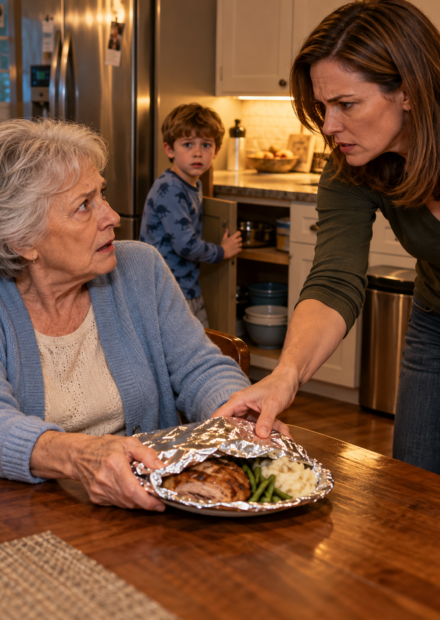
A pie placed at the end of a table.
A mother deciding another mother worried too much.
A husband asking his wife to keep the peace because challenging his mother felt harder.
A seven-year-old seeing something that looked like chocolate.
Disasters rarely announce themselves as disasters.
Sometimes they look like dessert.
Christmas dinner was awkward for the first hour.
Everyone was trying too hard.
Diane asked me whether the salad dressing was okay for Ethan.
Then whether the bread was okay.
Then whether the mashed potatoes were okay.
Finally I touched her arm.
“You don’t have to ask me about everything.”
She gave me a look.
“I’m learning.”
I smiled.
“So am I.”
That became our new relationship.
Not perfect.
Not easy.
Honest in ways it had not been before.
There were still moments when Diane thought I was too protective.
There were still moments when I thought she was too casual.
The difference was that neither of us treated those feelings as facts anymore.
She asked.
I explained.
Sometimes I gave a little.
Sometimes she did.
Sometimes we were irritated with each other and simply survived it.
That might not sound like healing.
In a family like ours, it was.
Lauren took longer.
For months, there was distance between us.
We were polite.
Nothing more.
Then one afternoon the following spring, she showed up at Ethan’s soccer game holding two coffees.
She handed one to me.
“Peace offering.”
I looked at the cup.
“No peanuts?”
She stared at me.
Then I laughed.
After one second, she did too.
“Too soon?”
“Probably forever too soon.”
We sat together on the bleachers.
Halfway through the game she said, “I really thought you were going to hit Mom.”
I looked at the field.
“I really wasn’t.”
“I know that now.”
“I was furious.”
“I know.”
“I shouldn’t have thrown anything.”
“I know.”
I glanced at her.
“You don’t have to enjoy hearing me admit it that much.”
She smiled.
“Sorry.”
“No, you’re not.”
“No.”
A few minutes passed.
Then she said, “Mom cried for two days after that Sunday meeting.”
I frowned.
“Why?”
“Because of what Mark said.”
“What did Mark say?”
“That you were treating Ethan like a child because he is one.”
I looked toward my son.
He was chasing the ball with three other boys, completely unconcerned with strategy.
“Yeah.”
Lauren sipped her coffee.
“She said she kept thinking about all the times she told you he needed to learn responsibility.”
“He does need to learn responsibility.”
“Sure.”
“But gradually.”
“I get that now.”
I looked at her.
Something in her voice made me believe her.
She shrugged.
“I kept thinking about my girls.”
Her daughters were nine and eleven.
“If one of them had a medical thing and I told you not to put something out…”
“I’d listen.”
“I know.”
There was no triumph in it.
I did not need there to be.
Time did what the Sunday conversation couldn’t.
It turned our positions into perspective.
Eventually the bruises disappeared.
Mark’s cut healed.
Diane replaced the broken serving bowl.
The scratch from the fallen tray stayed on the dining room floor.
She never repaired it.
One Thanksgiving, two years later, I noticed it.
A curved mark in the hardwood near the table.
I stared a little too long.
Diane noticed.
“Don’t.”
I looked at her.
“What?”
“I know what you’re looking at.”
“I wasn’t going to say anything.”
She gave me a skeptical look.
“I was considering putting a rug over it.”
“You should.”
“But then I thought maybe it’s useful.”
I laughed.
“As what? A warning?”
“Exactly.”
She handed me a stack of plates.
“Behave or Grandma points at the scratch.”
I smiled.
That second Thanksgiving was quiet.
Normal.
The kind of holiday I used to take for granted.
Ethan was nine.
He checked labels himself now.
He asked questions before taking food.
He carried his medication without needing me to remind him most days.
The independence I had wanted for him was coming.
Slowly.
At the right speed.
Before dessert, Diane stood in the kitchen arranging slices of pumpkin pie.
She had made chocolate cake too.
No peanut butter.
No peanuts anywhere.
I didn’t mention it.
Neither did she.
We didn’t need to.
Mark came up behind me and wrapped an arm around my waist.
“You okay?”
“Yeah.”
He nodded toward the dining room.
“Thinking about it?”
“A little.”
“Me too.”
I looked at the cabinet.
The one he had hit.
“You know, your mother should have childproofed that cabinet.”
He stared at me.
Then he laughed.
“That is not funny.”
“It’s a little funny.”
“I had stitches.”
“You survived.”
“So did Thanksgiving, apparently.”
I looked through the doorway.
Diane was arguing with Bob about whether the coffee was too strong.
Lauren’s daughters were showing Ethan something on a phone.
Lauren was stealing whipped cream directly from the bowl.
Ordinary.
That was all I had wanted.
An ordinary family.
I used to think ordinary meant nobody fought.
I know better now.
Every family has fractures.
Resentments.
Bad habits.
Old roles people refuse to release.
The mother who still thinks of her adult son as hers first.
The wife who expects her husband to take her side before she even explains what happened.
The sister who protects her mother.
The father who believes keeping the peace is the same thing as solving the problem.
The daughter-in-law who arrives already braced for disrespect and sometimes sees it before it happens.
We all had our parts.
That did not mean everyone was equally responsible for every event.
I still believe Diane was wrong that Thanksgiving.
She knew about Ethan’s allergy.
She understood my request.
She dismissed it because she thought I was overreacting.
Her choice created a danger that did not need to exist.
I will never pretend otherwise.
But I was wrong too.
Fear explains why I screamed.
It explains why I was furious.
It even explains the violent impulse that made me sweep that tray from the table.
It does not make throwing things right.
It does not make putting my hands on Lauren right.
Those were my choices.
I own them.
That was the part people in our family had trouble understanding afterward.
They thought admitting one person was wrong somehow made the other person right about everything.
It doesn’t.
More than one person can fail on the same night.
Diane could be dangerously dismissive.
I could lose control.
Lauren could escalate.
Mark could choose false peace over confronting his mother.
We could all love Ethan.
Every one of those things could be true at the same time.
The truth did not need a team.
Dessert was almost ready when Ethan came into the kitchen.
“Mom.”
“Yeah?”
“Can I have the chocolate cake?”
I looked at Diane.
Old habit.
She met my eyes.
“Safe,” she said.
Then she added, “I checked the label on the chocolate twice, cleaned the mixer first, used separate utensils, and your father-in-law was forbidden from touching anything after opening his snack earlier.”
From the dining room, Bob yelled, “I washed my hands!”
Ethan looked between us.
“Can I have cake or not?”
I laughed.
“Yes.”
He reached for a plate.
Then stopped himself.
“Which knife?”
Diane pointed.
“The silver-handled one.”
He nodded.
I watched him cut a slice.
My chest tightened in that familiar way.
I wondered whether that fear would ever disappear completely.
Probably not.
But fear was no longer running the room.
That mattered.
Ethan took his cake to the table.
Diane remained beside me.
For a moment, neither of us spoke.
Then she said quietly, “You know I still hate that you threw my stuffing.”
I turned toward her.
“Your stuffing was collateral damage.”
“That was my mother’s recipe.”
“I apologized.”
“You did.”
“Multiple times.”
“Doesn’t bring back the stuffing.”
I smiled.
Then her expression changed.
“I’m glad you made me understand.”
I shook my head.
“I didn’t.”
She looked puzzled.
“Ethan did.”
I nodded toward the dining room.
“He ate one bite.”
Diane went quiet.
One bite.
That was all it had taken.
One bite to expose every weak place in our family.
One bite to reveal how easily love could turn into defensiveness.
How quickly fear could turn into rage.
How dangerous pride could be when people confused a boundary with an insult.
One bite had sent my son to the hospital.
One bite had left my husband bleeding.
One bite had turned sisters-in-law into opponents and relatives into judges.
But it also forced us to say things we had avoided for years.
It forced Mark to stop treating peace as his responsibility.
It forced me to understand that being justified in my anger did not justify everything I did with it.
It forced Lauren to question why defending her mother had felt more urgent than asking whether her mother had been wrong.
And it forced Diane to understand that loving her grandson did not mean her judgment was automatically safe.
She touched my elbow.
“I am sorry, Claire.”
I looked at her.
She had apologized before.
But some apologies mean something different after time has passed.
“I know.”
“I mean it.”
“I know.”
She waited.
I smiled.
“So do I.”
From the dining room, Ethan called, “Grandma, there’s no whipped cream!”
Diane immediately turned.
“Yes, there is.”
“I don’t see it.”
“It’s next to Lauren.”
Lauren called back, “There used to be whipped cream.”
Diane gasped.
“Lauren!”
“What?”
“You are thirty-nine years old.”
“And?”
I started laughing.
Diane marched into the dining room.
I followed her.
Mark pulled out the chair beside him.
I sat.
Under the table, his hand found mine.
He squeezed once.
Around us, everyone talked at the same time.
Bob defended the coffee.
Lauren denied eating all the whipped cream despite clear evidence on her plate.
Her daughters laughed.
Diane complained.
Ethan ate chocolate cake.
And nobody watched the table in fear.
I looked around at the people who had frightened me, enraged me, disappointed me, forgiven me, and forced me to see parts of myself I would rather have ignored.
Family.
Still.
Not because what happened had been erased.
Because it hadn’t.
The scar on the floor was still there.
So was mine.
So was Diane’s.
Forgiveness had not restored us to what we were before Thanksgiving.
It had done something better.
It had made pretending impossible.
I used to think the worst thing that could happen to a family was a fight big enough to tear everyone apart.
I don’t anymore.
Sometimes the worst thing is years of tiny disrespect that everyone agrees not to name.
The pie didn’t create everything that happened that Thanksgiving.
It revealed it.
The fear.
The resentment.
The pride.
The habit of dismissing people instead of hearing them.
The instinct to defend ourselves before asking whether someone else had been hurt.
We had all been sitting around that table long before the first plate hit the floor.
Thanksgiving simply made us look.
Across from me, Diane caught my eye.
Then she glanced at Ethan’s empty cake plate.
“You want another piece, sweetheart?”
He looked at me automatically.
Before I could answer, Diane laughed.
“Ask your mother.”
I raised an eyebrow.
“Oh, now you remember?”
She gave me a look.
“I learn.”
Ethan groaned.
“Can I have more cake?”
I pretended to think.
“One more piece.”
“Yes!”
He jumped up.
“Use the silver-handled knife,” Diane and I said at the same time.
We looked at each other.
Then we laughed.
And this time, when my son reached for dessert, I let myself breathe.