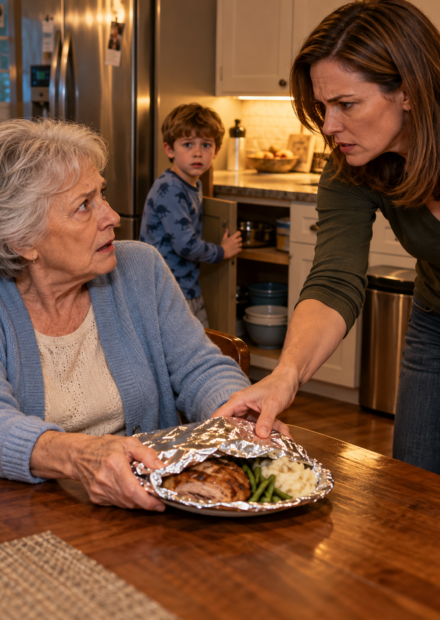






















YOU CAN LEAVE. THE BABY STAYS.
Chapter 1 – The Door That Wouldn’t Open
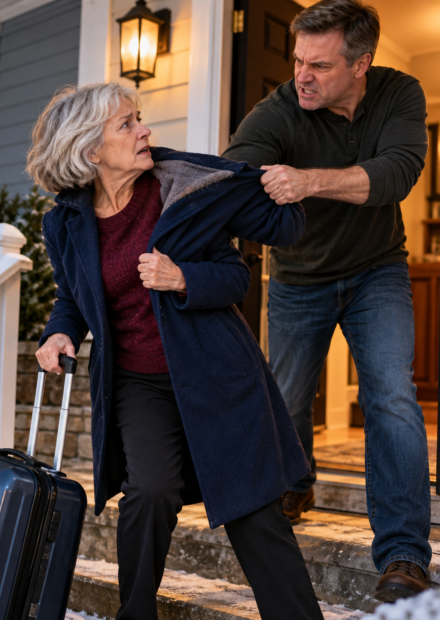
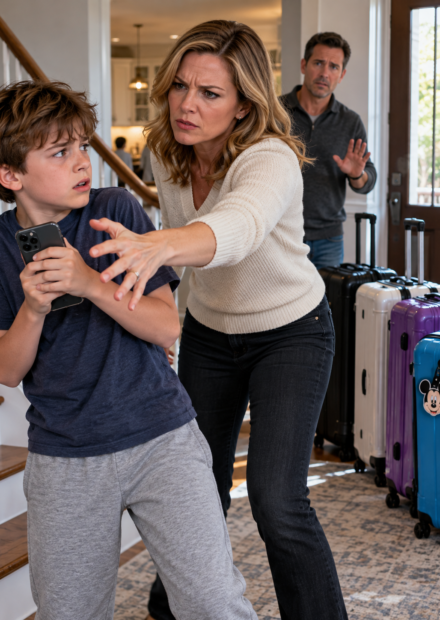
The night I tried to leave my mother-in-law’s house with my five-month-old son, the front door would not open.
At first, I thought the deadbolt was stuck.
Noah was burning against my chest, his small body limp with exhaustion after hours of crying. I had one arm under him and the other wrapped around the diaper bag hanging from my shoulder. His cheek rested against my collarbone, hot enough that I could feel the fever through my shirt.
I twisted the deadbolt again.
Nothing.
“Come on,” I whispered.
The lock was an old double-cylinder deadbolt, the kind that needed a key on both sides. Margaret insisted it was safer because the narrow window beside the door meant a burglar could otherwise break the glass and reach inside.
Normally, the inside key hung from a small brass hook beside the coat closet.
The hook was empty.
I stared at it.
Then I checked the little ceramic bowl on the entry table.
No key.
I looked beneath unopened mail, Margaret’s gardening gloves, Daniel’s spare sunglasses.
Nothing.
Behind me, one of the stairs creaked.
I turned.
Margaret stood at the top of the staircase in her pale blue robe.
She wasn’t surprised to see me dressed.
She wasn’t confused by the diaper bag.
Her eyes went first to Noah.
Then to my shoes.
Then to my hand still gripping the deadbolt.
“You shouldn’t take him out tonight,” she said.
I swallowed.
“He has a fever.”
“He’s teething.”
“His temperature is one hundred and two.”
She began walking down the stairs slowly, one hand sliding along the banister.
“Babies get fevers.”
“The nurse said if it stayed above one hundred and one after the medicine, I should bring him in.”
Margaret’s mouth tightened.
“You called someone?”
The question was strange enough that I almost laughed.
“Yes, Margaret. I called his pediatrician’s office.”
“You could have asked me.”
“He needs a doctor.”
“He needs sleep.”
I looked again at the empty hook.
“Where’s the key?”
Margaret stopped halfway down the staircase.
For several seconds, she said nothing.
Noah made a weak sound against my chest.
I rubbed his back.
“Where is the key, Margaret?”
Her expression changed.
Not dramatically.
That was the thing about Margaret. She almost never needed to scream.
She could make a room feel dangerous while speaking barely above a whisper.
“You’re upset,” she said.
“I’m not upset. I’m taking my son to urgent care.”
“Daniel will be home soon.”
“I’m not waiting.”
“You always do this.”
“Do what?”
“Make everything an emergency.”
I stared at her.
My son’s skin felt like fire under my palm.
“Give me the key.”
She reached the bottom stair.
And then she said the sentence she had been repeating since before Noah was born.
“You can leave.”
My body went still.
Margaret looked directly into my eyes.
“The baby stays.”
For months, I had tried to convince myself she didn’t mean it.
Standing at that locked door, I finally understood that she had meant every word.
It had started when I was eight months pregnant.
Margaret had been sitting at the kitchen table peeling an apple in one long strip. I remember the sound of the knife scraping against the skin, the late-afternoon sunlight on the yellow curtains, and the ache in my lower back from standing too long.
Without looking at me, she said, “Once you give this family a grandson, you’ve done what you came here to do.”
I thought I had misheard her.
“What?”
She continued peeling.
“After that, if you want to leave, go wherever you want.”
I laughed because the alternative was admitting that something cold had just moved through my stomach.
“Thanks for permission.”
Margaret smiled.
“But the baby stays.”
The knife continued around the apple.
I watched her hands.
“You’re talking about my baby.”
She finally looked up.
“Our baby.”
“No. Mine and Daniel’s.”
“He’s a Reynolds.”
“So?”
“So this is his home.”
I put a hand over my belly.
Noah kicked hard enough for me to feel his heel beneath my ribs.
“If I ever leave this house,” I said, trying to keep my voice light, “my child leaves with me.”
Margaret set the knife down.
“We’ll see about that.”
Those words followed me through the final month of my pregnancy.
I told Daniel that evening.
He laughed.
Not cruelly.
That almost made it worse.
“You know Mom.”
I was sitting on our bed folding tiny onesies while he searched for something on his phone.
“No, Daniel. Apparently I don’t.”
“She’s excited.”
“She told me I could leave but the baby would stay.”
“She’s joking.”
“She wasn’t smiling.”
“That doesn’t mean anything.”
I stopped folding.
“What exactly would she have to say before you believed she meant something?”
He looked up then.
I could see the tiredness in his face, the permanent guilt he seemed to carry whenever his mother and I were mentioned in the same conversation.
After his father died, guilt had become Margaret’s second language and Daniel’s first.
We had moved into her house three years earlier because she wasn’t doing well alone.
It was supposed to be for six months.
Then a year.
Then the plumbing needed repairs.
Then Margaret’s roof needed replacing.
Then Daniel wanted to save for a larger down payment.
Then the housing market changed.
Then I became pregnant.
Every time I brought up leaving, there was another reason to wait.
“We’ll move,” Daniel told me.
“When?”
“Soon.”
He had been saying soon for almost three years.
Once I became pregnant, Margaret stopped pretending our living arrangement was temporary.
She cleared out the bedroom beside hers.
I came home from work one afternoon and found a white crib assembled against the wall.
There was a changing table beneath the window.
A rocking chair sat in the corner.
Tiny blue stars had been painted across the ceiling.
“What is this?”
Margaret appeared behind me carrying a folded blanket.
“The nursery.”
“Noah’s room is with us.”
“For the first few weeks, maybe.”
“No. His crib is in our room.”
She laughed.
“You’ll learn.”
I hated that sentence.
Margaret used it whenever I made a decision about my own child.
I planned to breastfeed.
You’ll learn.
I wanted limited hospital visitors.
You’ll learn.
I didn’t want blankets in Noah’s crib.
You’ll learn.
I planned to take maternity leave and then reduce my hours rather than return full-time immediately.
“You’ll want to go back,” she told me.
“And if I don’t?”
“You will.”
“How do you know?”
She gave me a patient smile.
“Because you’ll realize how hard babies are.”
There was always something beneath her words.
Not quite an insult.
Not quite a threat.
Just the assumption that I would fail.
That eventually motherhood would exhaust me enough to hand Noah over.
She bought bottles even after I told her I planned to breastfeed.
She purchased formula “just in case.”
She washed baby clothes I had wanted to wash myself.
She referred to the room beside hers as “Noah’s room” no matter how many times I corrected her.
And whenever I protested, she cried to Daniel.
Not loudly.
Margaret’s tears were elegant.
Quiet.
A wounded expression.
A trembling voice.
“I’m only trying to help.”
Then Daniel would come find me.
“Could you give her a little grace?”
Grace.
I grew to hate that word too.
Grace meant Margaret could ignore a boundary and I was required to forgive her before she even admitted crossing it.
Noah’s birth made everything worse.
After twenty-one hours of labor, I was so exhausted I could barely lift my head.
I remember Daniel beside me.
I remember Noah’s first cry.
I remember the strange, overwhelming weight of him being placed on my chest.
And then I remember Margaret entering the room.
She didn’t ask how I was.
She walked straight toward the bed with both arms out.
“There he is.”
I tightened my hold.
She laughed.
“Emily, I’m not going to steal him.”
The nurse glanced at me.
I shook my head slightly.
Margaret noticed.
Her face hardened for half a second.
Then she smiled again.
“My boy,” she whispered.
Not my grandson.
My boy.
When we brought him home two days later, a banner stretched across the living-room wall.
WELCOME HOME, NOAH!
Underneath, in smaller blue letters:
GRANDMA’S LITTLE MAN.
I stood beneath it with the infant carrier in my hand.
Daniel kissed my forehead.
“She’s excited.”
That became his answer to everything.
When Margaret came into our bedroom at two in the morning because Noah cried.
She’s excited.
When she took him from the bassinet without asking.
She’s helping.
When she criticized how often I nursed him.
She’s worried.
When she told relatives that breastfeeding was preventing her from bonding properly with him.
She doesn’t mean anything by it.
When I asked her to knock before entering our room, she stared at me as if I had accused her of something obscene.
“What if he needs me?”
“He has parents.”
“I know that.”
“Then knock.”
She cried later.
Daniel came upstairs.
“She feels unwanted.”
“She walked into our bedroom while I was breastfeeding.”
“She’s family.”
“So am I.”
He looked exhausted.
“Emily.”
That single word carried an entire argument.
Please don’t make this harder.
Please don’t make me choose.
Please tolerate one more thing.
I always seemed to be the person asked to tolerate.
Then I found the diaper bag.
It sat beside the front door fully packed.
Four bottles.
Powdered formula.
Diapers.
Wipes.
Two outfits.
Blankets.
Pacifiers.
A sun hat.
Infant medicine.
Everything Noah would need to spend most of a day away from me.
I opened it while Margaret watched from the kitchen.
“What is this?”
“A diaper bag.”
“I know what it is.”
“Then why did you ask?”
“Why is it packed?”
She continued rinsing a coffee cup.
“In case I take him somewhere.”
I remember the silence afterward.
I could hear water striking porcelain.
“You won’t.”
She turned the faucet off.
“Excuse me?”
“You won’t take Noah anywhere without asking me.”
Her expression wasn’t angry.
It was confused.
As though I had just informed her that she needed permission to use her own refrigerator.
“I’m his grandmother.”
“And I’m his mother.”
“I know that.”
“Then you ask.”
That evening, she told Daniel I had humiliated her.
I sat across the living room holding Noah while Daniel comforted his mother.
“She treats me like a stranger,” Margaret said through tears.
Daniel rubbed her shoulder.
“No one thinks you’re a stranger.”
“I would never hurt that baby.”
“I know.”
“I’ve done everything for this family.”
“I know, Mom.”
She looked at me over his shoulder.
Her eyes were dry.
That was when I understood how she controlled the house.
She didn’t need to order Daniel to choose her.
She only needed to make him feel guilty enough that every conflict became my fault for causing her pain.
The family photographs were the first time something inside Daniel seemed to crack.
I came downstairs one Saturday afternoon and found Margaret wearing a blue dress.
Noah was in her arms dressed in a matching blue romper.
Daniel stood near the door holding his car keys.
“Where are you going?”
Margaret smiled.
“Family pictures.”
I looked from her to Daniel.
Then to my son.
“What?”
“We booked a photographer.”
“We?”
“Your husband and I.”
I stared at Daniel.
“You didn’t tell me.”
His face changed.
“I thought Mom did.”
“Why would I know about family pictures I apparently wasn’t invited to?”
Margaret sighed.
“Emily, please don’t start.”
“Start what?”
“It’s just a grandmother-and-grandson session.”
“Then why is Daniel going?”
No answer.
The room seemed to shrink.
I walked toward Margaret.
“Give me Noah.”
Her arms tightened.
“Emily.”
“Give me my son.”
“He’s already dressed.”
“I don’t care.”
“You’re being ridiculous.”
“Give him to me.”
Daniel stepped between us.
“Mom.”
Margaret looked at him.
“You’re choosing her?”
The question was so direct that even Daniel looked shocked.
“She’s my wife.”
Margaret’s face collapsed.
But he took Noah from her and handed him to me.
For the rest of that afternoon, she stayed in her bedroom.
Daniel and I fought in whispers downstairs.
“This can’t keep happening,” I said.
“I know.”
“I mean it.”
“I know.”
“No, Daniel. Look at me.”
He did.
“I can’t live here anymore.”
His shoulders dropped.
I expected another excuse.
Instead, he nodded.
“Okay.”
I almost didn’t believe him.
“Okay?”
“We’ll move.”
“When?”
“As soon as we find something.”
That night, he sent me three apartment listings.
The next morning, two more.
For the first time in years, I allowed myself to imagine a home where I could close a bedroom door and know it would stay closed.
I started packing quietly.
Not enough for Margaret to notice.
Just things we didn’t use every day.
Winter clothes.
Books.
Extra kitchenware.
I also gathered our important documents.
My passport.
Birth certificate.
Marriage certificate.
Noah’s birth certificate.
His insurance papers.
Medical records.
I placed everything in a small gray document box at the back of our closet.
Two weeks later, I came home from the grocery store and found the closet door open.
The gray box was sitting on our bed.
Empty.
I searched everything.
Drawers.
Laundry baskets.
Suitcases.
Under the mattress.
The bathroom cabinets.
I went downstairs.
Margaret was holding Noah.
“Where are our documents?”
She looked up.
“What documents?”
“The papers from our closet.”
“I don’t know what you mean.”
“My passport. Noah’s birth certificate.”
“You must have misplaced them.”
“They were in a box.”
“Well, perhaps Daniel moved them.”
“He didn’t.”
“How do you know?”
“Because I asked him.”
That was a lie.
I hadn’t yet.
Margaret studied me.
Then she stood and brought Noah toward me.
As I took him from her, she leaned close enough that I smelled her lavender hand cream.
“After all, Emily,” she whispered, “where exactly are you planning to go?”
That night, I waited for Daniel.
He came home after eight.
I followed him into our bedroom and closed the door.
“Did you tell your mother we were moving?”
He stopped removing his tie.
“Emily—”
My stomach dropped.
“You did.”
“I didn’t tell her everything.”
“What does that mean?”
“She asked why you were putting things in boxes.”
“So you told her.”
“She was upset.”
“I don’t care.”
“Could you lower your voice?”
“No.”
His eyes went toward the door.
That tiny movement told me everything about our marriage.
Even in our bedroom, his first instinct was to protect his mother from hearing me.
“What did you tell her?”
“That we were looking.”
“Why?”
“Because she asked me.”
“And?”
He rubbed his face.
“And I thought she deserved some warning.”
I stared at him.
“She stole our documents.”
“What?”
“Our documents are gone.”
His hands lowered.
“What documents?”
“All of them.”
“Emily, Mom wouldn’t—”
“Don’t.”
“She wouldn’t steal your passport.”
“She knew exactly where I kept them.”
“Maybe you moved them.”
I laughed once.
The sound surprised me.
Even then.
Even after everything.
He was still searching for an explanation that did not require his mother to be responsible.
“Ask her.”
“I will.”
“No. Ask her now.”
“Emily—”
“Now, Daniel.”
We went downstairs.
Margaret sat in the living room watching television.
Daniel stood beside the couch.
“Mom, did you move some papers from our room?”
She didn’t even look at him.
“No.”
Daniel looked at me.
Margaret turned the television volume up.
That should have been enough.
It wasn’t.
It took another three days.
Three days before the night Noah got sick.
Three days before I stood at the front door with my feverish child and discovered that the inside key was gone.
Three days before Margaret walked down the stairs and told me I could leave.
But the baby stayed.
I looked at her across the entryway.
My fear became something sharper.
“You locked me in.”
“No one locked you in.”
“Give me the key.”
“You’re being hysterical.”
“Give me the key.”
“You’re not taking Noah out in the middle of the night.”
“It’s seven thirty.”
“He is sick.”
“That’s why I’m taking him to a doctor.”
“You’re not going anywhere with him until Daniel gets home.”
I shifted Noah higher against my chest.
“You don’t get to decide that.”
Margaret took one more step toward me.
“This is my house.”
I reached into my coat pocket and pulled out my phone.
Her eyes dropped to it.
For the first time, she looked uncertain.
“What are you doing?”
“Calling someone who can open the door.”
Her face changed.
“Put that away.”
“No.”
“Emily.”
I unlocked the screen.
Margaret moved toward me.
And upstairs, from the bedroom I shared with Daniel, my phone suddenly began ringing.
Not the phone in my hand.
Daniel’s old spare phone.
The one I had charged that afternoon because my own battery had been dying.
The sound made Margaret freeze.
And in that moment, I realized she had been so focused on keeping me from leaving that she had forgotten something important.
The house had more than one way out.
And I was finally done asking permission.