





















MY DAUGHTER-IN-LAW ORDERED ME OUT OF MY OWN BEACH CONDO
Chapter 2 – THE INHERITANCE THEY HAD STARTED SPENDING BEFORE I WAS DEAD
Nobody moved for several seconds.
Harper recovered first.
She always did.
She had a talent for reorganizing reality quickly when reality disappointed her.
“This is insane.”
Her voice was low.
Controlled.
Not yet angry enough to shout in front of her parents.
“Harper,” Daniel murmured.
“No. I’m sorry, but this is insane.”
She turned toward me.
“We asked you for one favor.”
There it was again.
One favor.
The phrase had begun to sound almost funny.
I leaned against the kitchen counter.
“You told me to leave my property.”
“For less than a week.”
“You did not ask whether it was convenient.”
“We knew you could afford a hotel.”
“That was not the question.”
“Then what was the question?”
“Whether I mattered enough to be consulted.”
She stared at me.
For the first time, Catherine spoke.
“Harper, perhaps we should go.”
Her tone surprised me.
I had expected her to defend her daughter.
Instead, she looked uncomfortable.
Richard nodded.
“We can find a hotel.”
Harper turned on them.
“No. You drove all this way.”
Richard glanced toward me.
“So did Barbara.”
That was the first decent sentence anybody had spoken since they entered the condo.
Harper pressed her lips together.
“Dad, you don’t understand.”
“I understand this is her place.”
“She’s family.”
I nearly smiled.
There are strange words people use to excuse behavior they would never attempt with strangers.
Family.
As though love eliminated property lines.
As though blood erased manners.
As though closeness entitled people to take liberties respect would forbid.
Richard’s expression remained calm.
“That seems like more reason to ask properly.”
Harper looked betrayed.
I almost felt sorry for her.
Almost.
Daniel stepped toward me.
“Mom, can we talk privately?”
“No.”
His face tightened.
“Please.”
“Anything you can say to me about why I should leave my own home can be said in front of everyone who arrived expecting me to do it.”
Catherine shifted uncomfortably.
I noticed something then.
She looked confused.
Not offended.
Not entitled.
Confused.
That mattered.
Harper had told me her parents expected the condo.
But had her parents known I was already staying here?
“Catherine,” I said.
She looked at me.
“Did you know I was here?”
Harper’s head turned sharply.
“Barbara—”
I ignored her.
Catherine hesitated.
“We knew you were in Florida.”
“That is not what I asked.”
Richard’s jaw tightened.
Catherine glanced at Harper.
Then she looked back at me.
“We thought you were leaving today.”
“Why?”
Another hesitation.
“Harper said you were only here overnight.”
My daughter-in-law’s face hardened.
I felt something quiet settle into place.
“What else did Harper tell you?”
“Mom,” Harper snapped.
Catherine looked embarrassed.
“That you had offered us the condo.”
No one breathed.
I heard the ceiling fan.
The refrigerator.
A gull outside.
Daniel closed his eyes.
I looked at Harper.
“You told your parents I offered them my condo?”
Her cheeks flushed.
“I said it was available.”
“You said I offered it.”
“I was trying to simplify things.”
“For whom?”
She folded her arms.
“This is exactly why I didn’t want to make a big discussion out of it.”
I stared at her.
Not because I was shocked she had lied.
Because I suddenly understood how much easier my cooperation had made lying about me.
Harper could tell people I had volunteered because eventually I usually did.
She could promise my time because I rearranged it.
She could offer my house because I rarely said no.
She could speak for me because she had years of evidence that I would choose peace over correction.
The problem had not begun with Harper.
That was the part I did not want to face.
I had participated in my own disappearance.
Not knowingly.
Not willingly.
But consistently.
I had trained everyone around me to expect the version of Barbara who absorbed inconvenience before anyone else had to feel it.
Daniel opened his eyes.
“Mom, Harper shouldn’t have said you offered.”
Harper whipped around.
“Oh, now you’re taking her side?”
“This isn’t about sides.”
“It became about sides when your mother changed your inheritance in the middle of a family visit.”
I looked at my son.
“Did you tell Harper that condo was yours?”
His face changed.
Barely.
But I saw it.
“Daniel.”
“No.”
Harper laughed sharply.
“Are you serious?”
He turned toward her.
“Harper.”
“You told me your parents had structured it so the condo came to you.”
“That’s true.”
“You said we would always have it.”
“Eventually.”
“You never said she could remove you whenever she wanted.”
Daniel rubbed his forehead.
“I told you Mom controlled it while she was alive.”
“That is not the same thing.”
“It is exactly the same thing,” I said.
Harper looked at me.
I walked to the brown leather folder lying on the dining table.
I had placed it there after speaking to Alan.
I opened it carefully.
“Eleven years ago, Robert and I arranged our estate so that this property would pass to Daniel after we were both gone.”
My son stared at the floor.
“We did it because we loved him. We did it because he was going through a terrible year and we wanted him to know there would always be something stable in his future.”
I touched the edge of the old papers.
“But Robert insisted that we retain complete control while either of us was living. Daniel knew that.”
“I know,” he said quietly.
“Do you?”
He looked at me.
“Because somewhere along the way, you stopped behaving like you knew.”
His eyes filled with something.
Anger.
Shame.
Maybe both.
I continued.
“This was not a gift delivered eleven years early. This was an estate arrangement. There is a difference.”
Harper shook her head.
“So you’re punishing us.”
“No.”
“What would you call it?”
“I am correcting an assumption.”
“You removed your only son from a property worth—”
She stopped.
Too late.
The room became very still.
I had never discussed the condo’s current value with Harper.
Property on our stretch of the Gulf had risen sharply over the years.
I knew approximately what it was worth.
Alan knew.
Daniel probably knew.
Apparently Harper knew too.
Richard looked at his daughter.
Catherine’s expression changed.
Harper realized what she had said.
“That isn’t what I meant.”
I studied her face.
“How much is it worth, Harper?”
“That’s irrelevant.”
“You brought up the value.”
“Because this is a major financial decision.”
“It is my financial decision.”
“You’re doing it emotionally.”
“Yes.”
That seemed to surprise everyone.
Perhaps they expected me to deny it.
I didn’t.
“Of course I’m emotional,” I said. “My son asked me to vacate a home I own so his wife’s parents could use it. My daughter-in-law lied and told those parents I had volunteered. You arrived with luggage before I agreed. Why would I pretend emotion has nothing to do with how I respond?”
Harper opened her mouth.
I continued before she could speak.
“But the documents are not emotional. They are clear. Robert and I retained control. Daniel never owned this condo.”
I turned toward him.
“He expected to inherit it.”
Daniel’s jaw tightened.
“There’s a difference.”
He looked suddenly older than forty-two.
“Dad wanted me to have it.”
“Your father wanted you to have it after we were gone.”
“He told me it would stay in the family.”
“It is in the family.”
“You know what I mean.”
“Yes.”
I did.
And that was precisely the problem.
What he meant was that because he expected to receive something someday, he had begun emotionally possessing it today.
When had that happened?
I tried to remember.
Maybe there had not been one moment.
Entitlement rarely announces itself.
It grows through small permissions.
The first time Daniel used the condo without asking, he was thirty-four.
He had called me from the road.
“Mom, we’re already halfway to Florida. I figured you wouldn’t mind.”
I minded.
But I gave him the code.
The second time, Harper invited another couple for a long weekend.
I discovered it because the property manager called me about an extra parking permit.
Harper apologized.
I told her it was fine.
It was not fine.
Two years later they stayed for eight days during spring break after telling me they needed four.
I said nothing.
Then came borrowed beach chairs that were never returned.
A broken lamp nobody mentioned.
Wet towels left in a closet.
A cabinet rearranged because Harper preferred plates in a different location.
Family photographs replaced the small framed picture of Robert and me that had stood beside the television.
Nothing serious.
That was always the phrase.
Nothing serious.
Each incident too small to justify a fight.
Each surrender too minor to defend.
But years are built from minor things.
So are patterns.
Daniel looked at the leather folder.
“What exactly did Alan file?”
“I exercised the authority Robert and I retained.”
“That doesn’t answer me.”
“It does.”
“Mom.”
I closed the folder.
“The future interest that would have transferred this condo to you is no longer in effect.”
Harper stared at me.
“Who gets it now?”
The speed of the question nearly impressed me.
“I do.”
“I mean when you die.”
“I know what you mean.”
“Well?”
“That is no longer information you need in order to plan your vacations.”
Richard coughed into his hand.
I could not tell whether he was hiding a laugh.
Harper noticed too.
Her face darkened.
“This is humiliating.”
I looked at her.
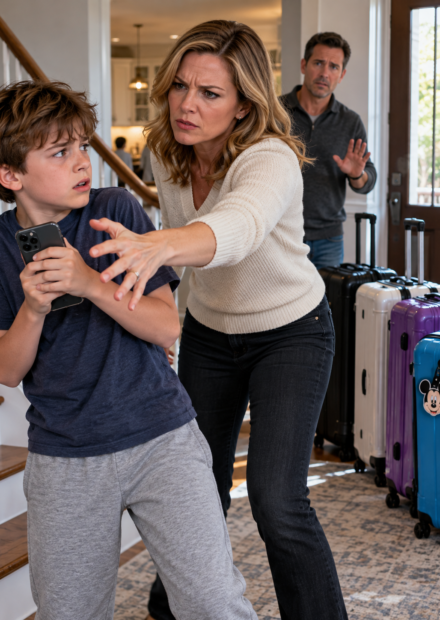
“You arrived at my home with six suitcases after instructing me to leave it.”
“I was talking about us.”
“So am I.”
Catherine stepped forward.
“Barbara.”
Her voice was softer.
“I am sorry.”
Harper turned.
“Mom, stop.”
“No.”
Catherine looked at me.
“I truly thought you offered the condo. If I had known you were here for your own vacation, I would never have agreed.”
Something in my chest loosened.
Not much.
But enough.
“Thank you.”
“We should go.”
“Yes.”
Harper stared at me.
“You’re throwing my parents out?”
“No. Your parents just told me they are leaving because they were invited under false pretenses.”
“Same thing.”
“No, Harper. Words matter.”
Her mouth tightened.
“Apparently only yours.”
Daniel looked exhausted.
“Can everybody stop?”
I turned toward him.
“No.”
He blinked.
“I’ve spent years stopping because you were uncomfortable.”
“Mom—”
“If Harper was angry, I stopped. If you were embarrassed, I stopped. If somebody wanted the holiday changed, the visit shortened, the check written, the grandkids watched, the room surrendered, the opinion swallowed—I stopped.”
My voice remained calm.
That was what frightened Daniel most.
He had seen me upset.
He had seen me cry.
He had seen me angry.
He had never seen me finished.
“I am not stopping this conversation because it makes you uncomfortable.”
His face reddened.
“So what? You want me to beg?”
“No.”
“What do you want?”
The answer came more easily than I expected.
“I wanted you to say no before I had to.”
He stared at me.
“To Harper?”
“To anyone.”
His eyes dropped.
“When your wife said your mother should move into a hotel so her parents could enjoy your mother’s home, I wanted you to say, ‘That’s not happening.’”
I swallowed.
“I wanted my son to be offended before I needed to defend myself.”
Daniel looked away.
That was the first time he had no argument.
Harper did.
“Daniel was trying to keep everyone happy.”
I almost laughed.
“No. He was trying to keep you happy because he believed I would recover from being disappointed.”
Daniel flinched.
I saw it.
I knew I had hit the truth.
Harper started to speak.
Daniel raised one hand.
“Don’t.”
She stared at him.
He looked at me.
For a moment, the room contained only the sound of the ocean.
Then he said, “You’re right about that.”
Harper’s face changed.
I felt my own breath catch.
Daniel continued before either of us could interrupt.
“I thought you’d be mad for a day.”
His voice was barely above a whisper.
“I thought Harper would be mad for weeks.”
There it was.
Not cruelty.
Not hatred.
Cowardice.
Sometimes that hurts more.
Because cruelty gives you someone simple to blame.
Cowardice comes wrapped in love.
He loved me.
I believed that.
He had simply trusted that my love would tolerate more injury.
“I see,” I said.
Daniel’s eyes filled.
“Mom.”
I shook my head.
“Not now.”
Catherine picked up the handle of her suitcase.
Richard lifted the other bags.
Harper stood perfectly still.
“What are we supposed to do?”
Richard answered before I could.
“We’re going to a hotel.”
“There probably aren’t rooms this close.”
“Then we’ll drive.”
“Dad—”
“We’ll manage.”
Catherine touched her daughter’s arm.
“Come on.”
Harper pulled away.
She looked at me one final time.
“You realize this changes everything.”
I nodded.
“I do.”
She expected fear.
I felt none.
That surprised me more than anything else that day.
Maybe everything had already changed.
Maybe this was simply the first time I had admitted it.
They carried the suitcases back toward the hall.
Daniel remained behind.
“Mom.”
I looked at him.
“Can I come back later?”
“No.”
His shoulders dropped.
“Tomorrow?”
“I don’t know.”
“Please don’t shut me out.”
For years, I would have rushed to reassure him.
I would have touched his arm.
Told him of course I loved him.
Promised everything would be all right.
Instead, I said the truest thing I had said to my son in a long time.
“I need one evening where nobody asks me for anything.”
He nodded.
Then he walked out.
The door closed.
For the first time since they arrived, the condo was silent.
I locked it.
Walked through the living room.
Stepped onto the balcony.
And sat at Robert’s old iron table.
Down in the parking lot, four people loaded six suitcases back into two cars.
I watched until the vehicles disappeared.
Then I cried.
Not because I regretted what I had done.
Because for the first time I could see how long it had taken me to do it.