





















MY SON TOOK THE COAT OFF MY BACK—SO I TOOK HIM TO COURT
Chapter 1 – THE COAT HE CALLED HIS
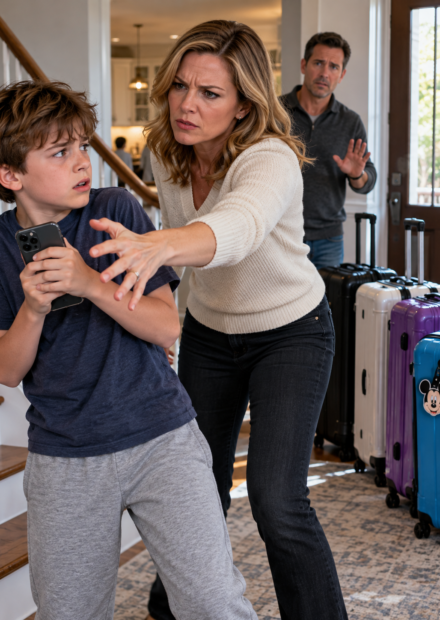
My son pulled my coat off my shoulders and said, “If you’re leaving, leave with what you came with.”
For a second, I thought I had misunderstood him.
The wind was blowing hard across the porch, carrying the kind of cold that slipped through every opening in your clothes and settled straight into your bones. I was seventy-two years old, standing on my son’s front step with one hand wrapped around the handle of an old suitcase, and Daniel was holding the sleeve of my winter coat like I had stolen it from him.
I stared at him.
“Daniel.”
He didn’t let go.
The porch light above his head cast a hard yellow glow over his face. I could see the muscle jumping in his jaw.
“I bought it,” he said.
I almost laughed.
Not because anything was funny.
Because sometimes cruelty is so ridiculous that your mind refuses to understand it at first.
“You gave it to me.”
“I paid for it.”
“It was my birthday present.”
“That doesn’t change who bought it.”
I looked down at the dark blue coat wrapped around my body.
He had given it to me two winters earlier.
He had stood in this same living room, smiling, holding out the department-store box while I told him he shouldn’t have spent so much money.
“You’re always cold, Mom,” he had said then. “You need something decent.”
I had kissed his cheek.
I remembered that.
He apparently remembered only the receipt.
“Let go of my coat,” I said.
His eyes hardened.
“You said you’re leaving.”
“Yes.”
“Then leave.”
“I am.”
“With your things.”
“This is my thing.”
“No, it isn’t.”
His fingers tightened around the fabric.
Behind him, through the open front door, I could see the hallway where my slippers still sat neatly against the wall.
The house looked warm.
The lamps were on.
The television flickered silently in the living room.
A ceramic bowl I had bought at a flea market sat on the console table.
There was a framed picture of Daniel when he was nine years old beside it.
In that photograph, he was missing a front tooth.
He had his arms wrapped around my waist.
I remember the day it was taken.
He had refused to let me go because he was afraid of the photographer’s dog.
That boy had once clung to me because I made him feel safe.
Now the man he had become was trying to strip a coat off my body in thirty-seven-degree weather because he had paid for it.
That was the moment something inside me finally broke.
Not when he called me ungrateful an hour earlier.
Not when he told me I made his life harder.
Not when he accused me of “dramatic nonsense” because I said I couldn’t continue living in a house where every favor was eventually turned into a debt.
It broke right there.
On the porch.
Over a coat.
“Daniel,” I said quietly, “you don’t get to give someone a gift and take it back because you’re angry.”
“Don’t lecture me.”
“I’m not lecturing you.”
“You’ve been doing it my whole life.”
I felt those words like a slap.
His hand jerked again.
The coat slipped halfway from my shoulder.
“Stop.”
“You wanted to leave.”
“I said stop.”
“Then take it off.”
“No.”
He gave the coat another hard pull.
I held the front closed with my left hand.
My suitcase tipped sideways and struck the porch railing.
“Daniel!”
“I bought it!”
“And you gave it to me!”
“You think that means you can stand in my house, insult me, walk out, and take things I paid for?”
His house.
That phrase had come up more and more often during the fourteen months I had lived there.
My house.
My electricity.
My groceries.
My rules.
It had never mattered how many dinners I cooked.
How often I cleaned.
How many times I sat awake listening for the garage door because Daniel was late getting home and some stupid maternal part of me still worried about him at forty-six years old.
It had never mattered that I gave him money every month toward household expenses even when he told relatives I was “staying with him.”
It had never mattered that I tried to make myself small.
Quiet.
Useful.
Grateful.
Somehow, I was always taking too much.
Too much space.
Too much time.
Too much attention.
And now, apparently, too much coat.
“I am not fighting you over this,” I said.
“Good.”
I reached up and tried to pull the sleeve free from his hand.
He pulled back.
Hard.
It happened fast.
Too fast for either of us to pretend afterward that it had been nothing.
My right foot slipped on the edge of the top step.
My suitcase fell.
I reached for the railing.
My fingers missed.
The world tilted.
I remember seeing Daniel’s face change.
Not to concern.
Not yet.
Just surprise.
Then my hip struck the wooden step.
My elbow hit next.
The back of my shoulder slammed against the edge of the porch.
Pain shot through my body so sharply that I couldn’t breathe.
I fell sideways and landed on the concrete walkway below.
For several seconds, I heard nothing except the wind.
My mouth opened.
No sound came out.
The coat was twisted underneath me.
My right leg was bent awkwardly.
My palm burned where the skin had scraped against the concrete.
I tasted blood where I had bitten the inside of my cheek.
Daniel stood above me.
“Mom?”
I looked up.
For one tiny, stupid moment, hope rose in me.
He’s going to come down.
He’s going to help me.
He’s going to realize what he did.
He’s going to say he’s sorry.
A mother can spend decades teaching herself to forgive a child before the child even asks.
Daniel stepped forward.
Then stopped.
His expression changed again.
The anger came back.
Not as hot this time.
Colder.
Defensive.
“You shouldn’t have pulled back.”
I stared at him.
“What?”
“I wasn’t trying to make you fall.”
I tried to push myself upright and nearly cried out.
My hip felt as if something inside it had been torn loose.
“Help me.”
He didn’t move.
“Daniel.”
“You were fighting me.”
“Help me get up.”
“You’re going to make this into something it wasn’t.”
I couldn’t understand what I was hearing.
The wind blew my hair across my face.
“Please.”
He glanced toward the neighboring houses.
That hurt more than I can explain.
Because I understood the look.
He was not checking whether anyone could help me.
He was checking whether anyone had seen him.
“Daniel.”
He stepped backward.
“Maybe you should call whoever you were planning to stay with.”
I stared at my son.
My own son.
The child I had carried through fevers.
The boy whose scraped knees I had washed in the kitchen sink.
The teenager I had waited for outside the principal’s office.
The young man whose first apartment I had cleaned after he moved out because he was too embarrassed to admit he didn’t know where to start.
I was sitting injured on freezing concrete at his feet.
And he was embarrassed.
Not ashamed.
Embarrassed.
He bent down.
For another ridiculous second, I thought he was finally going to help me.
Instead, he grabbed my suitcase.
He set it upright at the bottom of the steps.
Then he looked at the coat still tangled around me.
He said nothing.
He turned around.
“Daniel?”
He walked up the steps.
“Daniel!”
He entered the house.
The door closed.
The lock clicked.
I sat there listening to it.
There are sounds you remember for the rest of your life.
Your baby’s first cry.
A doctor saying someone you love is gone.
A wedding vow.
A final breath.
For me, one of those sounds would always be the deadbolt on my son’s front door sliding into place while I sat outside in the cold.
I don’t know how long I stayed still.
Maybe thirty seconds.
Maybe three minutes.
Long enough for the shock to become something else.
Long enough for me to understand that nobody was coming through that door.
My hands were shaking when I reached into my coat pocket.
Thank God he had not taken the coat completely off.
Thank God my phone was still inside it.
I pulled it out.
The screen was cracked along one corner from the fall, but it lit up.
There were several people I could have called.
My sister.
A friend from church.
A taxi.
Emergency services.
Instead, I found the name of the one person I suddenly needed more than anyone else.
Margaret Shaw.
Attorney.
Margaret had helped my husband and me with legal paperwork years earlier. After Robert died, she had handled the few things I had been too numb to understand.
We weren’t close.
But I trusted her.
My finger hovered above her name.
I had spent my entire life protecting Daniel.
When he failed classes in high school, I told his father he was struggling, not lazy.
When he lost his first job, I told relatives the company had downsized.
When his marriage ended, I never repeated the things his former wife had said to me, even when some of them frightened me.
When Daniel snapped at me, I explained that he was stressed.
When he forgot my birthday, I said he was busy.
When he made me cry, I told myself mothers should have thicker skin.
That was what mothers did, wasn’t it?
We took the sharp edges of our children and wrapped them in excuses before the rest of the world could get hurt.
But sitting on that concrete, I finally understood something.
I had been wrapping those edges around myself.
Margaret answered on the fourth ring.
“Evelyn?”
Hearing my name in a calm voice almost undid me.
“Margaret.”
“What’s wrong?”
I swallowed.
My teeth had started chattering.
“I need your help.”
“Where are you?”
“Outside Daniel’s house.”
There was a pause.
“Why are you outside?”
“Because he locked the door.”
Another pause.
This one longer.
“Evelyn, are you hurt?”
I looked at my scraped hand.
At my swollen wrist.
At the step where I had fallen.
“Yes.”
“What happened?”
My throat tightened.
“He pulled my coat.”
“He did what?”
“He said I couldn’t take it because he bought it. We fought over it. I fell down the steps.”
“Did he push you?”
“I don’t know.”
That was the truth.
“He pulled the coat. I pulled back. I lost my balance.”
“Where is he now?”
“Inside.”
“And you?”
“Outside.”
“In this weather?”
“Yes.”
“Can you stand?”
“I don’t think so.”
Her voice changed immediately.
“Evelyn, I need you to call for medical help.”
“I will.”
“Now.”
“I will.”
“Do not go back inside alone.”
I looked at the front door.
“I don’t think he’d let me.”
Margaret went silent again.
Then she said, very carefully, “Call an ambulance. Get examined. After that, call me.”
Something in me steadied.
Maybe it was her voice.
Maybe it was the cold.
Maybe it was the realization that Daniel had left me with no dignity to protect except my own.
“Margaret.”
“Yes?”
I looked at the door.
At the warm yellow light glowing behind the curtains.
At the house where I had washed dishes that morning and folded Daniel’s laundry the night before.
And then I said the sentence that changed both our lives.
“I want to sue my son.”
The paramedics arrived twelve minutes later.
My neighbor, Mrs. Harper, came outside before they did.
She lived across the street and had probably seen the flashing lights through her curtains.
“Oh my God, Evelyn.”
She rushed toward me wearing slippers and a robe beneath her winter coat.
“What happened?”
“I fell.”
“Where’s Daniel?”
I looked at the house.
“Inside.”
Her face changed.
She didn’t ask another question.
One of the paramedics knelt beside me.
“Ma’am, can you tell me where the pain is?”
“My hip. My shoulder. My wrist.”
“Did you hit your head?”
“I don’t think so.”
He began asking questions.
My name.
My age.
Whether I took blood thinners.
Whether I had any medical conditions.
While he spoke, I watched the front window.
The curtain moved.
Just slightly.
Daniel was watching.
I knew it.
He watched strangers lift his mother onto a stretcher.
He watched Mrs. Harper hold my suitcase.
He watched them wrap a blanket around me.
He watched the ambulance doors close.
He never came outside.
That was when I knew I would not change my mind.
Not this time.