THE NUMBER ON MY HUSBAND’S CROSS
Chapter 1 – THE NUMBER THEY ALREADY KNEW
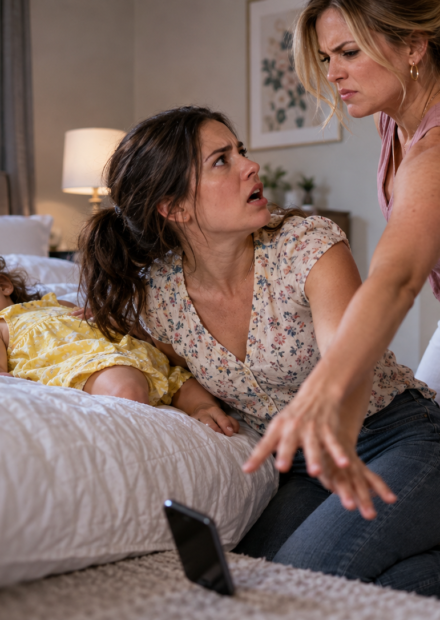
My daughter-in-law reached across my Sunday dinner table, hooked two fingers beneath the silver chain around my neck, and yanked me toward her hard enough to send my water glass tipping sideways.
The glass struck my plate.
Ice scattered across the tablecloth.
For half a second, nobody moved.
Then my seventeen-year-old grandson, Miles, caught the glass before it rolled off the edge.
My son Garrett gave a thin, nervous laugh.
“Mom, come on. It’s just an old necklace.”
I looked at him.
Not at Kendra.
At him.
Because Kendra had been my daughter-in-law for eighteen years.
Garrett had been my son for forty-eight.
He knew better.
The silver cross hanging from my neck had belonged to his father for forty-six years.
Owen wore it through our entire marriage.
He wore it when Garrett was born.
He wore it when we bought the house we were sitting in.
He wore it when his business nearly went under during the recession.
He wore it when he walked our son down the aisle because Kendra’s father had refused to attend their wedding.
And he wore it during the final weeks of his life, when the cancer had taken enough from him that even getting out of bed required my arm around his waist.
Nineteen months earlier, I had removed that cross from my husband’s neck after he died.
Since then, I had worn it almost every day.
Garrett knew all of that.
Yet when his wife pulled me halfway across my own table trying to get her hands on it, he laughed.
A nervous laugh.
But still a laugh.
I slapped Kendra’s hand away.
“Don’t touch me.”
Her mouth dropped open.
“I barely touched you.”
Across the table, Miles looked at his mother.
“You pulled Grandma.”
“Miles.”
“You did.”
His voice was quiet.
That was what made it powerful.
Miles had never been a loud boy. Even as a child, he watched before he spoke. Owen used to say Miles had the kind of eyes that made people confess things they hadn’t even been accused of yet.
Kendra turned toward him.
“This is between adults.”
“No,” I said.
I pushed my chair back.
“It stopped being between adults the moment you put your hands on me.”
Kendra’s cheeks flushed.
Garrett rubbed both hands over his face.
“Can we please not turn this into something it isn’t?”
I almost laughed.
Not because anything was funny.
Because I had spent nearly half a century watching my son become a man, and I had never imagined there would come a day when I would hear him defending his wife for trying to take his dead father’s necklace off my neck.
And somehow that wasn’t even the worst thing that had happened at dinner.
The evening had begun normally enough.
I had made roast beef with potatoes and carrots, Garrett’s favorite meal since he was ten.
I baked an apple pie because Miles loved the crust.
Kendra arrived carrying a bottle of wine she never opened.
Garrett kissed my cheek.
Miles hugged me hard enough that I had to tell him I still needed my ribs.
For the first twenty minutes, we talked about school and work and a neighbor who had painted his garage a color that could only be described as violent orange.
Then Kendra started talking about a house.
Not my house.
The one she wanted.
Four bedrooms.
Finished basement.
Renovated kitchen.
Stone countertops.
New appliances.
A fenced yard.
Better schools, even though Miles would graduate the following spring.
“A good investment,” Kendra said.
She had a way of speaking when she wanted something that made every sentence sound like it belonged in a brochure.
Garrett mostly pushed his food around.
That should have warned me.
“So,” I said eventually, “are you buying it?”
Kendra looked at Garrett.
Garrett looked at his plate.
“We want to.”
“But?”
Another silence.
I set down my fork.
“How short are you?”
Garrett’s head came up.
Kendra smiled.
“Forty thousand.”
I waited for the rest.
When none came, I asked, “And the bank won’t lend it?”
“It isn’t about the bank,” Kendra said. “We’ve already stretched things as far as we responsibly can.”
The word responsibly nearly made me admire her.
Nearly.
Garrett cleared his throat.
“We thought maybe you could help.”
I nodded slowly.
“All right. Are you asking me for a loan?”
Kendra gave a small laugh.
“I wouldn’t exactly call it a loan.”
Something inside me tightened.
“What would you call it?”
She glanced at my son.
He looked miserable.
That should have mattered to me more than it did.
But misery is not the same as innocence.
“An advance,” Kendra said.
“On what?”
This time Garrett forced himself to look at me.
“My inheritance.”
There are moments when a sentence doesn’t feel like sound.
It feels physical.
Like someone has opened a door beneath your feet.
I didn’t shout.
I didn’t throw my napkin.
I didn’t tell them to leave.
I simply stared at my only child.
“My what?”
“Mom—”
“You said your inheritance.”
“I didn’t mean it the way it sounded.”
Kendra leaned forward.
“It’s practical, Evelyn.”
I turned to her.
“Is it?”
“You have no mortgage. Your pension covers your regular expenses. You have savings. This house is paid off. There’s money sitting here doing nothing when your family could use it.”
Money sitting here doing nothing.
I followed her eyes as they moved around my dining room.
The hardwood floors Owen and I refinished ourselves.
The built-in cabinet his brother helped us install.
The photograph of Owen holding Garrett at six months old.
The doorway into the living room.
The staircase.
The walls.
For the first time, I understood the look on Kendra’s face.
She wasn’t sitting inside my home.
She was evaluating future property.
I was seventy-two years old.
Not ninety-two.
I drove.
I volunteered twice a week at the library.
I tended my garden.
I walked three miles every morning unless the weather was miserable.
But apparently, somewhere in my son’s household, my life had already been converted into numbers.
House value.
Savings.
Pension.
Inheritance.
Forty thousand available now.
The rest later.
“When exactly,” I asked, “did the two of you start planning your finances around my death?”
Garrett flinched.
“Mom.”
“Answer me.”
“It isn’t like that.”
“Then explain what it is like.”
He opened his mouth.
Nothing came out.
Kendra did what Kendra always did when Garrett became uncomfortable.
She took over.
“You’re being dramatic. Families help each other.”
“I helped you with your wedding.”
“That was eighteen years ago.”
“I helped when Miles was born.”
“We appreciated that.”
“I paid for half his braces.”
“You offered.”
“I gave you twelve thousand dollars when Garrett was laid off.”
“That was different.”
I stared at her.
“How?”
No answer.
Miles sat so still I could hear the refrigerator running in the kitchen.
Finally Garrett said, “We’re not demanding anything.”
“No?”
“No.”
“Then if I say no, this conversation is over?”
Kendra’s jaw tightened.
Garrett hesitated.
That hesitation told me more than a yes ever could.
Then Kendra said, “Maybe you should at least understand the full situation before making a decision.”
“What full situation?”
Again, she looked at Garrett.
Again, he looked alarmed.
“Kendra.”
“What?”
“I told you not to bring that up.”
Now I was paying attention.
“Bring what up?”
“It’s nothing, Mom.”
“What is nothing?”
Kendra folded her arms.
“Your husband’s old business papers.”
Garrett’s head snapped toward her.
“Jesus Christ, Kendra.”
I felt something cold move down my spine.
“What business papers?”
Garrett shoved his chair back an inch.
“Old junk.”
“Then why did you tell her not to talk about it?”
“Because I knew she’d make it sound strange.”
Kendra laughed without humor.
“I’m not making anything sound strange. They look like partnership documents.”
My fingers tightened around my napkin.
Owen had once owned a property-maintenance company with a man named Leonard Carlson.
Pierce-Carlson Property Services.
They maintained office buildings, small shopping centers, warehouses, apartment complexes.
Owen started with one truck.
By the time Garrett was in college, he and Leonard employed more than thirty people.
Then, twenty-three years earlier, Owen came home one evening and told me the partnership was over.
No scandal.
No lawsuit.
No dramatic fight.
At least, none he told me about.
He simply said he was tired of working seventy-hour weeks and wanted out.
Leonard continued with the business.
Owen took a facilities-management position with a local hospital and stayed there until retirement.
I had believed the matter finished.
“What partnership documents?” I asked.
Garrett stood.
“We should leave.”
I stared up at him.
“You have barely touched your dinner.”
“I’m not hungry.”
“Sit down.”
“Mom.”
“If you have something that belonged to your father, I want to know about it.”
“I don’t have anything.”
Kendra looked at him.
That was the first crack.
Small.
Almost invisible.
But I saw it.
“What?” I asked.
“No one has anything,” Garrett said.
Then Kendra’s eyes dropped to my chest.
To Owen’s cross.
Her entire expression changed.
“Let me see that necklace.”
“No.”
She blinked.
“I just want to look at it.”
“Why?”
“Because I do.”
“That isn’t an answer.”
Garrett said, “Kendra, leave it.”
She ignored him.
“Evelyn, please.”
I closed my hand around the cross.
“No.”
The first time she reached for it, I stopped her before she touched me.
Garrett laughed awkwardly.
“Kendra gets obsessive about puzzles.”
Nobody smiled.
A few minutes passed.
We tried to continue the conversation.
Nobody succeeded.
Then Kendra reached again.
Faster.
That was when she hooked the chain and pulled.
That was when my water tipped.
That was when Miles spoke.
And that was when something inside my family changed.
After I slapped her hand away, I unclasped the necklace myself.
“If anyone is going to inspect this,” I said, “it will be Miles.”
Kendra looked furious.
Garrett looked terrified.
I put the cross into my grandson’s palm.
Miles carried it beneath the dining-room light.
He turned it once.
Then twice.
“I never noticed this.”
My heart began to beat harder.
“What?”
“There’s something engraved on the back.”
Garrett stopped breathing.
I know that sounds dramatic.
But I watched him.
His chest actually stopped moving.
Miles squinted.
“Four-seven-one-nine dash C.”
Kendra’s chair scraped violently backward.
“That’s it.”
Nobody spoke.
I looked at her.
“That’s what?”
Garrett stood again.
“We need to go.”
Too late.
Because Kendra was staring at the cross with the expression of someone who had just found the final piece of something she had been building in secret.
She pointed at it.
“We think 4719-C identifies a safe-deposit box.”
The room went silent.
I could hear the clock over the stove.
Tick.
Tick.
Tick.
I took the cross from Miles.
“Garrett.”
“Mom, I don’t know anything for sure.”
“But you knew that number.”
He said nothing.
“Kendra knew it.”
Still nothing.
“You were searching for something connected to your father.”
Garrett rubbed the back of his neck.
“It’s complicated.”
“It becomes less complicated when you tell the truth.”
Kendra stood.
“We found a reference to that number.”
“Where?”
Neither answered.
“Where?”
Garrett looked at me.
In that moment he looked eight years old again.
Eight years old with a broken window behind him and a baseball bat in his hands.
The same guilty face.
But when he had been eight, the lie was about a window.
Now it was about his dead father.
And me.
“We should go,” he said.
“Garrett, sit down.”
“No.”
“If you know what this means, tell me.”
“I don’t know anything for sure.”
“But you knew enough to search for it.”
His silence hurt more than Kendra’s hand around my necklace.
Because my son knew something about Owen’s affairs that I did not.
And instead of bringing it to me, he had investigated in secret.
Garrett took his coat.
Kendra followed.
At the front door, I said, “I want whatever papers you have.”
Garrett turned.
“What?”
“Your father’s papers.”
“I told you—”
“Whatever you took from this house, bring them back.”
His face changed.
Just slightly.
But enough.
So I knew.
“You did take something.”
“Mom, you were getting rid of boxes.”
“I was not.”
“You said we could clean the garage.”
“I said you could help me organize it.”
“Same thing.”
“No.”
Kendra said, “We’re not doing this tonight.”
I looked at my son.
“Apparently you’ve been doing it for weeks.”
They left.
Miles stayed behind.
Ten minutes later his mother texted him.
He looked at the screen.
Then turned it facedown.
“Do you want to go home?” I asked.
He shook his head.
“Can I stay here tonight?”
I studied him.
“Did something happen?”
His eyes filled with something I hadn’t seen before.
Not fear exactly.
Disappointment.
“Grandma,” he said, “I think you need to know what they’ve been doing.”
We cleaned dinner in silence.
The roast went into a container.
The potatoes went untouched.
The pie remained on the counter.
I wiped gravy from the tablecloth where Kendra had pulled me.
Miles dried the plates.
Then we sat at the kitchen table.
And my grandson told me the truth.
Three weeks earlier, Garrett had brought boxes into their basement.
Boxes from my garage.
My stomach tightened.
I remembered those first weeks after Owen died.
There were days when grief made ordinary objects seem impossible.
His work boots by the back door.
A coffee mug.
His handwriting on the calendar.
Garrett had come almost every day.
He cleaned the garage.
Made donation piles.
Carried things.
Told me not to worry.
I had thanked him.
I had actually thanked him.
“Miles,” I said, “are you sure those boxes came from here?”
He nodded.
“Dad said they were Grandpa’s old business stuff.”
“Did he say I gave them to him?”
Miles hesitated.
“No.”
That hesitation was answer enough.
He told me Kendra had gone through the files too.
They spread papers across the basement floor.
They searched names online.
They photographed documents with their phones.
One night Miles came downstairs for a charger and heard them arguing.
“What were they arguing about?”
“He thought she was getting too excited before they knew what it meant.”
“What what meant?”
“A number.”
My hand moved automatically to the cross.
“4719-C?”
He nodded.
I felt cold.
“How did they already have that number?”
“There was some old bank paper. I only saw it from the stairs. Mom kept saying there had to be something attached to it.”
“What else?”
Miles stared at the table.
“Grandma…”
“What?”
“I heard a name.”
I knew before he said it.
“Carlson.”
The room seemed to tilt.
“Leonard?”
“I think so.”
Owen’s former partner.
Then Miles told me that Garrett and Kendra had searched First County Trust.
The old bank Owen used when he owned the company.
Two Saturdays earlier, they had left home claiming they were shopping for furniture.
When they returned, Kendra was furious.
Miles heard her say, “They won’t tell us anything without her.”
Without me.
My mouth went dry.
I stood so quickly my chair scraped the floor.
“Come with me.”
I went to my bedroom.
At the foot of my bed sat a cedar chest Owen bought for me on our tenth anniversary.
Inside were things too important to throw away and too personal to leave in a filing cabinet.
Photographs.
Letters.
Military records.
Insurance papers.
Garrett’s first drawing from kindergarten.
Owen’s retirement watch.
Cards from birthdays and anniversaries.
Miles sat on the floor beside me while I searched.
Thirty minutes passed.
Then I found a small card wedged behind our twenty-fifth anniversary photographs.
Cream-colored.
Faded at the edges.
FIRST COUNTY TRUST.
SAFE CUSTODY DEPARTMENT.
My hands started shaking.
On the reverse side, in Owen’s unmistakable handwriting, were three words.
E.P. — PERSONAL ACCESS ONLY.
My initials.
Evelyn Pierce.
At the bottom was a date.
October 14.
Twenty-three years earlier.
The year Owen left Leonard Carlson.
The year he told me the partnership was finished.
I stared at the card.
Then I stared at the cross.
Garrett had called me before I went to bed.
I let it ring once.
Twice.
Three times.
Then answered.
“Mom.”
“What?”
“Please don’t do anything tonight.”
I almost smiled.
“Do what?”
“Call people.”
“What people?”
“You know what I mean.”
“No, Garrett. Apparently I know very little.”
“Just let me explain tomorrow.”
“You had three weeks to explain.”
“It isn’t what you think.”
“I don’t know what I think.”
“Don’t call the bank.”
That settled it.
“Why?”
“Because you could make a mistake.”
“With my husband’s property?”
“With old paperwork you don’t understand.”
I went completely still.
Old paperwork you don’t understand.
I had balanced our household books for forty-seven years.
I had handled Owen’s medical bills.
I had filed the insurance paperwork after his death.
I had settled every ordinary account connected to our marriage.
But now my son had decided there were things I was too old or too foolish to understand.
“Good night, Garrett.”
“Mom—”
I hung up.
Then I called First County Trust.
A woman answered.
I gave her Owen’s name.
Then the number.
4719-C.
She placed me on hold.
Returned.
Asked me to repeat my name.
Placed me on hold again.
When she came back, her voice had changed.
More careful.
“Mrs. Pierce?”
“Yes.”
“You’ll need to speak directly with someone from our secure custody department.”
My fingers tightened around the phone.
“Why?”
There was a pause.
Then she said the sentence that kept me awake until morning.
“Because, ma’am, that reference number still exists in our records.”
And suddenly I knew one thing for certain.
Whatever my husband had hidden twenty-three years earlier was still there.
And my son had tried to find it before I did.