My Daughter-in-Law Shoved Me Outside Courtroom 4B. Then the Bailiff Said, “All Rise.
Chapter 2 – THE ROBE BEHIND THE COAT
The first time I put on a judicial robe, I was fifty-one years old and terrified.
People assume judges stop being afraid.
We do not.
At least the good ones do not.
You learn how to walk while afraid.
How to speak while uncertain.
How to make decisions knowing someone will leave your courtroom believing you ruined his life.
The robe does not give you wisdom.
It gives you responsibility.
That morning, as Lila helped settle the fabric across my aching shoulder, it felt heavier than it had twenty years earlier.
“Lift your arm,” she said.
“I can.”
“You are doing an excellent impression of someone who cannot.”
“I am conserving movement.”
“You are seventy.”
“So you keep reminding me.”
“You keep behaving surprised.”
A nurse from courthouse medical services arrived before I could argue further.
Her name was Denise.
She examined my shoulder while I sat on the edge of the leather chair beside my desk.
“Any numbness?”
“No.”
“Dizziness?”
“No.”
“Did your head strike the wall?”
“No.”
“Pain from one to ten?”
“Four.”
Lila said, “Seven.”
Denise looked between us.
“Which one of you was injured?”
“I was.”
“Then why does she look more reliable?”
“Because she is annoying.”
Denise smiled despite herself.
There was already discoloration beginning near the top of my shoulder.
Not severe.
But visible.
She recommended imaging if the pain worsened and told me not to lift anything heavy.
Lila immediately confiscated my case bag.
Then Chief Judge Miriam Bell arrived.
Miriam and I had known each other for almost thirty years.
There was no polite conversation.
She entered my chambers, closed the door and said, “Tell me exactly what happened.”
I did.
Every word.
Including David’s.
Especially David’s.
Miriam listened without interrupting.
That was one reason she was a good judge.
People often confuse silence with passivity.
Real listening requires discipline.
When I finished, she sat across from me.
“Security has preserved the corridor camera footage.”
I nodded.
“Marcus reported the incident?”
“He did.”
“Witnesses?”
“At least four identified so far.”
“And Clara?”
“Still in the building.”
My stomach tightened.
“Has she been detained?”
“No. Security separated everyone and took names. They are following standard procedure. Because you are a member of the judiciary, I have told them expressly that no one is to give you special treatment.”
“Thank you.”
Miriam’s expression softened.
“Eleanor.”
“I mean it.”
“I know.”
She glanced at my shoulder.
“How bad?”
“I’ll survive.”
“That was not my question.”
“Bruised.”
She sighed.
“What about David?”
I looked away.
She waited.
“He asked me to go downstairs.”
Miriam’s jaw tightened.
“I see.”
“Yes.”
The room became quiet.
Then she looked at the files on my desk.
“You are not hearing Ashcroft.”
“I’ve already told Lila to prepare recusal.”
“Good.”
“I’ll hear the rest.”
“I can move them.”
“To whom?”
She hesitated.
That was the problem.
The morning calendar had already been strained before Judge Lawson became ill. Another judge was in trial. One had a jury selection. A third was handling a lengthy sentencing.
“I can manage,” I said.
“You don’t have to.”
“The people on those files have already been waiting.”
“Eleanor, you were physically attacked less than an hour ago.”
“And if my concentration fails, I step down immediately.”
Miriam frowned.
I knew that look.
She was weighing friendship against administration.
I made it easier.
“I am not asking to hear my family’s case.”
“I know.”
“I am not asking to make a point.”
“I know that too.”
“I am asking to do the job I came here to do.”
She was silent for a long moment.
Then she nodded.
“If I see one sign you are not steady, I pull you.”
“Agreed.”
“And the Ashcroft case will be reassigned to Judge Patel.”
“Good.”
“Neither you nor your chambers will have contact with him about the merits.”
“Obviously.”
Miriam stood.
At the door, she paused.
“Eleanor?”
“Yes?”
“You understand that what happened in the hallway does not become less serious because the woman who was shoved happens to be you.”
I looked at her.
She continued.
“You have spent your career telling frightened people they do not have to minimize what was done to them just because confrontation makes everyone else uncomfortable.”
I almost laughed at the precision of it.
“That sounds annoyingly familiar.”
“It should.”
She left.
For several seconds, I sat alone.
Her words remained.
Do not minimize.
I had said that phrase hundreds of times.
To women who apologized for requesting protection.
To elderly parents exploited by adult children.
To teenagers who believed being afraid made them weak.
To men embarrassed to admit they had been hit.
Human beings were remarkably compassionate when pain belonged to someone else.
When it was our own, we became lawyers.
We negotiated against ourselves.
She was angry.
He was under pressure.
It only happened once.
They didn’t mean it.
Families are complicated.
She didn’t really hurt me.
He didn’t know what to say.
We build arguments for the defense of people who would never bother defending us.
I had done exactly that with David.
For years.
The door opened slightly.
Lila looked in.
“Five minutes.”
I nodded.
She remained there.
“What?”
“There is one issue.”
“What issue?”
“Your son is asking to speak to Chief Judge Bell.”
“About?”
“He says he wants clarification about the reassignment.”
My chest tightened.
“Of course he does.”
Lila hesitated.
“He has not asked how you are.”
That should not have surprised me.
It did anyway.
I looked down at the robe.
“When was the last time he saw me in this?”
Lila considered.
“Your retirement ceremony?”
“Five years.”
“Probably.”
David knew I still accepted senior assignments occasionally.
At least, I had told him.
Whether he had listened was another question.
My recent appointment to cover several dates at this courthouse had come together only the previous week.
I had not mentioned the specifics.
There was no reason to.
David had been too busy to return my last two calls.
Clara almost certainly knew I was a retired judge.
She simply considered retirement a kind of social death.
To her, I had once held a title.
Now I was an old woman in an inexpensive coat.
That distinction said more about Clara than anything I could have said from the bench.
“Does David know I’m taking Lawson’s calendar?” I asked.
“Not unless someone told him.”
“Don’t.”
Lila blinked.
“Don’t?”
“Not for dramatic effect. Because it isn’t his business. The courtroom announcement will handle the reassignment.”
A smile threatened one corner of her mouth.
“What?”
“Nothing.”
“Lila.”
“I am imagining his face.”
“Don’t.”
“I said I was imagining it. I did not say I was proud.”
I stared at her.
She cleared her throat.
“Four minutes.”
When she left, I walked to the small mirror beside the bookcase.
The woman looking back at me appeared older than I felt.
Gray threaded through my dark hair.
There were lines around my mouth that had not existed when I first took the bench.
My eyes were tired.
My shoulder hurt.
I thought about Clara calling me filthy.
I thought about the smile she had given when David asked me to leave.
For a few seconds, I allowed myself to want the thing people expected me to want.
Revenge.
I imagined Clara walking into Courtroom 4B and seeing me elevated above her.
I imagined her face draining of color.
I imagined David understanding, in one humiliating instant, that the woman he had asked to disappear had authority in the very building where he had tried to erase her.
The fantasy lasted perhaps five seconds.
Then I was ashamed of it.
Not because I was a judge.
Because I was a mother.
I did not want my son humiliated.
I wanted him to become the man I remembered.
Those were not the same thing.
I turned away from the mirror.
The courtroom deputy knocked.
“Judge Warren?”
“Yes.”
“We’re ready.”
I walked through the private door.
There is a particular sound a courtroom makes before a judge enters.
Papers moving.
Chairs shifting.
Whispers ending.
People preparing their faces.
I paused behind the door.
My shoulder pulsed beneath the robe.
Beyond the wall were strangers who needed decisions.
Beyond another wall was my son.
I breathed once.
Then the deputy opened the door.
“All rise.”
The words passed through me like an old current.
I stepped into the courtroom.
Everyone stood.
For the next hour, I became what the job required.
Not Clara’s mother-in-law.
Not David’s disappointed mother.
Not a seventy-year-old woman with a bruise forming under her blouse.
Judge Eleanor Warren.
The first matter involved a woman requesting emergency temporary guardianship over her younger sister’s child.
I listened.
Asked questions.
Read the supporting affidavit twice.
The second involved a landlord attempting to lock out a tenant despite an existing court order.
The third concerned temporary authority for a medical decision.
None of those people knew what had happened to me fifteen minutes earlier.
They did not need to know.
Their emergencies were not smaller because my heart hurt.
By ten thirty, the throbbing in my shoulder had settled into a dull ache.
I took a short recess.
Lila met me in chambers with water.
“You’re doing all right.”
“That sounded surprised.”
“I am perpetually surprised by you.”
“Status?”
She knew what I meant.
“Judge Patel can take Ashcroft at eleven thirty.”
“And?”
“Security completed the initial report.”
I waited.
“Clara says you approached her aggressively.”
I almost smiled.
“Of course.”
“She acknowledges touching you but calls it an instinctive defensive gesture.”
“Interesting.”
“She also says you have a history of harassing her family.”
I looked at Lila.
“Did she provide examples?”
“No.”
“More interesting.”
Lila leaned against the desk.
“The camera exists.”
“Yes.”
“And witnesses.”
“Yes.”
“You are very calm.”
“No.”
That stopped her.
I looked through the door toward the empty courtroom.
“I am controlled.”
There was a difference.
A large one.
The phone on Lila’s desk rang.
She answered.
Listened.
Her expression changed.
Then she covered the receiver.
“It’s the courtroom clerk from 4B.”
“What?”
“She says David and Clara are asking why their case disappeared from Lawson’s calendar.”
“Tell them it was reassigned.”
“She did.”
“And?”
“They want to know who authorized it.”
I closed my eyes briefly.
Of course they did.
Not how is she.
Not what happened.
Who has control?
That was Clara’s language.
And increasingly, David’s.
Lila spoke into the phone again.
“Yes. Correct. Judge Patel at eleven thirty.”
She listened.
Then her eyebrows rose.
“No, counsel does not need to speak to Judge Warren about the reassignment.”
Silence.
Lila’s eyes met mine.
“Yes,” she said. “Judge Warren.”
Another silence.
A much longer one.
Then Lila said, “That is correct.”
She hung up.
Neither of us spoke.
Finally I asked, “Which one?”
“David.”
“What did he say?”
“Nothing for several seconds.”
“And then?”
“He asked you to call him.”
I looked at the clock.
Court resumed in nine minutes.
“No.”
Lila nodded.
“Good.”
“He has my number.”
“Also true.”
She gathered the next files.
At the door, she stopped.
“Eleanor?”
“Yes?”
“I think he just realized something.”
“What?”
“That his mother did not suddenly become valuable because she put on a robe.”
I looked at her.
“That is not what he realized.”
“What did he realize?”
I turned toward the courtroom.
“That he made a terrible mistake in front of people whose opinions he values.”
Lila’s face fell slightly.
“You think that’s all?”
“I hope not.”
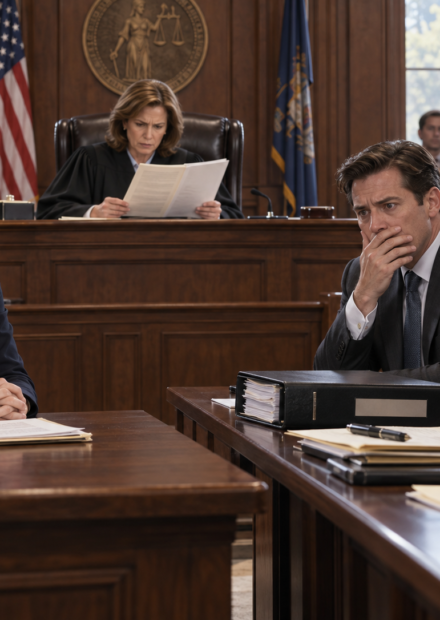
The courtroom deputy opened the door.
“Judge?”
I stood.
My shoulder protested.
I ignored it.
As I reached the bench, I saw movement through the glass panel in the rear courtroom door.
Two figures were standing in the public corridor.
David.
And Clara.
Clara was staring through the glass.
Her face was pale.
For the first time that morning, she was not smiling.
The deputy called the room to order.
I looked down at the next file.
And did not look at her again.