My Daughter-in-Law Shoved Me Outside Courtroom 4B. Then the Bailiff Said, “All Rise.
Chapter 1 – THE MARBLE WALL
My daughter-in-law shoved me into a marble wall outside Courtroom 4B while my only son stood three feet away and watched.
I was seventy years old.
My right shoulder struck first, hard enough to steal the breath from my lungs. The back of my head missed the stone by inches. My heel slipped on the polished courthouse floor, and for one frightening second I thought I was going down.
I caught myself with one hand against the wall.
Around us, conversations stopped.
A young clerk carrying a stack of folders froze near the courtroom doors. An attorney with a yellow legal pad lowered his pen. Two people waiting on a wooden bench turned toward us.
And the bailiff posted beside Courtroom 4B straightened.
Every one of them had seen what Clara had done.
But I barely noticed them.
I was looking at my son.
David stood no more than three feet away.
He had seen his wife step toward me.
He had seen her palm strike my shoulder.
He had watched me stumble backward.
And the first expression that crossed his face was not fear for me.
It was fear that someone important had seen it.
His gaze moved past my shoulder toward the courtroom doors, then toward the clerk, then toward the bailiff.
Only after that did he look at me.
That was the moment something inside me went quiet.
Not broken.
Not yet.
Just quiet.
There are pains the body understands immediately. A bruised shoulder. A twisted ankle. A cut.
The heart is slower.
Sometimes it takes years to understand what has been happening to it.
Sometimes it understands all at once.
That morning, mine finally did.
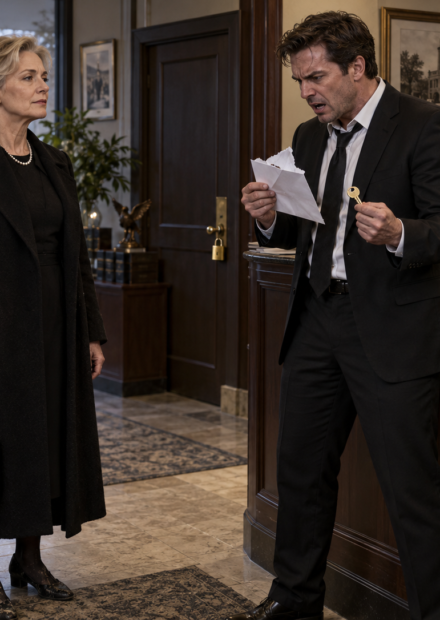
Clara stood in front of me in a fitted navy dress that probably cost more than my first car.
Her blond hair was pinned neatly at the back of her head. A diamond bracelet flashed beneath the courthouse lights every time she moved her hand.
She looked immaculate.
Controlled.
Expensive.
And furious.
“You need to stop doing this,” she hissed.
I pressed my left hand against my shoulder.
“Doing what?”
“Appearing.”
For a moment, I honestly thought I had misheard her.
“Appearing?”
“In places where you know you are going to make things awkward.”
I looked at David again.
His tie was the dark burgundy one Clara liked. His briefcase stood beside his leg. His hair had begun thinning slightly at the temples, something I had noticed the previous Christmas but had never mentioned.
At forty-two, he looked more and more like his father.
That resemblance had once comforted me.
That morning, it hurt.
“I came over to say good morning to my son,” I said.
Clara gave a short laugh.
There was no amusement in it.
“That is exactly what I mean.”
The corridor remained strangely quiet around us.
People were pretending not to listen.
Courthouse people become very skilled at pretending.
I knew.
I had spent more than half my life among them.
I had learned long ago that in a courthouse, very little went unnoticed. The janitor knew which lawyer cried in the restroom after losing custody cases. The clerks knew who lied about being stuck in traffic. Bailiffs knew which attorneys treated receptionists badly when no judge was watching.
And everyone knew how to look away while seeing everything.
Clara glanced down at my clothes.
I wore a charcoal wool coat I had owned for nearly fifteen years.
It was clean.
Pressed.
Warm.
Underneath it I had on a simple cream blouse, dark trousers and sensible black shoes.
There was nothing remarkable about any of it.
That, apparently, was the problem.
“Look at you,” Clara said.
I looked down at myself.
Then back at her.
“There is nothing wrong with my clothes.”
“That’s not the point.”
“Then what is the point?”
She exhaled through her nose.
“You make everything uncomfortable.”
That was one of Clara’s favorite words.
Uncomfortable.
Not cruel.
Not humiliating.
Not selfish.
Not wrong.
Uncomfortable.
It allowed her to turn other people’s pain into a problem of atmosphere.
“You know how important today is,” she continued.
“I know you have a hearing.”
“Not me. My family.”
Her correction came quickly.
The Ashcrofts had always spoken about family as if it were both a corporation and a country.
They owned commercial properties, investment companies and a collection of homes in places I had only seen in magazines. Clara’s father had spent decades building the family businesses. Her brothers controlled most of the operations now.
The dispute scheduled that morning involved one of their companies and an emergency petition that had already generated several weeks of quiet panic.
David was part of their legal team.
He had been preparing for it for days.
Apparently my standing in the same hallway had become a threat to that preparation.
“I am aware,” I said.
“Then why are you here?”
“I told you. I have business in the courthouse.”
Clara’s mouth tightened.
“What business?”
“That is my concern.”
She looked at David.
“Do you hear this?”
David rubbed one thumb over the handle of his briefcase.
“Clara.”
That was all he said.
Just her name.
Softly.
Not stop.
Not don’t speak to my mother that way.
Not she has every right to be here.
Just Clara.
I had spent years learning the difference.
When David was a boy, he had been incapable of remaining silent when someone was treated unfairly.
At eight, he had come home from school furious because another child had been blamed for throwing a milk carton when David had seen someone else do it.
At twelve, he had stood between a smaller boy and two older teenagers on the playground despite being terrified.
At seventeen, he had once told me he wanted to become a lawyer because words mattered most when somebody had less power than everyone else in the room.
I had believed him.
More than that, I had built parts of my life around believing him.
His father died when David was young.
Afterward, there were years when I could measure our finances by what I did not buy.
No new winter coat.
No vacation.
No proper dining table.
No replacement for the old washing machine until the repairman finally told me, almost apologetically, that it could no longer be saved.
When David was accepted to law school, I cried at the kitchen counter after he went to bed.
Not because I was sad.
Because I knew exactly what it was going to cost.
And I knew we would find a way.
We always had.
I worked.
He worked.
We borrowed carefully.
I sold a few things I had thought I would keep forever.
None of it felt like sacrifice at the time.
That is something no one tells mothers.
Love does not feel like sacrifice while you are giving it.
It only begins to feel that way if the person who received it later decides your existence has become inconvenient.
Clara crossed her arms.
“I don’t know why you insist on pretending you don’t understand,” she said.
“I understand perfectly.”
“No, you don’t.”
“Then explain it.”
David looked toward the courtroom doors again.
“Mom,” he said quietly.
I turned to him.
“Yes?”
His jaw tightened.
“We really don’t need this right now.”
There it was.
Not she.
This.
I had become an event.
A disturbance.
Something occurring to them.
I studied his face.
“You think I caused this?”
He didn’t answer.
Clara did.
“You always do this.”
“Do what?”
“Make everything about yourself.”
“I walked over and said good morning.”
“You appeared when David is trying to focus on one of the most important hearings of his career.”
“I did not know saying good morning required advance permission.”
Clara’s cheeks reddened.
“See? That tone.”
“What tone?”
“That wounded, innocent tone you use whenever anyone expects you to respect boundaries.”
I almost laughed.
It would have been easier if she were shouting.
Clara rarely shouted.
She preferred the controlled cruelty of someone who believed being well dressed made her reasonable.
“What boundary have I crossed?” I asked.
“You refuse to accept that David has another life now.”
I felt something cold settle in my stomach.
“He has had another life for twenty years. That is what children are supposed to have.”
“You know exactly what I mean.”
“I am beginning to.”
Her eyes hardened.
“Then leave.”
The word landed between us.
I looked at David.
He lowered his eyes.
That was when I asked the only question that mattered.
“Is that what you want?”
David raised his head.
Our eyes met.
For one second I saw uncertainty.
Then shame.
Then something softer.
Something that belonged to the boy he had once been.
I thought he was going to speak.
Clara said, “David.”
Just his name.
One word.
But I watched his face close.
Whatever courage had almost reached the surface disappeared.
“Mom,” he said, “today is complicated.”
I nodded slowly.
“I see.”
Clara stepped closer.
“No, I don’t think you do.”
I turned to her.
“I will leave when I am ready.”
The words were calm.
That seemed to anger her more than shouting would have.
Her eyes flashed.
Then her hand came up.
I did not expect it.
Not because she had never been cruel.
She had.
But cruelty usually remained safely inside words.
Her palm struck high on my shoulder.
Hard.
There was enough force behind it to move me.
My heel slid.
My back hit marble.
Pain exploded down my arm.
Someone gasped.
The bailiff moved away from the courtroom doors.
Clara stared at me.
She did not look shocked by what she had done.
She looked offended that I was still standing.
“You filthy old woman,” she said under her breath. “You are an embarrassment to this family.”
The insult hurt less than the shove.
My son’s silence hurt more than both.
“Ma’am.”
The bailiff’s voice cut through the corridor.
Clara turned.
He was a broad-shouldered man in his late forties whom I recognized immediately.
Marcus Hale.
We had worked in the same building years earlier.
He had put on weight around the middle and grown gray at the temples, but his eyes were the same.
Sharp.
Patient.
He looked at Clara first.
Then at me.
Recognition flickered across his face.
He did not say my name.
Not yet.
“Did you just put your hands on her?”
Clara’s expression changed instantly.
Her chin lifted.
“It was a family matter.”
Marcus came closer.
“Putting your hands on someone inside a courthouse is not just a family matter.”
“She was provoking me.”
“I watched the interaction.”
“She wouldn’t leave us alone.”
“So did I,” said the woman with the legal pad.
Clara looked at her.
The woman’s eyebrows rose.
“I saw the whole thing.”
“So did I,” the clerk said.
David shut his eyes briefly.
Not from concern for me.
From disaster management.
I knew that expression too.
Clara turned toward him and lowered her voice.
“Get rid of her.”
She probably believed no one else could hear.
But court corridors carried whispers better than people realized.
David looked at his wife.
Then at me.
I waited.
I waited for him to say no.
I waited for him to ask whether my shoulder was injured.
I waited for him to tell Clara that she had crossed a line that could never be uncrossed.
I waited for one sentence.
Any sentence that sounded like a son.
Instead he stepped toward me.
“Mom.”
I said nothing.
His voice dropped.
“Maybe you should wait downstairs.”
I stared at him.
There are moments when your heart does not shatter loudly.
There is no dramatic crack.
No collapse.
No music.
It simply understands something it has spent years trying not to know.
I had explained away so much.
The dinners to which I was no longer invited because they were “business dinners.”
The holidays shortened because Clara’s family had “traditions.”
The birthday calls David made from his car instead of coming by.
The Christmas when my invitation somehow disappeared until December twenty-third.
The way he had begun saying, “You know how Clara is,” as though her cruelty were weather.
The way I kept accepting scraps of him because he was my only child and I was afraid that demanding dignity would cost me even those scraps.
Now he had watched his wife shove me into a wall.
And he wanted me to leave so their morning could proceed without embarrassment.
I nodded.
“Of course.”
Clara smiled.
Not broadly.
Just enough.
She thought she had won.
I pushed away from the marble wall.
Marcus spoke.
“Ma’am, I need to—”
“I’m all right,” I told him.
My shoulder was not all right, but that was not what I meant.
His eyes stayed on mine.
There was a pause.
Then he nodded once.
I walked away.
I could feel people watching me.
My shoulder throbbed with every step.
At the far end of the corridor, I finally looked back.
Clara was speaking rapidly to David.
David stood with one hand pressed against his forehead.
Marcus was talking into his radio.
And the clerk beside Courtroom 4B was staring at me.
Her name was Sofia Ramirez.
She had transferred into the courthouse two years earlier.
I had met her twice.
Her eyes widened.
Recognition.
Marcus saw it too.
Something about his posture changed.
David did not notice.
Neither did Clara.
I reached the intersection where the public hallway turned toward the elevators.
I could have gone downstairs.
I could have gone home.
For one irrational second, part of me wanted to.
I was tired.
Tired of being dignified.
Tired of explaining people’s cruelty to myself.
Tired of pretending love required endless patience.
But I had not come to the courthouse for David.
I had told the truth about that.
I had business there.
So I did not turn toward the elevators.
Instead I walked past them.
Beside the records office was a narrow gray door with no public sign.
I removed the access card from my handbag and touched it to the reader.
The light turned green.
The lock clicked.
I stepped through.
The door closed behind me.
And the public courthouse disappeared.
The private corridor on the other side smelled faintly of paper, old wood and coffee.
A cart of case files stood against one wall.
Framed photographs of retired judges hung beneath muted lights.
I had taken only three steps when Lila Brennan rounded the corner carrying a stack of files.
She looked up.
Stopped.
“Judge Warren?”
I said nothing.
Her eyes dropped to the hand I was holding against my shoulder.
“What happened?”
I leaned against the wall.
“My daughter-in-law shoved me.”
Lila’s face went completely still.
Then, within seconds, it moved through concern, disbelief and fury.
“She did what?”
“Outside 4B.”
“Inside this building?”
“Yes.”
“Where was security?”
“Watching.”
Her mouth fell open.
“Where is David?”
“Watching too.”
That silenced her.
Lila had been my judicial assistant for eleven years before I retired from full-time service.
When I agreed to return periodically as a senior judge, she had agreed to work the assignment calendar with me whenever possible.
She knew David.
She knew what he had once been to me.
And she knew enough about what he had become not to ask whether I was joking.
She carefully set the files on a side table.
“I’m calling security.”
“They already know.”
“I’m calling Chief Judge Bell.”
“Lila.”
“And medical.”
“Lila.”
She folded her arms.
“You are seventy years old.”
“I am aware.”
“You were shoved into a marble wall.”
“I was present for that too.”
She gave me a look.
I almost smiled.
Almost.
Then her expression changed.
“Oh.”
“What?”
She looked toward the stack of files she had put down.
I saw it before she said anything.
Something was wrong.
“What happened?”
“Judge Lawson was admitted to the hospital during the night.”
My irritation vanished.
“What?”
“Chest pain. His daughter called chambers early this morning. He’s stable, but they’re keeping him for observation.”
“Thank God.”
“Yes.”
I glanced at the files.
“And his emergency calendar?”
“Reassigned.”
“To whom?”
Lila did not answer.
She did not need to.
I closed my eyes.
“To me.”
“You were the only senior judge already in the building with authorization to take it.”
I opened my eyes again.
Lila touched the top file.
“There is something else.”
She lifted it.
Even before I read the label, something inside me knew.
ASHCROFT HOLDINGS — EMERGENCY PETITION.
Below it was counsel information.
DAVID WARREN.
My son’s name.
For several seconds neither of us spoke.
The throbbing in my shoulder seemed to move deeper.
Lila finally said, “Obviously, we contact the chief judge.”
“Yes.”
“And you recuse.”
“Immediately.”
“You don’t have to take any calendar today.”
“The other litigants have nothing to do with my family.”
“You were just assaulted.”
“Allegedly.”
She stared at me.
“Do not become a lawyer with me right now.”
“I was a lawyer long before I was a judge.”
“And you are currently an injured person who is making jokes because she does not want me to notice she is shaking.”
I looked down.
My fingers were trembling.
I closed them.
Lila’s anger disappeared.
She stepped closer.
“Eleanor.”
She used my first name only when we were alone and only when she was worried.
“You do not have to prove anything today.”
I looked at the file containing my son’s name.
Then at the others beneath it.
A domestic violence protection application.
A temporary guardianship motion.
An emergency request involving a child’s medical treatment.
People whose lives had already become complicated before sunrise.
They did not deserve to lose their judge because my son had lost his courage.
“I’m not proving anything,” I said.
“Then what are you doing?”
“My job.”
I picked up the Ashcroft file and handed it back to her.
“Prepare the recusal order. Relationship to counsel. No additional explanation.”
Lila nodded.
“And the hallway?”
“Security handles the hallway.”
“You are not going to interfere?”
“No.”
“You’re not going to call the district attorney?”
“No.”
“You’re not going to ask anyone for favors?”
“No.”
She studied me.
“Good.”
I raised an eyebrow.
“Did you think I would?”
“No.”
She gathered the files.
“But I wanted to hear you say it, because someday when I am telling this story at your funeral, I intend to make you sound extremely noble.”
“That is comforting.”
“I’m still calling medical.”
“Fine.”
“And Chief Judge Bell.”
“Yes.”
“And if they tell you to go home?”
I looked toward my chambers.
For five years after retiring from full-time service, I had kept one old coat in the wooden cabinet there.
Behind it hung something else.
I crossed the room.
Opened the cabinet.
Removed the charcoal coat I had worn through the public corridor.
Behind it hung my black judicial robe.
Lila watched me.
“Are you sure?”
I touched the sleeve.
The fabric was heavier than most people expected.
So was everything it represented.
“No,” I said.
Then I lifted it from the hanger.
“But I am ready.”
And somewhere beyond the private corridor, a courtroom bell rang.