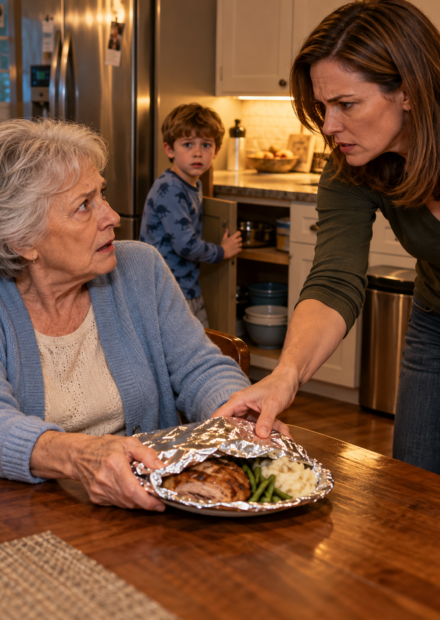






















MY SON ASKED ME TO TELL THE POLICE I HAD BEEN DRIVING THE CAR
Chapter 1 – The Favor
My son asked me to tell the police I had been driving the car.
He said it the way he used to ask me to sign permission slips when he was fifteen.
Calmly.
Almost casually.
As if what he was asking required nothing more from me than a pen.
“Mom, listen,” Daniel said, leaning across my kitchen table. “Nobody got seriously hurt. The car is insured. You’re already on the policy. We just need you to say you were driving.”
For several seconds, I thought I had misunderstood him.
The clock above the refrigerator ticked.
Outside, rain tapped softly against the window over the sink.
My coffee had gone cold between my hands.
“What?”
Daniel sighed.
Not nervously.
Impatiently.
That hurt more than anything.
My son was forty-four years old. He wore a gray wool coat over an expensive blue shirt, and his hair was combed neatly despite the weather. He looked exactly like the successful man I had bragged about for years.
My Daniel.
Regional sales director.
Beautiful house.
Beautiful wife.
Two beautiful children.
A son headed for college.
A daughter who still hugged me when she saw me.
I had spent half my life believing I had raised a good man.
That morning, sitting across from him in my little kitchen, I began to wonder if I had mistaken success for goodness.
“Tyler was driving,” I said.
“I know.”
“He hit another car.”
“A parked car.”
“And a woman was standing beside it.”
“She bruised her hip.”
“She went to the hospital.”
“She walked into the ambulance.”
I stared at him.
Daniel rubbed both palms down his face.
“Mom, please don’t make this dramatic.”
There it was.
The sentence people use when they want your conscience to become an inconvenience.
I put down my coffee.
“Tell me exactly what happened.”
“You already know.”
“I know what Melissa told me last night. I want to hear it from you.”
His jaw tightened.
For a moment I saw the boy he had been whenever I caught him lying—eyes sliding away, lips pressing together, shoulders becoming rigid.
Then he looked toward the window.
“Tyler took the SUV.”
“Without permission?”
Daniel paused.
“Technically.”
“That means yes.”
“He has his permit.”
“He’s supposed to have a licensed adult in the car.”
“I know that.”
“Was there one?”
“No.”
“Then why was he driving?”
Daniel pushed back from the table.
“Because he’s seventeen, Mom. Because seventeen-year-olds do stupid things.”
I waited.
He finally added, “He wanted to meet some friends.”
“At eleven-thirty at night?”
“He wasn’t drinking.”
“You know that?”
“Yes.”
“You were there?”
“No, but Tyler told me.”
I nearly laughed.
Not because anything was funny.
Because Daniel had said Tyler told me as though the boy’s word were sacred scripture.
Tyler had been protected from consequences since kindergarten.
If he forgot his homework, Melissa drove back to school to deliver it.
If he failed a test, the teacher was unfair.
If he got benched for missing soccer practice, the coach had a personal problem with him.
When he was thirteen and broke a neighbor’s window throwing rocks with two other boys, Daniel paid for the glass before sunset and told everyone there was “no point turning a childish mistake into a federal case.”
When Tyler was sixteen and was caught cheating on a chemistry exam, Melissa cried harder than he did.
Not because he had cheated.
Because it might affect his academic record.
Every mistake Tyler made became something the adults around him rushed to erase.
I had noticed it.
I had even complained.
But I had never called it what it was.
Worship.
Tyler was their golden child.
Their proof that they had done everything right.
Their handsome, athletic, college-bound son whose future had to remain spotless even if everyone else had to get dirty protecting it.
Daniel leaned toward me again.
“The police came to the house last night.”
My stomach tightened.
“Why?”
“Because the SUV’s license plate fell off at the scene.”
I stared at him.
“He left?”
“Mom—”
“Tyler left the scene?”
“He panicked.”
I stood so quickly my chair scraped across the floor.
“You told me it was an accident.”
“It was.”
“You didn’t tell me he drove away.”
“He pulled over around the corner first.”
“That is not what you said.”
“The woman was already with people. Someone had called 911. Tyler got scared.”
“So he ran.”
Daniel’s face hardened.
“He made a bad decision.”
“He made several bad decisions.”
“That doesn’t mean his life should be ruined.”
There it was again.
His life.
His future.
His record.
Everything was about what might happen to Tyler.
Not the woman whose hip had been bruised.
Not the owner of the damaged car.
Not whoever paid the insurance.
And certainly not me.
“What exactly do you want me to tell the police?” I asked.
Daniel answered too quickly.
“That you borrowed the SUV last night.”
“And?”
“You were driving back from the pharmacy.”
“At eleven-thirty?”
“The twenty-four-hour one on Keller Avenue.”
I folded my arms.
“You’ve planned this.”
“Mom.”
“You have.”
He looked down.
That told me everything.
“You want me to say I hit the parked car.”
“You got confused in the rain.”
“I got confused.”
“The visibility was bad.”
“And then I drove away?”
“You didn’t realize the damage was serious.”
I stared at my son until his eyes finally lifted to mine.
“You want me to confess to leaving the scene of an accident.”
He exhaled sharply.
“Stop saying confess.”
“What word would you prefer?”
“Nobody is going to prosecute a sixty-eight-year-old grandmother over a dented car and a bruised hip.”
I felt something cold move through me.
Not fear.
Not yet.
Recognition.
Daniel had already calculated the cost.
My age.
My reputation.
My insurance.
My clean driving record.
My usefulness.
He had taken all the pieces of my life and placed them on one side of a scale.
On the other side, he had placed Tyler’s future.
And he had decided mine weighed less.
“Mama,” he said softly.
He had not called me Mama in years.
The manipulation was so obvious that it made my chest hurt.
“This could affect Tyler’s college applications. You know he’s waiting to hear from Brighton. If there’s a police report connected to reckless driving or leaving the scene…”
“He did leave the scene.”
“He panicked.”
“You keep saying that like panic erases choices.”
“He’s a kid.”
“He’s seventeen.”
“Exactly.”
I shook my head.
“No, Daniel. Exactly means he’s old enough to understand that when you hit someone, you stop.”
“He didn’t hit her directly.”
“He hit the car she was standing beside.”
“That distinction matters legally.”
I stared at him.
My son had come prepared.
He had probably searched penalties before coming to see me.
Perhaps he had already spoken to someone.
Maybe Melissa had sat beside him on their leather sectional last night while they worked out how to transfer their son’s mistake onto his grandmother.
The thought made me sick.
I went to the sink and gripped the counter.
For years, I had been useful to that family.
When Tyler was born, I took three weeks off work because Melissa’s mother lived across the country.
When Sophie came five years later, I practically moved into their house.
I cooked.
I babysat.
I drove children to soccer, piano lessons, dentist appointments, birthday parties.
When Daniel changed jobs and traveled every week, I filled the gaps.
When Melissa’s father died, I stayed with the children while they flew to Arizona.
When Tyler needed braces, I quietly paid the portion insurance did not cover because Daniel had just bought the bigger house and money was “temporarily tight.”
When Sophie had pneumonia at nine, I spent three nights in a hospital chair because Daniel and Melissa were exhausted.
I never kept score.
Mothers are not supposed to keep score.
Grandmothers least of all.
But standing at that sink, I suddenly remembered every favor.
Not because I regretted them.
Because my son had apparently mistaken love for a resource he could withdraw from whenever he needed something.
“What did the police ask you?” I said.
Daniel hesitated.
“Who had been driving.”
“What did you tell them?”
“That I needed to speak with my family first.”
My hands went cold.
“You mentioned me?”
“No.”
“Did you tell them Tyler was home?”
“He was home when they arrived.”
“And?”
“He went upstairs.”
“You let him hide upstairs?”
Daniel shot me an irritated look.
“He was shaken.”
“He should be shaken.”
“You’re his grandmother.”
“Yes.”
“Then act like it.”
The words struck harder than he intended.
Or perhaps exactly as hard as he intended.
I turned slowly.
“What does that mean?”
“It means you’re supposed to care about him.”
“I care enough not to teach him that somebody else will always take the punishment.”
“You’re making this philosophical.”
“No. You made it practical. You came here with a script.”
He stood.
“This is exactly why Melissa didn’t want me to ask you.”
“Then why did you?”
“Because I told her you’d understand.”
I almost smiled.
“How generous.”
“Mom, come on.”
“No.”
The word was quiet.
Daniel stopped.
“What?”
“No.”
His face changed.
Not much.
But enough.
He had expected questions.
He had expected resistance.
He had not expected refusal.
“Think about it,” he said.
“I have.”
“You’ve been thinking for ten minutes.”
“I’ve been your mother for forty-four years.”
“That has nothing to do with this.”
“It has everything to do with this.”
He reached for his coat.
“Fine.”
For a second, relief loosened my shoulders.
Then he added, “We’ll talk tonight with Melissa.”
“We don’t need to.”
“Mom.”
“My answer will still be no.”
His hand tightened around the coat.
“I’m asking you not to decide while you’re emotional.”
I looked at him.
“You came to my house before breakfast and asked me to lie to the police.”
His eyes narrowed.
“And you think I’m the emotional one?”
He walked out without saying goodbye.
I stood in the kitchen listening to his car pull away.
Only after it disappeared did I realize my hands were shaking.
I told myself that was the end of it.
I was wrong.
At two that afternoon, Melissa called.
She did not ask how I was.
“Daniel says you’re upset.”
“I’m not upset.”
“All right.”
“I’m horrified.”
Silence.
Then a tiny sigh.
Melissa had perfected that sigh during twenty-one years of marriage to my son. It meant she believed someone else was being unreasonable and she had been burdened with the exhausting responsibility of handling them.
“Evelyn,” she said, “we’re all horrified.”
“No, we’re not.”
“What does that mean?”
“If we were all horrified, Tyler would be at the police station telling the truth.”
“He is a minor.”
“He’s seventeen, Melissa.”
“And seventeen is legally a minor.”
“Not old enough to tell the truth?”
“Please don’t twist my words.”
“I don’t have to.”
Her voice sharpened.
“This could change the entire direction of his life.”
“So could believing he can run away from every consequence.”
“You’ve never had a child applying to competitive universities.”
For a moment, I could not speak.
Then I laughed.
I actually laughed.
“Melissa, where do you think Daniel came from?”
“That isn’t what I meant.”
“I know exactly what you meant.”
“Tyler has worked for years.”
“So have lots of children.”
“He’s top twelve percent of his class.”
“Then maybe he should know the difference between right and wrong.”
“That’s cruel.”
“No. Cruel would be letting him become a man who thinks his grandmother is disposable.”
She went silent.
Then she said, very softly, “Nobody said you were disposable.”
“You want to hand my name to the police because it is safer than handing them his.”
“You have nothing to lose.”
My breath stopped.
Melissa realized what she had said only after the words were out.
I heard it in the silence.
Then she rushed to fix it.
“I mean professionally.”
I said nothing.
“You’re retired,” she continued. “You don’t have a career that could be affected. You aren’t applying to colleges. You have a perfect record. They’ll probably give you a fine.”
Probably.
There are few uglier words when someone else is gambling with your life.
“What about my insurance?”
“We’ll pay.”
“What about my license?”
“We’ll drive you.”
“What about lying to the police?”
“Daniel looked into it.”
My stomach turned.
“He looked into lying?”
“I mean he looked at the likely consequences.”
“And?”
“It’s complicated.”
“Complicated for whom?”
Another sigh.
Then her voice changed.
Not softer.
Colder.
“You know, Evelyn, Tyler adores you.”
I felt the threat before she finished.
“So does Sophie.”
I gripped the phone.
“What are you saying?”
“I’m saying families help each other.”
“Say what you mean.”
“I’m saying things like this affect relationships.”
“Melissa.”
“If Tyler believes his grandmother chose the police over him—”
“I’m not choosing the police over him.”
“That is how he’ll see it.”
“Because you’ll tell him to see it that way.”
“That’s unfair.”
“Is it?”
A pause.
Then she said the words that changed something in me permanently.
“I don’t know how comfortable I would feel having the children spend time with someone who refused to protect them when it mattered.”
The kitchen seemed to tilt.
I sat down.
“You’re threatening to keep my grandchildren from me.”
“I’m not threatening anything.”
“You just did.”
“I’m telling you actions have consequences.”
I closed my eyes.
The cruelty of the phrase almost impressed me.
Actions have consequences.
Exactly.
Just not Tyler’s actions.
Never Tyler’s.
Mine.
Yours.
Anyone else’s.
But not his.
When I opened my eyes, rain was still crawling down the window.
“All right,” I said.
Melissa’s voice brightened slightly.
“All right what?”
“All right. Now I understand.”
“Understand what?”
“That this isn’t a favor.”
She said nothing.
“It’s extortion.”
“Evelyn—”
I ended the call.
My phone rang again immediately.
I turned it face down.
Then it rang again.
And again.
When it finally stopped, a message appeared.
DANIEL: We need to discuss this as a family.
Two minutes later:
DANIEL: Please don’t make decisions that hurt everyone.
Then:
DANIEL: Tyler is terrified.
I stared at that last message.
A memory came to me.
Tyler at six years old, standing on my porch with chocolate around his mouth after denying he had taken cookies from the kitchen.
I had crouched in front of him.
“Everybody makes mistakes,” I told him. “But a mistake becomes something worse when you lie about it.”
He had started crying.
Then he confessed.
I hugged him.
That evening we baked another batch together.
For years I had remembered it as a sweet story.
Now I wondered when everyone had stopped teaching him that lesson.
My phone buzzed again.
This time the message was from Tyler.
GRANDMA PLEASE.
That was all.
I read it three times.
Then I typed:
Tell the truth.
I watched the little status beneath the message.
Delivered.
Then read.
No reply came.
But five minutes later, Daniel called again.
And this time, when I answered, he did not sound like my son.
He sounded like a man whose plan was beginning to fail.
“Mom,” he said, “you need to stop messaging Tyler.”
“Why?”
“Because you’re upsetting him.”
“He contacted me.”
“He’s already overwhelmed.”
“He asked me to protect him.”
“He asked for help.”
“No. He asked me to lie.”
Daniel went silent.
Then he said, “Come over tonight. Seven o’clock.”
“I’m not sure that’s a good idea.”
“It’s not optional anymore.”
I almost asked him what he meant.
Then he hung up.
I sat alone in my kitchen for a long time.
At six forty-five, I put on my coat.
Not because Daniel had ordered me to come.
Because I suddenly understood something.
If I stayed home, they would keep calling.
They would each tell me a different version of the same lie until I began to doubt myself.
So I decided to go.
I would hear them once.
All of them.
Then I would give them my answer.
I just did not know yet how much that answer was going to cost me.