





















THEY CHANGED THE LOCKS WHILE I WAS VISITING MY SISTER—BUT THEY DIDN’T KNOW WHOSE HOUSE IT REALLY WAS
Chapter 1 – The Key That Wouldn’t Turn
The first time I understood that my son wanted me gone, my key stopped working in my own front door.
I stood on the porch with my overnight bag at my feet, one hand wrapped around the brass key I had used for twenty-three years, and tried it again.
It slid into the lock.
It simply would not turn.
For a few seconds, I thought I was doing something wrong.
At seventy-two, you become painfully aware that other people are waiting for you to make mistakes.
You forget a name, and someone exchanges a look.
You leave the stove light on, and suddenly everybody is discussing whether you should still be living alone.
You misplace your reading glasses, and people begin saying things like, “Maybe we need to start thinking about the future.”
So when the key didn’t turn, my first thought was not betrayal.
My first thought was me.
I took it out, wiped it against my coat, and tried again.
Nothing.
I shifted my overnight bag with my shoe and leaned closer to the lock.
The brass was new.
That was when I noticed.
My old deadbolt had a thin scratch beneath the keyhole from the time my late husband, Frank, tried to replace the weather stripping and slipped with a screwdriver.
This lock had no scratch.
It was smooth.
Bright.
New.
I stared at it.
Then I looked at the doorknob.
That lock was new too.
For a moment, I heard nothing except the rustling of the maple tree beside the driveway.
My son Daniel’s SUV was parked at the curb.
His wife Melissa’s car was in the driveway.
The curtains were open.
The porch light was on.
Someone was home.
I rang the bell.
No answer.
I rang it again.
“Daniel?”
I knocked.
“Daniel, honey? It’s me.”
Nothing.
I stepped back and looked at the upstairs windows.
The house sat exactly as it had when I left three days earlier to visit my older sister, Ruth, two towns over.
The flowerpots I had planted in May were still arranged along the porch railing.
The little wooden cardinal Frank had carved was still nailed beneath the mailbox.
My rocking chair sat in its corner.
Everything looked normal.
Except I couldn’t get inside.
I knocked harder.
“Daniel!”
This time I heard footsteps.
Not approaching quickly.
Not surprised.
Slow footsteps.
Measured footsteps.
Someone who had heard me the first time.
The curtain beside the front door shifted.
Then Melissa appeared behind the glass.
My daughter-in-law did not open the door.
She stood on the other side of it.
Looking at me.
I remember that detail more clearly than anything else.
She didn’t look shocked to see me.
She didn’t look confused.
She looked prepared.
“Melissa,” I said through the door. “The lock is broken.”
Her expression barely changed.
“It isn’t broken.”
I waited.
Maybe I had misheard her.
“What?”
“We changed it.”
I stared at her.
The wind caught the collar of my coat.
“You changed the locks?”
“Yes.”
“Why?”
She exhaled through her nose as if I were making a difficult conversation even more difficult by forcing her to explain the obvious.
Then she said the words I would hear again in my head for months.
“We thought it was time you found somewhere else.”
For a moment, I genuinely believed the world had tilted beneath me.
Not metaphorically.
My balance shifted.
I put one hand against the brick beside the door.
“You thought what?”
Melissa folded her arms.
“Eleanor, this arrangement hasn’t been working.”
“This arrangement?”
She looked over her shoulder.
I followed her gaze through the glass.
Behind her, I could see the edge of my hallway table.
Frank’s framed photograph used to sit there.
It was gone.
“Where’s Daniel?”
“He doesn’t want this to turn into a scene.”
That hurt even more than the locked door.
“He doesn’t want a scene?”
“He thought it would be easier if I explained.”
“Then open the door and explain it.”
“I don’t think that’s a good idea.”
I looked at her through the glass.
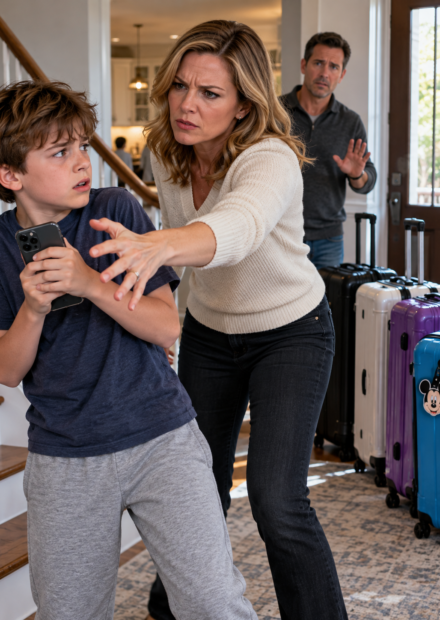
Eight years earlier, when Daniel had called me and said he and Melissa were struggling after the rent on their apartment went up, I had opened this same door and told them they could stay with me until they got back on their feet.
I had cleared Frank’s old study for them.
I had given them half the closet in the upstairs hall.
When they had their daughter, Lily, I transformed the little sewing room into a nursery.
Six months became a year.
A year became three.
Then five.
Then eight.
There were always reasons.
Daniel’s hours got cut.
Melissa changed jobs.
Daycare was expensive.
They needed time to save for a down payment.
The housing market was terrible.
Interest rates were too high.
They almost had enough.
Something always happened.
And every time they apologized for staying longer, I said the same thing.
“You’re family. We’ll figure it out.”
Apparently, they had figured it out.
Just not the way I expected.
“Where are my things?” I asked.
Melissa shifted her weight.
“Most of them are still here.”
“Most?”
“We packed some essentials.”
“Packed them where?”
“Garage.”
Something cold moved through me.
Not anger yet.
Anger would come later.
This was something quieter.
The sensation of discovering that people you loved had held meetings about you while you were making them dinner.
I looked beyond Melissa.
“Daniel,” I called.
A shadow moved near the staircase.
My son stepped into view.
He was forty-four years old, but for one terrible second I saw the boy who used to run into my kitchen with scraped knees.
I saw the child who used to fall asleep in Frank’s recliner with his head tipped backward.
I saw him at twelve, furious because another boy had called him stupid.
I saw him at twenty-one, standing beside me at his father’s hospital bed.
Then the memories disappeared.
The man behind the door wouldn’t meet my eyes.
“Daniel.”
He looked at me finally.
“Mom.”
“Open the door.”
He rubbed one hand across the back of his neck.
“We should talk.”
“I am standing outside my house.”
“I know.”
“Then open the door.”
Melissa turned toward him.
He looked at her.
That little glance told me more than either of them had said.
They had rehearsed this.
Perhaps not the exact words, but the moment.
I had become a problem to be managed.
Daniel came closer but stopped several feet from the door.
“Mom, we’ve been trying to talk to you about this for months.”
“No. You’ve been hinting that I should move into one of those retirement communities Melissa keeps emailing me.”
“They’re not retirement homes.”
“I know what they are.”
“They have activities. Transportation. People your age.”
“People my age?”
I almost laughed.
Instead, my voice cracked.
“My friends are here.”
“You barely see anybody.”
“I see Mrs. Alvarez next door. I go to church. I meet Ruth every Tuesday when the weather is good. I have lived in this neighborhood for thirty-seven years.”
Daniel’s jaw tightened.
“We’re trying to think long-term.”
“For whom?”
He didn’t answer.
That was answer enough.
I looked past them again.
A cardboard box sat near the staircase.
Written across it in black marker was one word.
MOM.
I felt the blood drain from my face.
“You packed my things before I came home.”
Melissa stepped forward.
“Just what we thought you’d need immediately.”
“And where exactly did you expect me to go?”
Daniel finally came nearer.
“We thought you could stay with Aunt Ruth for a while.”
“You thought.”
“Until we found something.”
“We?”
“A senior apartment. Assisted living if necessary.”
“If necessary?”
“Mom, don’t twist everything.”
“I left here Friday morning to spend three nights with my sister. You used that time to change my locks and box up my clothes.”
“It wasn’t like that.”
I gave a short, disbelieving laugh.
“What was it like?”
Daniel looked irritated now.
That was almost easier to bear than the shame on his face.
“We can’t keep living this way.”
“What way?”
“You question everything.”
“I ask why the electric bill doubled.”
“You criticize Melissa.”
“I asked her not to put cast-iron pans in the dishwasher.”
“You come into our space.”
“Your space is upstairs in my house.”
Melissa’s face hardened.
“There. That. Exactly that.”
I turned toward her.
“What?”
“You always say ‘my house.’ Every disagreement ends with ‘my house.’”
“Because it is my house.”
Melissa glanced at Daniel.
This time he didn’t look away.
“We’ve paid for things here too.”
I looked at my son.
“What things?”
“Repairs. Groceries. Utilities.”
“You contribute to household expenses because four people live here.”
“I replaced the water heater.”
“After you flooded the old one trying to repair it yourself.”
“That’s not the point.”
“What is the point, Daniel?”
He pressed his lips together.
Then he said it.
“We’ve put years into this place too.”
Something about the sentence made the truth suddenly visible.
Not all of it.
Not yet.
But enough.
This was not an impulsive fight.
This was not Melissa getting angry and replacing a lock.
They believed they had a claim.
Perhaps Daniel had convinced himself that because he was my only child, the house would eventually belong to him anyway.
Maybe in his mind, the future had simply arrived ahead of schedule.
I looked at him for a long time.
“Did you change those locks?”
His silence lasted half a second too long.
“Yes.”
“Did you know she was going to tell me to find somewhere else?”
Another pause.
“Yes.”
That one hurt more.
I nodded slowly.
“Thank you.”
He frowned.
“For what?”
“For answering me.”
“Mom—”
“I needed to know.”
I bent down and picked up my overnight bag.
“Where are you going?”
I looked at him through the glass door.
“To find somewhere else.”
His face changed then.
Perhaps he expected yelling.
Perhaps tears.
Perhaps he expected me to beg.
I had cried plenty in my life.
When Frank died.
When my mother died.
When Daniel nearly failed his first year of college.
When Lily was born six weeks early and spent eleven days in the neonatal unit.
But I would not cry on that porch.
Not with my daughter-in-law watching me from inside my house.
Not while my son stood behind a lock he had bought to keep me out.
“Mom, wait.”
I turned away.
“Your suitcase is in the garage,” Melissa called.
I stopped.
The humiliation burned so hot that for a second I couldn’t breathe.
Then something inside me settled.
A strange calm.
“Keep it there tonight,” I said.
I walked toward my car.
Daniel opened the front door then.
The new deadbolt clicked.
“Mom.”
I heard him come onto the porch.
I did not turn around.
“Come on,” he said. “Don’t make this worse than it has to be.”
That sentence finally made me face him.
I looked at the son I had spent forty-four years loving.
“You locked a seventy-two-year-old woman out of her home while she was visiting her sister.”
His face went red.
“I didn’t say you’d be homeless.”
“No. You decided I could become somebody else’s responsibility.”
“That’s not fair.”
“Neither was changing the locks.”
“We were going to talk to you.”
“You did. From behind a locked door.”
Melissa remained in the doorway.
She put one hand on Daniel’s shoulder.
I watched him allow it.
Something in me broke.
But something else woke up.
I opened my car door.
Daniel took another step toward me.
“Mom, we need to handle this like adults.”
I almost smiled.
“You’re right.”
He seemed relieved.
Then I said, “Tomorrow morning, we will.”
I got into my car.
I drove three blocks before pulling over.
Only then did my hands begin shaking.
I gripped the steering wheel and tried to breathe.
My house.
Frank’s house.
The place where Daniel had learned to ride a bicycle.
The place where I had brought my husband home after his bypass surgery.
The kitchen where my granddaughter had smeared chocolate frosting over her entire face on her third birthday.
The bedroom where I had slept alone for nine years after Frank died.
They had locked me out.
I could still hear Melissa.
We thought it was time you found somewhere else.
I lowered my forehead to the steering wheel.
And cried.
I cried for exactly seven minutes.
I know because when I finally lifted my head, the clock on the dashboard said 5:42.
Then I wiped my eyes.
And I made one phone call.
Not to the police.
Not to Daniel.
Not even to Ruth.
I called my younger brother.
He answered on the fourth ring.
“Ellie?”
I swallowed.
“Thomas.”
One word.
That was all I managed.
His voice changed immediately.
“What happened?”
I looked back toward the street where my house stood hidden behind the trees.
“Daniel changed the locks.”
Silence.
Then, very quietly, my brother said, “He did what?”
“He and Melissa packed some of my things. They said I need to find somewhere else.”
Another silence.
This one felt different.
Thomas was six years younger than me.
He had always been the calmer one.
Even as children, I was the one who cried, argued, and slammed doors.
Thomas watched.
Listened.
Remembered.
When our father died, Thomas handled the paperwork.
When Frank became ill, Thomas sat beside me in hospital waiting rooms without filling the silence with useless promises.
And three years earlier, when I finally admitted that I was frightened about what would happen if I became sick or confused and Daniel started making decisions for me, Thomas helped me make a plan.
A legal plan.
One Daniel knew nothing about.
“Ellie,” Thomas said, “are you safe?”
“Yes.”
“Are you in your car?”
“Yes.”
“Go to Ruth’s.”
“I was going to.”
“Do not go back tonight.”
“I won’t.”
“Do not argue with Daniel by phone.”
“All right.”
“And don’t tell him anything.”
I closed my eyes.
“You mean about the trust.”
“Yes.”
I looked down the street again.
Three years earlier, with the help of an estate attorney, I had transferred the house into the Eleanor Whitmore Family Residence Trust.
I remained the beneficiary.
I retained the right to live there.
Thomas was the trustee.
Not Daniel.
The deed had been recorded.
The insurance had been updated.
The tax documents were handled through the trust.
Everything was legal.
Everything was deliberate.
Daniel assumed the house was still mine personally.
He assumed that someday, as my son, it would automatically become his.
He had never asked how my estate was structured.
And I had never volunteered the information.
At the time, keeping it private had seemed unnecessarily secretive.
Now I understood why my attorney had advised it.
“You think we should tell him tonight?” I asked.
“No.”
“Why?”
“Because I want him to sleep.”
Despite everything, I almost laughed.
“Thomas.”
“I’m serious.”
His voice became colder.
“I want him to wake up tomorrow believing he successfully threw the homeowner out of the house.”
“Technically, the trust owns it.”
“Exactly.”
I leaned back against the seat.
“He’s my son.”
“I know.”
“He’s your nephew.”
“I know that too.”
“I don’t want to destroy his life.”
“Then don’t.”
Thomas paused.
“But don’t let him destroy yours because you’re afraid of hurting his feelings.”
I stared through my windshield.
The trees blurred again.
“What are you going to do?”
“I’m going to call Margaret Levin.”
My attorney.
“Our attorney,” Thomas corrected.
I knew from his tone that he was already moving around his office.
Opening drawers.
Finding files.
“Thomas—”
“Go to Ruth’s. Eat something. Sleep if you can.”
“I don’t think I can.”
“Try.”
“What happens tomorrow?”
He was quiet for a moment.
Then he said, “Tomorrow, I come to the house with Margaret.”
I tightened my hand around the phone.
“And then?”
“Then your son learns whose lock he changed.”