




















SHE DRAGGED ME OUT OF THE VIP CHAIR—THEN THE AUCTIONEER CALLED MY NAME
Chapter 5 – WHAT MONEY COULD NOT BUY
By breakfast the next morning, my phone had thirty-seven missed calls.
I turned it off.
Then I made coffee.
There are moments when the world wants something from you before you have decided what you want from yourself.
That morning, I wanted toast.
So I made toast.
I sat in my kitchen wearing an old gray robe and stared at the small crack in the tile near the refrigerator that I had been meaning to repair for six years.
The house was quiet.
No crystal chandeliers.
No ballroom.
No applause.
Just the radiator knocking and a delivery truck groaning somewhere on the street.
I felt more like myself there than I had at any point the night before.
At nine thirty, someone knocked.
I knew who it was before I opened the door.
Daniel stood on the stoop holding two coffees.
“You turned off your phone.”
“Yes.”
“I thought you might.”
I stepped aside.
He entered.
For a moment, he looked around the hallway.
At the framed family photographs.
At the old wooden staircase.
At the stained-glass panel Olivia had once mocked.
His eyes stayed on it longer than usual.
“I always liked that thing,” he said.
“I know.”
We went to the kitchen.
He put one coffee in front of me.
“You already made some.”
“I can drink two.”
He smiled faintly.
Then his expression changed.
“The video is everywhere.”
I closed my eyes.
“Daniel.”
“I’m not asking you to do anything.”
I opened them.
That was progress.
He sat across from me.
“Olivia’s company called her this morning.”
I waited.
“They saw it.”
I said nothing.
“She works with clients who were at the event.”
“Yes.”
“They’ve asked her to take a few days away.”
I folded my hands.
Daniel looked almost as though he expected me to apologize.
I didn’t.
“What happens with her work is between Olivia and her employer.”
“I know.”
“Do you?”
He nodded.
“I think I’m starting to.”
I took a sip of coffee.
He stared into his cup.
“I stayed at the hotel.”
I did not ask whether he planned to return home.
After a moment, he continued.
“She called me until four.”
“Did you answer?”
“Twice.”
“What did you say?”
“That I needed time.”
I nodded.
“Good.”
He looked up.
“Mom, do you hate her?”
The question surprised me.
“No.”
“After everything?”
“Hating her would require more energy than I want to give her.”
He almost laughed.
Then I shook my head.
“I am angry. I’m hurt. And right now, I don’t trust her.”
“That sounds like hate.”
“It isn’t.”
I looked toward the window.
“People like Olivia think the opposite of love is hate.”
Daniel waited.
“Sometimes it’s distance.”
He absorbed that.
I continued.
“I don’t want revenge against your wife.”
“I know.”
“I want peace.”
He looked down.
“Real peace this time.”
“Yes.”
Not the old version.
Not the peace purchased by my silence.
Real peace has boundaries.
Real peace allows uncomfortable conversations.
Real peace does not require one person to disappear so another person can remain comfortable.
Daniel reached into his jacket.
“I brought you something.”
He placed a folded piece of paper on the table.
I didn’t touch it.
“What is it?”
“A letter from Olivia.”
“No.”
His face fell.
“Mom—”
“I’m not reading a letter you delivered.”
“She asked me—”
“That is exactly the problem.”
He stopped.
I pushed the paper back toward him.
“If Olivia wants to apologize, she can do it herself.”
He nodded slowly.
“You’re right.”
“Don’t become her messenger.”
“I’ve spent a lot of time doing that, haven’t I?”
“Yes.”
He tucked the letter away.
We sat quietly.
Then he asked something I had not expected.
“Why didn’t you ever tell her about the money?”
I smiled.
“You make it sound like I had a secret vault under the stairs.”
“You know what I mean.”
“I didn’t hide it.”
“Mom, she thought you were practically broke.”
“That was her invention.”
Daniel considered that.
“I suppose it was.”
“I never told Olivia I didn’t have money. She saw my coat, my house, my habits, and decided what they meant.”
“Why didn’t you correct her?”
“Why should I?”
He opened his mouth.
Then closed it.
Exactly.
I leaned back.
“If someone only respects me after seeing my bank statement, what exactly have I gained by showing it?”
Daniel looked toward the table.
Nothing.
We both knew it.
The most painful part of the auction was not discovering Olivia respected wealth.
I already knew that.
The painful part was seeing how quickly respect appeared once she believed I possessed it.
There are compliments that insult you more deeply than criticism.
Two days later, a florist delivered six dozen white roses.
No card.
I knew.
I sent them to the neighborhood nursing home.
The next day, another arrangement arrived.
Orchids.
This one had a card.
I’m sorry.
Olivia.
I sent the orchids to the foundation office.
On Sunday afternoon, Olivia came herself.
I saw her through the front window.
She wore jeans.
A black sweater.
No makeup that I could see.
She looked younger.
Smaller.
Human.
For several seconds, I stood in the hallway deciding whether to open the door.
Then I did.
“Hello, Olivia.”
“Hi.”
She held no flowers.
No gift.
That helped.
“Is Daniel here?”
“No.”
“I know.”
I waited.
“I asked him not to come.”
That helped too.
“May I talk to you?”
I considered saying no.
Then I stepped aside.
She entered the house.
Her eyes moved over everything she had once mocked.
The antique table.
The patterned wallpaper.
The old staircase.
This time, she said nothing.
We went to the living room.
She sat on the sofa.
I took the chair opposite her.
For a long moment, Olivia stared at her hands.
Finally, she said, “I watched the video.”
I stayed quiet.
“More times than I should have.”
“That sounds unpleasant.”
“It was.”
She looked up.
“Not because people were attacking me.”
I waited.
“Because I kept watching your face.”
Something in her voice changed.
“I didn’t remember your face.”
My throat tightened despite myself.
“I remembered being angry. I remembered thinking you shouldn’t be sitting there. I remembered worrying Daniel’s colleagues would think…”
She stopped.
“What?”
“That you had wandered into the wrong place.”
There it was.
Ugly.
Plain.
True.
Olivia’s eyes filled.
“When I watched the video, you looked scared.”
I said nothing.
“I did that.”
“Yes.”
“I made you look scared of me.”
“Yes.”
She wiped her cheek.
“I told myself I was protecting Daniel.”
“From me.”
Her face crumpled slightly.
“Yes.”
I let the silence remain.
She had spent years filling silence with explanations.
I was no longer going to help her.
“I spoke to a counselor yesterday,” she said.
That surprised me.
“Daniel asked you to?”
“No.”
She looked almost offended.
Then the expression faded.
“My company recommended someone.”
Ah.
Consequences.
Still, she had gone.
“That sounds useful.”
“She asked me why I cared so much about what people thought.”
I almost smiled.
“Sensible question.”
“I hated her.”
That did make me smile.
Olivia gave a weak laugh.
“For about twenty minutes.”
Then she became serious again.
“I told her about my father.”
“I remember.”
“I told her about losing the house. My mother’s friends disappearing.”
She rubbed her palms together.
“She asked me why I learned to identify with the people who abandoned us instead of the people being abandoned.”
I went very still.
That was a good question.
Olivia nodded.
“Yeah.”
She looked around my living room.
“I didn’t know how to answer.”
“Maybe you don’t have to answer immediately.”
She looked at me.
“I’m sorry.”
I waited.
“For pulling your hair.”
Her voice shook.
“For touching you at all.”
Another breath.
“For taking your chair.”
Her eyes dropped.
“For deciding you didn’t belong there before I knew anything.”
My chest tightened.
“For everything I’ve said about this house.”
Her gaze moved toward the staircase.
“Your clothes. Your neighborhood. Your Christmas presents.”
She swallowed.
“I’ve been horrible to you.”
It would have been easy to rescue her then.
Human instinct is strange.
Someone finally admits the harm they caused, and the person they harmed often rushes to make them feel better.
No, you weren’t horrible.
It wasn’t that bad.
We all make mistakes.
I said none of those things.
Instead, I answered, “Yes.”
Olivia closed her eyes.
A tear rolled down her cheek.
“Yes,” I repeated gently. “You were.”
She nodded.
“I know.”
That was the first apology she gave me that felt real.
Not because she cried.
Not because she listed specific offenses.
Because she allowed me to agree with her.
She did not demand immediate forgiveness to reduce the discomfort of apologizing.
That mattered.
After a moment, she asked, “Can you forgive me?”
I looked at her.
“Not today.”
Her lips trembled.
But she nodded.
“Okay.”
“I may eventually.”
“Okay.”
“But forgiveness won’t make what happened disappear.”
“I know.”
“And it won’t mean we return to the way things were.”
Her eyes lifted.
“What does it mean?”
“I don’t know yet.”
The truth.
For once, the truth was enough.
Olivia wiped her face.
“I miss Daniel.”
“I imagine he misses you.”
“He won’t come home.”
“That is between you and Daniel.”
“I know.”
I saw how difficult it was for her not to ask me to intervene.
That mattered too.
“He says he doesn’t know if he can trust who I am.”
I thought about that sentence.
“Maybe he is trying to find out who you are when you’re not performing for people.”
Olivia looked toward me.
“Do you know?”
“No.”
That hurt her.
I could see it.
But I continued.
“I don’t think you know either.”
She nodded slowly.
“No.”
We sat together for almost an hour.
Not comfortably.
Not warmly.
Honestly.
For now, that was more valuable.
When Olivia finally stood to leave, she stopped near the front door.
“I meant what I said.”
“About what?”
“I’m sorry.”
I nodded.
“I believe you’re sorry.”
Hope appeared on her face.
I raised one hand.
“That isn’t the same as trust.”
The hope softened.
But she nodded again.
“I understand.”
After she left, I stood in the hallway for a long time.
Then I went upstairs and opened the drawer where I kept old jewelry, receipts, Robert’s cuff links and objects I did not know what else to do with.
Paddle 101 did not fit.
So I put it on top of the dresser.
For the next several weeks, it stayed there.
Life did not transform overnight.
Daniel remained at the hotel for twelve days, then rented a furnished apartment.
He and Olivia began counseling separately and together.
I did not ask for details.
That was their marriage.
Some weeks he believed they might repair it.
Other weeks he wasn’t sure.
I stopped trying to interpret every development.
For once, I allowed my son to live his own difficult life without rushing ahead to remove the sharp edges.
Olivia did not come to my house for Thanksgiving.
Daniel came for dessert after spending part of the day with her.
I meant what I had said.
No one had to choose.
At Christmas, she sent a card.
No flowers.
No expensive gift.
Inside, she had written:
I hope someday I can sit at your table again because you want me there, not because Daniel asks.
I kept the card.
In February, I invited her for coffee.
Only coffee.
She arrived exactly on time.
She complimented nothing in the house.
That made me trust her more than flattery would have.
In March, she came again.
In April, we had lunch.
There was no dramatic reconciliation.
No tearful embrace.
No moment when everything became what it had been before.
I did not want what it had been before.
I wanted something different.
Something honest.
Whether we would ever become close, I could not say.
But Olivia learned to knock before entering my life.
And I learned I did not have to open the door every time.
The foundation held another event the following autumn.
Smaller.
Less formal.
When the invitation arrived, I almost threw it away.
Then Daniel called.
“You going?”
“I don’t know.”
“Mom.”
“Don’t start.”
He laughed.
“I wasn’t going to pressure you.”
“That would be new.”
“Very funny.”
I went.
Not for recognition.
Not for the room.
Because the programs we funded had expanded.
Because families had been helped.
Because hiding from a place where I had been humiliated would have allowed that humiliation to own more of me than I was willing to surrender.
I wore the same navy jacket.
Twenty-one years old now.
Before I left the house, I looked at myself in the mirror.
Silver hair.
Old jacket.
Sensible shoes.
My own face.
I smiled.
At the event, Michael met me near registration.
He looked at my jacket and grinned.
“Mrs. Bennett.”
“Michael.”
“We have your seat ready.”
“I hope no one is attached to it.”
He nearly choked.
I laughed.
Then he handed me a bidding paddle.
Plain white.
No gold trim.
Number 46.
I liked it better.
Across the room, I saw Daniel.
Beside him stood Olivia.
She wore a simple black dress.
When she saw me, she did not rush over.
She looked at me first.
Then at the empty chair beside her.
Questioning.
Waiting.
That tiny hesitation told me more than any grand gesture could have.
I crossed the room.
“Hello.”
“Hi, Margaret.”
Daniel kissed my cheek.
Olivia touched the back of her chair.
“We saved you a seat, but Michael said you have another table, so…”
I looked at it.
Then at her.
“I’m at Table Three.”
She nodded immediately.
“Of course.”
No disappointment.
No offense.
No performance.
I took one step away.
Then stopped.
“Come find me during dessert.”
Her eyes widened.
“Okay.”
It was not forgiveness completed.
It was not trust restored.
It was a door opened one inch.
Sometimes one inch is enough.
Later that evening, after the donations were counted and the speeches ended, I stood near the windows overlooking Manhattan.
Daniel joined me.
“You okay?”
“Yes.”
He looked at my paddle.
“Forty-six.”
“I’ve been demoted.”
“Tragic.”
I smiled.
After a moment, he said, “You know, I used to think the worst thing that could happen was being forced to choose between people I loved.”
I looked at him.
“What do you think now?”
He considered it.
“The worst thing is pretending there’s no choice when you’re already choosing.”
I said nothing.
He continued.
“Every time I stayed quiet, I chose.”
“Yes.”
“Every time I asked you to let something go, I chose.”
“Yes.”
He looked toward Olivia across the room.
“And she chose too.”
“Yes.”
Then he looked at me.
“So did you.”
That surprised me.
I raised an eyebrow.
“How?”
“You chose to stop.”
I thought about that.
He was right.
For years, I had imagined strength as endurance.
How much could I absorb?
How much could I forgive?
How much could I ignore for the sake of family?
But endurance is not always strength.
Sometimes strength is the moment you decide something ends with you.
I looked out at the city.
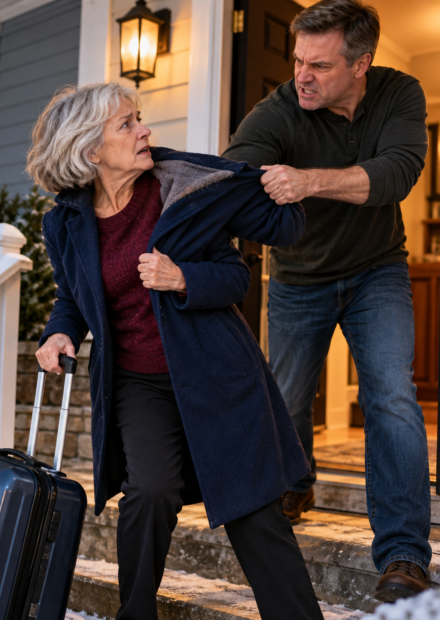
A year earlier, in a ballroom not far from this one, Olivia had grabbed me by my silver hair and pulled me from a chair because she believed I had not paid enough to deserve it.
She had thought money determined where I belonged.
The irony was almost too perfect.
But the money had never been the lesson.
If I had been broke that night, she still would have been wrong.
If Paddle 101 had belonged to someone else, she still would have been wrong.
If the auctioneer had never called my name, she still would have been wrong.
That was what I wished everyone in that ballroom had understood before the microphone made me important.
Dignity is not an award.
Respect is not a donor benefit.
No one should need a gold-trimmed paddle, a bank account, a title, a famous friend or a public announcement before other people decide they deserve to be treated like a human being.
I was fortunate.
The truth about me happened to embarrass the person who humiliated me.
Life is not always so theatrical.
Most cruel people never discover that the woman they mocked secretly funded the room.
Most victims do not receive microphones.
Most injustices do not end with applause.
That is why we have to learn to recognize wrong before the reveal.
Before the status.
Before the proof.
Before someone important tells us to care.
Daniel touched my shoulder.
“Dessert?”
“In a minute.”
He walked away.
I remained by the window.
Months earlier, Michael had mailed Paddle 101 back to me after I accidentally took it home.
It still sat on top of my dresser.
I had considered framing it.
I decided against it.
I did not want a trophy for being underestimated.
I did not need a monument to Olivia’s humiliation.
Eventually, I put it in the bottom drawer beneath Robert’s old cuff links and a stack of photographs.
But I kept it.
Not because it proved I belonged in a VIP chair.
Because it reminded me of something more important.
The paddle had never given me worth.
The chair had never given me worth.
The donation had never given me worth.
And Olivia’s contempt had never taken it away.
What changed that night was not my value.
It was my willingness to defend it.
For seventy-one years, I had believed that being kind meant making room for other people.
I still believed that.
I simply understood now that kindness did not require giving away my own chair.
Across the ballroom, Olivia caught my eye.
She did not wave.
She only smiled.
Carefully.
I smiled back.
Then I walked toward my table.
This time, no one had to tell me where I belonged.
I already knew.