
















THE NIGHT I HEARD MY FIANCÉE THREATEN MY MOTHER
Chapter 5 – WHAT THE TRUTH LEFT BEHIND
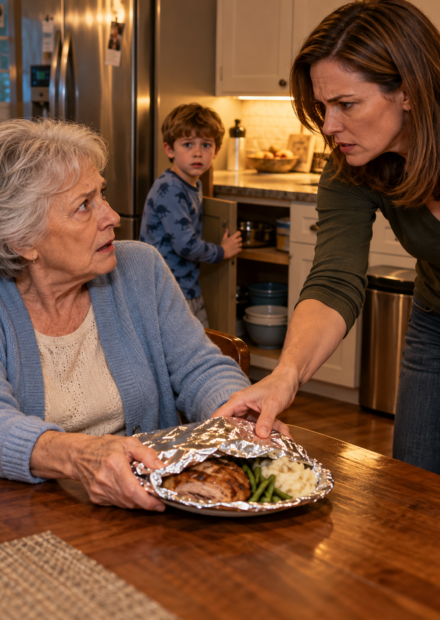
For weeks after Bianca left, my mother checked everything twice.
She checked whether doors were locked.
Checked where she placed her glasses.
Checked whether she had taken her medication.
Then checked the notebook to make sure the first check had been accurate.
At breakfast one morning, I watched her touch the sugar bowl, pause, then write something down.
“What are you doing?”
“Nothing.”
“Mom.”
She sighed.
“I moved it.”
“I saw.”
“I wanted to remember that I moved it.”
My heart sank.
“Why?”
“So if it’s somewhere else later, I’ll know.”
Bianca was gone.
But there she was.
Inside every moment of uncertainty.
I sat across from my mother.
“You don’t need to record the sugar bowl.”
“I know.”
“Then don’t.”
“It’s easy for you to say.”
I didn’t answer.
She looked at me.
“I don’t mean that cruelly.”
“I know.”
Her fingers rested on the notebook.
“Do you know what happens when someone makes you doubt small things long enough?”
“What?”
“You stop knowing which things deserve confidence.”
That was the damage I hadn’t understood.
The pool had been terrifying.
But the pool lasted minutes.
The doubt lasted much longer.
So we changed our focus.
I had spent the first days after Bianca left trying to prove what she had done.
Now I stopped.
We already knew enough.
Instead, I began helping my mother rebuild normal life.
Not by hovering.
That made things worse.
The first time I asked whether she’d remembered her medication, she gave me a look that could have cracked marble.
“Don’t become her.”
The words hit hard.
I stopped asking.
If she wanted help, she asked.
If she didn’t, I trusted her.
We changed the lock on her desk.
Then, at her insistence, she gave the only spare key to Samuel, not me.
“Why not me?”
“Because boundaries are healthy.”
“You sound like a therapist.”
“You need one.”
“So do you.”
“I already have one.”
I stared at her.
“You do?”
“Started Tuesday.”
I laughed.
“What?”
“Nothing.”
“You think seventy-eight-year-old women don’t go to therapy?”
“I think you’ve spent my entire life saying therapy was expensive conversation.”
“I changed my mind.”
“Apparently.”
She smiled.
“Try it sometime.”
I did.
She never let me forget that she had been right.
The calls from friends slowly changed.
At first, they had been cautious.
Then people began remembering things.
Not dramatic evidence.
Just moments.
A friend recalled Bianca asking unusual questions about whether my mother managed her own finances.
Another remembered Bianca making a joke about “senior moments” after Martha forgot a restaurant name.
Daniel admitted Bianca had once instructed him not to correct my mother when she got a dinner time wrong because “we need Julian to see the pattern.”
That sentence sickened me.
“Why didn’t you tell me?” I asked.
Daniel looked ashamed.
“I thought she was concerned.”
The same answer I had given myself.
I couldn’t condemn him for it.
A housekeeper remembered Bianca entering my mother’s room several times when Martha was in the garden.
Again, not proof of what she did inside.
But the pattern no longer required imagination.
Bianca had created circumstances.
Then interpreted those circumstances for everyone else.
I never learned whether she deliberately caused my mother to fall into the pool.
Martha never claimed certainty.
Neither did I.
That mattered to us.
What I knew was enough.
Bianca had left her there.
She had threatened her.
She had used months of manufactured doubt to convince her that no one would believe her.
That was the truth.
We didn’t need to decorate it.
The wedding was canceled.
The venue kept part of the deposit.
I didn’t care.
Florists called.
Caterers called.
A photographer sent a carefully worded email asking whether we wanted to convert our deposit into family portraits.
My mother laughed for ten minutes.
“We should do it.”
“What?”
“Family portraits.”
“Absolutely not.”
“You hate photographs because you always look serious.”
“I am serious.”
“You look constipated.”
“Mom.”
“We’ll schedule it.”
We did.
The photograph still hangs in the hall.
My mother is sitting in the center wearing blue.
I’m behind her, one hand on her shoulder.
Daniel stands at the side because my mother insisted anyone who had survived our family for eight years qualified as family.
I do look too serious.
She never lets me forget it.
Bianca’s public campaign faded.
Not because I destroyed her reputation.
I didn’t.
I never issued the dramatic statement some people expected.
I never leaked messages.
Never gave interviews.
Never tried to turn mutual friends into soldiers.
I discovered that truth often has an advantage lies don’t.
It doesn’t need constant maintenance.
Bianca had to keep explaining.
Why had she been holding my mother’s desk key?
Why had the missing asset page been among her belongings?
Why had she told different people slightly different versions of the pool incident?
Why had she described Martha as physically aggressive when there were no injuries?
Why had she claimed she tried to pull my mother from the pool when I saw her standing several feet away?
Each answer required another answer.
I only had one.
I was there.
Eventually, people stopped asking.
Some apologized.
Some didn’t.
A few disappeared from our lives entirely.
My mother took those losses better than I did.
“People don’t like discovering they’ve been fooled,” she told me. “Sometimes they avoid the person who reminds them.”
One evening, about two months after the pool, I found her sitting outside.
Not beside the pool.
Near it.
That distinction mattered.
She had refused to go onto the back terrace for weeks.
I didn’t push.
That evening I came home and saw her sitting beneath the pergola with a book.
I stopped inside the glass doors.
For a moment, I was back on that first night.
Roses falling.
Water glowing.
Her scream tearing through the house.
Then my mother looked up.
“You planning to stand there all evening?”
I stepped outside.
“What are you doing?”
“Reading.”
“Out here?”
She glanced around.
“Unless someone moved the house.”
I smiled.
Then I noticed her hands.
They were steady.
I sat across from her.
She closed the book.
“I thought I should stop letting a swimming pool insult me.”
“That sounds healthy.”
“I thought so.”
We sat in silence.
The late afternoon sun reflected off the water.
For months afterward, I would remember Bianca whenever I looked at that pool.
But memories change.
Not disappear.
Change.
Eventually, the image of my mother sitting peacefully beside it became stronger than the image of her struggling inside it.
That mattered.
She looked at me.
“Have you spoken to her?”
I knew who she meant.
“No.”
Bianca had sent one final email three weeks after the confrontation.
It was longer than all her messages combined.
She apologized.
Then explained.
Then blamed.
Then apologized again.
She wrote about feeling like an outsider in my life.
About believing marriage would finally give her the security she had never had growing up.
About resenting my mother because Martha possessed something Bianca believed she never would: an unquestioned place beside me.
She admitted telling people my mother’s memory was becoming unreliable.
She called it “preparing them for what I genuinely believed was happening.”
She did not admit moving the objects.
She did not admit taking the asset sheet.
She did not admit pressing her heel against my mother’s fingers.
Instead, she wrote that fear and anger had caused her to behave in ways she “deeply regretted.”
At the end, she said she would always love me.
I read the email twice.
Then archived it.
I never responded.
“Do you miss her?” my mother asked.
I looked across the garden.
“Sometimes.”
She nodded.
No judgment.
“That probably worries you.”
“It did.”
“Why?”
“Because it felt like betrayal.”
“Of me?”
“Yes.”
My mother rolled her eyes.
“Don’t be stupid.”
I laughed.
“Comforting.”
“You loved someone for almost two years.”
“I loved who I thought she was.”
“No.”
I looked at her.
My mother leaned back.
“You loved a real person.”
“She lied.”
“Real people lie.”
“She manipulated you.”
“Real people do terrible things.”
“What exactly is your point?”
“My point is that you keep trying to divide her into two women.”
I frowned.
“The woman you loved and the woman by the pool.”
She tapped the arm of her chair.
“They were the same woman.”
I felt something tighten in my chest.
“That’s worse.”
“For a while.”
“What does that mean?”
“It means you don’t have to decide every good memory was fake just because the relationship ended badly.”
I looked at her.
“You’re defending her again.”
“No.”
My mother smiled.
“I’m defending you.”
The words settled over me.
I had spent weeks trying to erase every happy memory because I thought keeping them made me foolish.
But my mother was right.
I had loved Bianca.
Some moments had been real because I had been real inside them.
Her later betrayal did not change my sincerity.
It changed what future I could build on it.
Nothing more.
“You’re irritatingly wise,” I said.
“I’ve had practice.”
We fell silent again.
After a while, my mother asked, “Do you know why I never wanted you to throw her out because of me?”
“I did throw her out because of you.”
“No.”
She shook her head.
“You threw her out because of what she did.”
“Same thing.”
“Not at all.”
She leaned toward me.
“If you’d chosen between two women who simply disliked each other, I would never have wanted to win that contest.”
“It wasn’t a contest.”
“Exactly.”
Her eyes moved toward the pool.
“That’s what she never understood.”
I thought about Bianca saying, You’re choosing her.
At the time, I had answered that I was choosing the truth.
I still believed that.
Bianca had viewed love as territory.
If my mother occupied too much, less remained for her.
But love had never worked that way in my life.
My father’s love for my mother hadn’t reduced his love for me.
My mother’s love for me hadn’t vanished when I became engaged.
A wife wouldn’t replace a mother.
A mother shouldn’t control a marriage.
These relationships required boundaries.
They didn’t require destruction.
Bianca had tried to solve an imaginary competition by making it real.
And lost.
Six months after the pool incident, my mother announced she wanted to move.
I nearly dropped my coffee.
“What?”
“I’m thinking of buying a smaller place.”
“No.”
She stared at me.
“Excuse me?”
“No.”
“I wasn’t requesting permission.”
“Why?”
“Because this house is enormous.”
“You love this house.”
“I love you.”
“That’s manipulative.”
“I learned from the best.”
“Not funny.”
She smiled.
“A little.”
I stood.
“Is this because of what Bianca said?”
“No.”
“Because she told you I wanted you gone?”
“No.”
“Then why?”
My mother sighed.
“Sit down.”
I didn’t.
“Julian.”
I sat.
She folded her hands.
“When your father died, staying here mattered. Every room had him in it.”
My chest tightened.
“I know.”
“Then you came home more often. Then eventually you moved back while renovating your apartment, and somehow you never completely moved out again.”
“You asked me to stay.”
“I did.”
“You still want me here.”
“I do.”
“Then?”
She smiled.
“This house belongs to your next life.”
I stiffened.
“Don’t.”
“What?”
“Talk like you’re disappearing.”
“I’m seventy-nine next month.”
“That’s not dead.”
“I’m aware.”
“Good.”
She reached across the table.
“I am not dying, Julian.”
“Then stop giving away the house in speeches.”
She laughed.
“I want something smaller because I want something that is mine.”
“This is yours.”
“No.”
She shook her head.
“This is ours. Your father built most of it. You expanded it. Bianca tried to claim it.”
Her expression became thoughtful.
“I’m tired of everyone treating a house like a throne.”
That sentence made me laugh despite myself.
She continued.
“I found a place ten minutes away.”
“You already looked?”
“Of course.”
“Without telling me?”
“I’m an adult.”
“Debatable.”
“There’s a garden.”
“You hate gardening.”
“I like watching other people garden.”
“At least that’s honest.”
“And a guest room.”
“For me?”
“No. For attractive younger men.”
“Mom.”
She smiled.
I stared at her for a long moment.
“You’re serious.”
“Yes.”
“Do you want to live alone?”
“Mostly.”
“What does mostly mean?”
“It means I expect dinner here twice a week and reserve the right to complain if you don’t call.”
“That sounds exactly like now.”
“Then the transition should be easy.”
My first instinct was fear.
Not rational fear.
The old kind.
The fear that if she moved, I wasn’t protecting her.
Then I recognized it.
Not my mother’s fear.
Mine.
I had spent months correcting the lie that Martha was helpless.
Now I was in danger of treating her that way myself.
So I nodded.
“If that’s what you want.”
“It is.”
“Then we’ll find the best place.”
“I already did.”
“Of course you did.”
She moved three months later.
Ten minutes away.
She called me twelve times the first week, mostly to complain that the oven controls were badly designed.
I visited almost every evening until she accused me of stalking.
Eventually we found a rhythm.
The mansion became quieter.
At first, painfully so.
Then peacefully.
I sold the engagement ring.
My mother was serious about donating the money.
We chose a local organization that provided legal advocacy and support for older adults facing financial exploitation and coercive control.
When the director asked why we had chosen them, my mother simply said, “Because believing older people is a good place to start.”
She did not tell the pool story.
She didn’t need to.
Almost a year after Bianca left, I received a letter.
A real letter.
No email.
No text.
My name was handwritten on the envelope.
I recognized the writing immediately.
I nearly threw it away.
Instead, I opened it.
Bianca wrote only one page.
There were no explanations this time.
No accusations.
No claims that I had misunderstood.
She wrote that therapy had forced her to confront something she had spent her life avoiding: she had confused being chosen with being safe.
She wrote that every relationship had become a test.
Every boundary felt like rejection.
Every person she couldn’t control became a threat.
She said none of that excused what she had done.
Then came one sentence that I read several times.
I knew your mother wasn’t losing her memory before you did.
My hand tightened around the paper.
The admission continued.
She wrote that she had started with small comments.
Small tests.
She wanted to know whether people would believe her version of Martha.
When they did, she went further.
She admitted moving the glasses.
The scarf.
The medication bottle.
She admitted erasing one calendar entry.
She admitted taking the desk key after seeing my mother use it.
She wrote that she had copied the asset page because she wanted to understand “what the future might look like.”
Even on paper, the phrase chilled me.
She said she had never planned to physically harm Martha.
She claimed the fall into the pool truly had been an accident.
I believed that was possible.
Not because I trusted Bianca.
Because my mother had always said she wasn’t certain.
Then Bianca wrote the part that mattered.
When Martha fell, I knew I should help her. I didn’t. I was angry, and for a few seconds I liked that she was afraid of me. I wanted her to understand that I had power too.
I stopped reading.
The room blurred.
A few seconds.
That was how Bianca described it.
A few seconds.
The same few seconds in which my mother had believed she might drown.
Bianca wrote that when Martha threatened to expose her, panic took over.
She said things she had thought privately but never expected to say aloud.
Then I arrived.
At the bottom of the page was one final paragraph.
I am not asking you to forgive me or answer this. I am writing because Martha deserved to know she was right. You deserved to know she was right too.
I folded the letter.
Then drove to my mother’s house.
She was in the garden watching a man trim the hedge.
I held up the envelope.
“From Bianca.”
My mother stared at it.
“Do I want to read it?”
“I don’t know.”
“Did you?”
“Yes.”
“Does she apologize?”
“Yes.”
“Does she explain?”
“A little.”
“Does she admit it?”
I nodded.
My mother became very still.
“The things?”
“Yes.”
“All of them?”
“Most.”
She looked toward the garden.
For nearly a minute, neither of us spoke.
Then she held out her hand.
I gave her the letter.
She read slowly.
Once.
Then again.
I watched her face.
There was no triumph.
That surprised me.
I had imagined this moment many times.
Proof.
Confession.
Vindication.
I expected anger.
Maybe satisfaction.
Instead, my mother sat on a bench.
I sat beside her.
“Are you okay?”
She kept looking at the paper.
“I spent so much time wanting this.”
“I know.”
“I thought if she admitted it, something would change.”
“Did it?”
She considered.
“Yes.”
“What?”
She folded the letter carefully.
“I don’t need it anymore.”
I understood.
For months, the truth had lived inside us without Bianca’s permission.
My mother had already recovered her trust in herself.
She no longer needed the person who had harmed her to certify that the harm had been real.
“Do you want to keep it?” I asked.
She shook her head.
“No.”
“Throw it away?”
“No.”
She handed it back.
“You decide.”
I looked down at the envelope.
“What should I do?”
My mother smiled.
“You’re almost fifty, Julian. Eventually you’re going to have to make your own decisions.”
“I regret helping you recover.”
“I’m sure.”
I kept the letter for a while.
Not because I wanted revenge.
Because I needed time to understand what closure actually was.
I had always imagined closure as an answer.
A confession.
A door slamming.
But the real ending had happened much earlier.
It happened the day my mother sat beside the pool and read a book.
It happened when she stopped writing down where she put the sugar bowl.
It happened when she chose a new home because she wanted one, not because someone made her feel unwanted.
It happened when I stopped wondering whether I could have saved my relationship with Bianca by doing something differently.
A year after receiving the letter, I found it while cleaning my desk.
I read one line.
Then I fed the pages into the shredder.
I felt nothing dramatic.
No surge of freedom.
No anger.
Just quiet.
That evening, I went to my mother’s house for dinner.
She opened the door wearing the same shade of purple as the night of the pool.
For a second, I stared.
She noticed.
“What?”
“Nothing.”
“You’re staring at my dress.”
“I like it.”
“Good. It was expensive.”
I laughed.
She led me inside.
Dinner was roast chicken, potatoes and a salad she claimed to have made herself but had obviously bought.
Halfway through, she looked at me.
“You seem happy.”
“I’m eating.”
“That’s not what I mean.”
I knew.
For a long time after Bianca, happiness made me suspicious.
If life felt too calm, I waited for betrayal.
I questioned motives.
Second-guessed kindness.
Then one day I realized I was doing to myself what Bianca had done to my mother.
Teaching myself not to trust what I saw.
So I stopped.
Not all at once.
But deliberately.
“I am happy,” I said.
My mother nodded.
“Good.”
“That’s all?”
“What do you want? A speech?”
“You usually have one.”
“I’m conserving material.”
We ate in comfortable silence.
After dinner, we sat outside.
The air was warm.
Her garden lights had come on automatically.
Somewhere nearby, water moved through a small stone fountain.
For a moment, the sound reminded me of the pool.
But only for a moment.
My mother leaned back.
“Do you ever think about that night?”
“Yes.”
“Me too.”
I looked at her.
“Less often.”
“Same.”
She smiled.
“Do you know what I remember most?”
“What?”
“Not Bianca.”
That surprised me.
“What then?”
“You walking through the door.”
I said nothing.
She continued.
“I remember seeing you behind her.”
“She didn’t know I was there.”
“I know.”
“You couldn’t have seen me until I stepped forward.”
“I did.”
“When?”
“Before you spoke.”
I frowned.
“You were in the shadows.”
“Your father always said you were terrible at hiding.”
I laughed.
She smiled.
“I remember thinking, I’m safe now.”
The words hit me harder than I expected.
“Mom.”
“I know you wish you’d come sooner.”
I looked down.
Because of course I did.
Some guilt doesn’t respond to logic.
She touched my hand.
“But you came when you came.”
I swallowed.
“And you listened.”
“Too long.”
“No.”
I looked at her.
“You needed to hear her.”
“At your expense.”
“For a minute.”
“A minute matters in a pool.”
“So does the truth.”
I closed my eyes.
She squeezed my hand.
“I don’t remember that night as the night Bianca almost won.”
I looked at her.
“What do you call it?”
“The night she stopped winning.”
I smiled.
That was my mother.
She could turn survival into an argument.
We stayed outside until the air grew cool.
When I finally stood to leave, she walked me to the door.
“Call me tomorrow.”
“You call me.”
“I’m old.”
“You spent a year proving that doesn’t make you helpless.”
“It doesn’t. It makes me entitled to inconvenience my son.”
“Good night, Mom.”
“Drive carefully.”
I stepped outside.
Then stopped.
She was still standing in the doorway.
Small.
Silver-haired.
Completely herself.
I thought about the woman I had found in the pool.
Terrified.
Doubting her own memory.
Begging someone crueler than she understood to help her.
For a long time, I believed saving her meant pulling her from the water.
I was wrong.
I had only helped with that part.
My mother saved herself afterward.
By trusting what she knew.
By refusing to lie simply because lying would have made revenge easier.
By rebuilding confidence one ordinary day at a time.
And by reminding me that being deceived does not make you foolish forever.
Sometimes it simply makes the truth more expensive.
That night cost me a fiancée.
It cost my mother months of peace.
It cost us friends we thought we knew.
But it also taught me something I should have understood long before I walked through those glass doors carrying roses.
Love is not proved by who demands to be chosen.
It is proved by who refuses to make you choose at all.
Bianca had looked down at my mother and believed she had finally become powerful.
She thought age made Martha weak.
She thought love made me blind.
She thought enough small lies could eventually replace reality.
For a while, she was almost right.
But lies have one weakness.
They need you to keep looking away.
That night, I looked.
I listened.
And once I heard the truth, I couldn’t unhear it.
The roses I bought Bianca stayed scattered across the marble floor until morning.
Daniel eventually asked whether I wanted them saved.
I told him no.
Years later, I can still picture them.
Deep red petals against white stone.
Beautiful things meant for a future that never existed.
For a long time, I thought that was the perfect image of what I lost.
Now I see it differently.
Those roses weren’t the end of something beautiful.
They were the last gift I ever brought to a lie.
And beyond them, through those open glass doors, was my mother.
Alive.
Waiting for me to see the truth.
This time—
I did.