Chapter 5 – What Was Mine Before I Became His Wife
The settlement did not end everything overnight.
Nothing involving a company that large, two children that loved both parents, and thirteen years of marriage ends with one signature.
There were valuations.
Tax questions.
Schedules.
Appraisals.
Board meetings.
Parenting coordinators.
Attorneys who found problems inside sentences I thought were simple.
But the war changed after that Friday.
Tristan stopped trying to prove I was incapable of supporting our sons.
Mostly because the argument had become impossible.
The house remained mine as part of the final property arrangement.
The boys stayed in their school.
Their bedrooms stayed the same.
Lucas kept the glow-in-the-dark stars above his bed even though he insisted he was too old for them.
Mason kept leaving hockey equipment in the mudroom despite promising at least twice a week that he would stop.
Normal life returned in pieces.
It was not the same life.
But it was ours.
The final hearing took place several months later.
There were fewer spectators.
No dramatic crowd.
No three-lawyer parade.
No Chloe in a cream dress.
Tristan came with Carlton.
I came with Rachel.
Judge Callahan reviewed the settlement and remaining findings.
The court recognized my traced sixty-seven-percent premarital ownership interest in Pembroke Freight Systems as separate property under the prenuptial agreement.
Tristan retained his thirty-three-percent separate interest.
Marital assets accumulated outside those interests were divided according to the parties’ agreement.
Neither of us got “everything.”
That was never the point.
The point was that he did not get to call everything his simply because the world had watched him stand in front of it.
On custody, Judge Callahan approved the parenting agreement.
Joint legal custody.
The boys’ primary residence with me.
Substantial and meaningful parenting time with Tristan.
Restrictions against discussing litigation or finances with the children.
No using money to pressure parenting decisions.
No asking Mason and Lucas to carry messages.
No allowing romantic partners to make legal-parenting decisions.
The judge looked at both of us.
“Your children should never again be placed in the position of believing love is something a court awards to one parent and takes from another.”
I felt my throat tighten.
Tristan nodded.
So did I.
The judge continued.
“Mr. Pembroke, financial resources are one factor in providing for children. They are not a substitute for consistent parenting.”
His face reddened slightly.
“Mrs. Pembroke, I hope you understand that recognizing your role as primary residential parent does not diminish the importance of the children’s relationship with their father.”
“I understand.”
I meant it.
Then Judge Callahan looked at the settlement one last time.
“I understand the parties have also corrected certain descriptions regarding the business’s formation.”
Carlton looked uncomfortable.
Rachel smiled.
“Yes, Your Honor.”
The judge glanced at me.
“Mrs. Pembroke, anything further?”
Months earlier, I had imagined this moment differently.
I imagined making a speech.
Telling the courtroom everything Tristan had done.
Every lie.
Every missed dinner.
Every humiliation.
Every time Chloe smiled at me while sleeping with my husband.
Every article that erased my name.
Every corporate banquet where strangers shook my hand and said, “You must be so proud of what your husband built.”
I thought justice would feel like finally forcing everyone to listen.
But when the moment arrived, I no longer wanted a speech.
I wanted to go home.
“No, Your Honor.”
Judge Callahan nodded.
“Mr. Pembroke?”
Tristan looked at me.
Then at the judge.
“No.”
The gavel fell.
Our marriage was over.
Outside the courtroom, Rachel hugged me.
Not the polite attorney-client hug she usually gave.
A real one.
“You did it.”
“We did it.”
She pulled back.
“No.”
Her expression became serious.
“I handled the law. You decided you were worth defending.”
I looked toward the hallway.
Mason and Lucas were waiting downstairs with my sister.
“I need to get the boys.”
“Go.”
I took three steps before Tristan called my name.
“Nora.”
I stopped.
Rachel continued toward the elevators.
Tristan walked toward me alone.
For the first time since the divorce began, there was no lawyer beside him.
No Chloe.
No camera.
No board member.
No assistant.
Just Tristan.
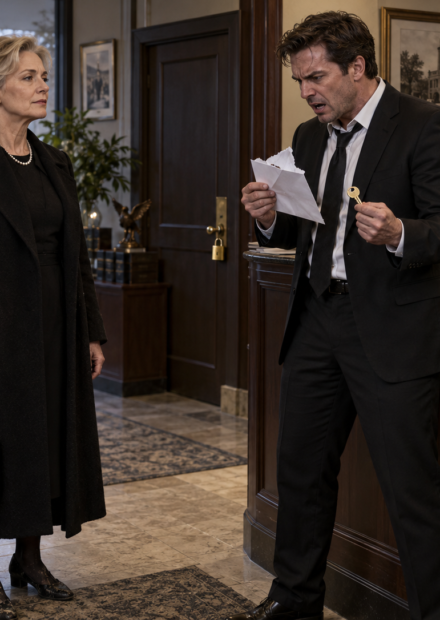
He held something in his hand.
A folded piece of paper.
“What is it?”
He gave it to me.
I opened it.
It was a photocopy of the original membership schedule.
NORA LAWSON — 67%.
TRISTAN PEMBROKE — 33%.
I looked at him.
“Why are you giving me this?”
“I found the original last week.”
My heart skipped.
“Where?”
“In an old file box from the first office.”
I almost laughed.
“Of course.”
The rented room above the tire shop had been emptied fifteen years earlier.
Boxes had followed us through three offices and two warehouses.
Apparently one survived.
Tristan put his hands in his pockets.
“There was other stuff.”
“What kind?”
“Old invoices. Driver logs. That horrible brochure we printed ourselves.”
I smiled despite myself.
“The blue one?”
“With the truck that wasn’t ours.”
“It was a stock photo.”
“It had a Canadian license plate.”
“We had six hundred copies.”
“You insisted we use them.”
“We couldn’t afford to reprint.”
We both laughed.
For five seconds, we were twenty-eight and thirty again.
Broke.
Sleep deprived.
Terrified.
Certain we were building something together.
Then the laughter faded.
Tristan looked at the ownership schedule in my hands.
“I remembered signing this.”
“You should have.”
“I mean after court.”
I waited.
“I remembered that day.”
So did I.
We had been sitting in Margaret Chen’s office.
Tristan thought thirty-three percent sounded too low.
I thought it sounded generous considering the capital contributions.
We argued for twenty minutes.
Then he had grinned and said, “Fine. You can be the majority owner. I’ll be the charming one.”
I had told him charm was not a corporate asset.
History had proved me wrong about that.
Tristan looked at me.
“I convinced myself it didn’t matter anymore.”
“The document?”
“No.”
He paused.
“That you started it.”
I said nothing.
“I told the story so many times that eventually…” He exhaled. “I don’t know. It became my memory.”
“That happens when no one corrects you.”
“You could have.”
“Yes.”
“Why didn’t you?”
I looked toward the courthouse windows.
Cars moved through the wet Minneapolis streets below.
“Because I didn’t think I needed strangers to know.”
He nodded slowly.
“And then I started believing you didn’t need me to know either.”
That was closer to an apology than anything he had offered.
It still was not enough.
Maybe it never would be.
But I no longer needed it to be enough.
“Take care of the boys,” I said.
“I will.”
“Not your assistant. Not Chloe. You.”
His jaw tightened at Chloe’s name, but he nodded.
“I will.”
I started walking again.
“Nora?”
I looked back.
“I’m sorry.”
There are apologies that open doors.
There are apologies that close them gently.
His was the second kind.
“I know.”
I left.
Downstairs, Mason saw me first.
He ran across the lobby.
Lucas was right behind him.
“Is it done?” Mason asked.
I crouched and pulled both boys against me.
“Yes.”
Lucas whispered into my shoulder.
“Who won?”
That question nearly broke my heart.
I leaned back.
“No one.”
He frowned.
“Then what happened?”
“We figured out where you’re going to live.”
“With you?”
“Most school nights, yes.”
Mason looked worried.
“What about Dad?”
“You’ll be with him a lot too.”
Lucas considered this.
“And the house?”
“We’re staying.”
Both boys shouted.
Several people looked over.
I laughed for what felt like the first time in months.
My sister wiped her eyes behind them.
We walked toward the exit.
Before stepping outside, Mason noticed the paper in my hand.
“What’s that?”
I looked down at the old ownership schedule.
“A very old piece of paper.”
“Important?”
“Apparently.”
He reached for it.
I let him look.
His eyes moved over the typed names.
“Why does it say Nora Lawson?”
“That was my name before I married Dad.”
“You had a different name?”
“Yes.”
He studied the document.
Then his eyes widened.
“Pembroke Freight?”
“Yes.”
“You owned it?”
“I still do.”
His mouth fell open.
“But Dad started the company.”
My sister looked at me.
I looked at my son.
This was the exact moment when I understood how completely a public story could become family truth.
“No,” I said gently. “Your dad and I started it together.”
Mason pointed at the percentages.
“You had more.”
I smiled.
“I put in more money at the beginning.”
Lucas leaned over his brother’s shoulder.
“Were you Dad’s boss?”
I laughed.
“Absolutely not.”
“Could you fire him?”
My sister made a choking sound.
“No.”
That answer required more explanation than I wanted to give in a courthouse lobby.
“Companies are complicated.”
Mason handed the paper back.
“Why didn’t you ever tell us?”
I folded it carefully.
“Because being your mom mattered more to me than telling people what I owned.”
He thought about that.
Then he said something I have never forgotten.
“You can be both.”
Three words.
From a ten-year-old.
You can be both.
Mother and founder.
Caregiver and owner.
Soft and strong.
Private and significant.
Loving and unwilling to disappear.
I had spent years believing I had to choose.
Maybe Tristan had believed it too.
That afternoon, the rain finally stopped.
We went home.
I ordered pizza because I was too tired to cook.
Mason argued that winning a court case deserved pepperoni and sausage.
I reminded him nobody had won.
He said keeping the house felt like winning.
Lucas wanted extra cheese.
We ate on the living-room floor because the dining table was covered in mail.
Nothing about the evening looked important.
That was why it mattered.
Weeks later, I attended my first Pembroke Freight Systems board meeting in nearly seven years.
I almost turned around in the parking lot.
The headquarters had changed since I last worked there regularly.
The lobby was three stories tall.
A digital map displayed hundreds of trucks moving across the United States.
Photographs lined the walls.
New terminals.
Community projects.
Awards.
Near the elevator hung an enormous black-and-white photograph of Tristan beside one of our first trucks.
Below it were the words:
TRISTAN PEMBROKE
FOUNDER & CEO
I stood there for a long time.
An employee at reception recognized me.
“Mrs. Pembroke?”
“Nora is fine.”
She smiled nervously.
“Can I help you?”
I pointed at the photograph.
“When was that installed?”
“About three years ago.”
I nodded.
“Thank you.”
I did not tear it down.
I did not demand someone remove it before the meeting.
I went upstairs.
The boardroom doors opened.
Conversation stopped.
Some directors knew me socially.
Others knew me only from legal documents produced during the divorce.
Tristan stood at the far end of the table.
For a second, the old tension returned.
Then he nodded toward an empty chair.
Not at the far end.
Not against the wall.
At the table.
Beside the other owners and directors.
“Nora.”
I sat.
The first meeting was uncomfortable.
The second was less so.
I had no interest in returning to daily operations.
I had built a different life.
I liked picking the boys up from school.
I liked knowing their teachers.
I liked having dinner with them.
I did not want airports and hotels to consume me.
But ownership gave me something I had not realized I missed.
A voice.
I pushed for stronger governance.
Independent directors.
Clearer separation between family relationships and company reporting.
Better succession planning.
Expanded driver mental-health resources.
A review of executive travel.
Tristan disagreed with me often.
Sometimes loudly.
That was fine.
We were no longer married.
We did not need to agree to preserve peace at home.
Three months after the divorce became final, the company redesigned its history page.
I did not request it.
Tristan did.
The new first sentence read:
PEMBROKE FREIGHT SYSTEMS WAS CO-FOUNDED IN 2011 BY NORA LAWSON PEMBROKE AND TRISTAN PEMBROKE.
There were no percentages.
No courtroom story.
No public humiliation.
Just the truth.
When I saw it, I closed the laptop and went upstairs to remind Mason and Lucas to brush their teeth.
That was enough.
People occasionally asked whether I regretted staying silent for so long.
I do.
And I don’t.
Silence gave me years with my children I would never trade.
But silence also taught the people around me that my contributions could be forgotten without consequence.
There is a dangerous moment in any relationship when sacrifice stops being recognized as a choice and starts being treated as proof that the person making it has less value.
I crossed that line without noticing.
So did Tristan.
By the time we understood what had happened, our marriage was already too damaged to save.
The court did not give me my life back.
It couldn’t.
It did something smaller.
It forced everyone involved to look at what had always been there.
A name.
Mine.
At the top of a document written before I became Mrs. Pembroke.
Before the mansion.
Before the magazine covers.
Before the twins.
Before Chloe.
Before Tristan learned how easily a polished story could replace an inconvenient truth.
The prenup he believed would take everything from me did exactly what it had promised to do.
It protected what each of us brought into the marriage.
He brought his thirty-three percent.
I brought sixty-seven.
And when the judge read the first name on that ownership list, she did not create a new truth.
She simply uncovered the old one.
I had never been the woman standing behind the man who built Pembroke Freight Systems.
I was the woman who stood beside him when we built it.
Then I stepped away to raise our sons.
And somehow, during all those quiet years, Tristan forgot that stepping away from the spotlight was not the same thing as surrendering what was mine.
He forgot.
The paperwork didn’t.
And neither did I.