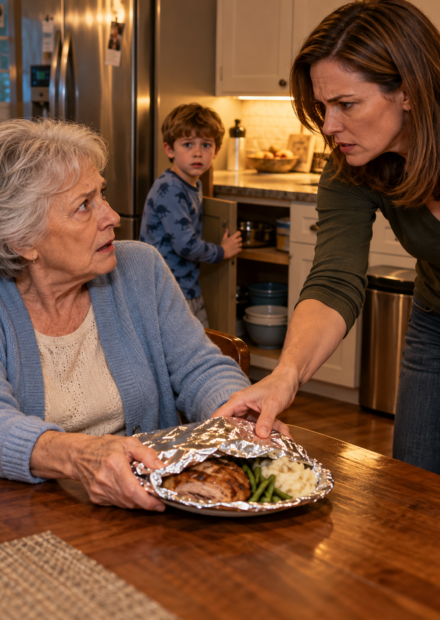






















MY SON MADE ME EAT THANKSGIVING DINNER ALONE IN THE KITCHEN—IN THE HOUSE I PAID TO MAKE POSSIBLE
Chapter 3 – The Morning After Thanksgiving
At six the next morning, I made coffee.
Not for Daniel.
Not for Claire.
For myself.
That sounds insignificant.
It wasn’t.
For years, I had measured mornings by other people.
Daniel liked coffee ready before seven.
Claire preferred the kitchen empty until she came downstairs because she enjoyed “quiet time.”
On weekdays, I ate breakfast early and disappeared downstairs before she began work at the kitchen island.
I had adapted myself to their rhythms so completely that I had forgotten I had one of my own.
So at six, I turned on every kitchen light.
I opened the blinds.
I ground coffee beans.
I toasted bread.
I sat at the breakfast table and read the paper.
At seven-thirteen, Daniel appeared.
He looked terrible.
His hair stood up on one side. His eyes were bloodshot.
He stopped when he saw me.
“Morning,” I said.
He stared.
“Did you sleep?”
“Some.”
“Claire didn’t.”
I folded the newspaper.
“I’m sorry she had a difficult night.”
He pulled out the chair opposite me.
“Mom.”
I knew that tone.
The same soft tone he had used in the kitchen.
The tone that prepared me to sacrifice something so he could avoid discomfort.
I took another sip of coffee.
He leaned forward.
“Last night got out of control.”
“No.”
He frowned.
“No?”
“It got very clear.”
“Come on.”
“I’m serious.”
“You humiliated Claire.”
There it was again.
I looked at him.
“Do you believe I humiliated her?”
“She had coworkers here.”
“That isn’t what I asked.”
“She was mortified.”
“So was I.”
He sighed.
“I know.”
“No. You don’t.”
“I said I know.”
“You shut me in the kitchen.”
His face tightened.
“I made a mistake.”
“You lied about it afterward.”
“I panicked.”
“You told everyone I wanted to eat alone.”
“I was trying to keep things from getting worse.”
“For whom?”
Daniel pushed back from the table.
“This is exactly what I mean.”
“What do you mean?”
“You keep forcing everything into this good guy, bad guy thing.”
I studied him.
Daniel had always hated conflict.
As a child, if two friends argued, he would agree with whoever was standing closest.
As an adult, he called that being easygoing.
I had called it kindness.
I saw it differently now.
Avoiding conflict is not the same as being kind.
Sometimes it means allowing the person with the least shame to control everyone else.
“Do you think Claire was wrong?” I asked.
He looked toward the stairs.
I almost laughed.
She wasn’t even in the room, and he still checked.
“Daniel.”
“Yes.”
The word was barely audible.
“Louder.”
His jaw tightened.
“Yes. Claire was wrong.”
“And were you?”
He looked at me.
“Yes.”
It should have helped.
It didn’t.
Because he sounded like a man admitting he had forgotten milk.
I waited.
Finally he said, “I’m sorry.”
“For what?”
His eyebrows rose.
“Mom.”
“For what?”
“I’m sorry I asked you to eat in the kitchen.”
“You didn’t ask.”
He looked down.
“I’m sorry I told you.”
“Why did you do it?”
He rubbed his face.
“I thought it would be easier.”
“For whom?”
“Everybody.”
“No.”
“Can we stop doing this?”
“No.”
He stared at me.
For years, that look would have worked.
The tired son.
The overwhelmed husband.
The middle-aged man caught between two difficult women.
I had accepted that picture because it gave me a role I understood.
The mother who yielded.
But I was no longer willing to pretend Daniel had been caught between us.
He had made a choice.
He had chosen the person whose anger frightened him more.
“You thought hurting me would cost less than upsetting Claire,” I said.
His eyes lifted.
“That isn’t fair.”
“It is exactly fair.”
“She can be intense.”
“And I’ve been convenient.”
He said nothing.
I leaned back.
“That is why you chose me.”
His face changed.
“Mom—”
“You knew I would forgive you.”
“I didn’t think—”
“That is the problem.”
He stood.
“Okay. What do you want?”
I looked at him.
There are sentences that reveal a relationship more completely than years of conversation.
What do you want?
Not: How do I repair this?
Not: How did we get here?
What do you want?
As if my pain were a negotiation.
I folded the newspaper and placed it beside my cup.
“I want you and Claire to move out.”
Daniel stared at me.
Silence.
Then he laughed once.
It was not amusement.
It was disbelief.
“What?”
“You heard me.”
“Mom, stop.”
“I am not angry enough to joke.”
“You’re throwing us out over one dinner?”
“No.”
I stood.
“I am asking you to leave because one dinner finally showed me what I have been allowing for years.”
His face hardened.
“This is my house too.”
“Yes.”
He seemed startled again by my agreement.
I walked to the drawer beside the refrigerator and took out a small notepad.
“I know exactly how the house is held. I also know what I contributed.”
Daniel’s expression changed.
“You went through paperwork?”
“I looked at paperwork with my name on it.”
“I can’t believe this.”
“That makes two of us.”
“You’re seriously doing this?”
“Yes.”
“Where are we supposed to go?”
The question almost broke my heart.
Not because it was unfair.
Because I remembered another version of it.
Thirty-nine years earlier, three-year-old Daniel had stood in a grocery store crying after he lost sight of me beside the cereal aisle.
Where am I supposed to go?
I had scooped him up and promised I would never leave him.
Mothers make promises to children that cannot survive adulthood.
Not if the children insist on turning those promises into chains.
“You are forty-four years old,” I said. “You have a job. Claire has a job. You can rent somewhere.”
He stared as if I had slapped him.
“You know what rent costs.”
“I do.”
“Our mortgage payment here is already high.”
“Our mortgage payment.”
He flinched.
“Yes. Ours.”
“Then perhaps you should have remembered who ‘our’ included before you removed my chair.”
The kitchen went quiet.
Daniel walked to the window.
For a long time, he looked into the backyard.
The chrysanthemums had gone brown after the first frost.
Finally he said, “How long?”
“I haven’t decided.”
He turned.
“You just decided to blow up our lives without deciding how?”
“I decided ten hours ago that I would no longer be treated like a burden in a home I helped create. The logistics will follow.”
“You can’t just—”
He stopped himself.
“Just what?”
He shook his head.
“You need to calm down.”
I smiled then.
Not because it was funny.
Because it was familiar.
Women hear that sentence whenever their anger becomes inconvenient.
“I am calm.”
“That’s not what I mean.”
“I know.”
Footsteps sounded on the stairs.
Claire entered.
She was already dressed.
Black leggings.
Cream sweater.
Hair pulled back perfectly.
She did not look at me.
She walked to the coffee maker.
There was no coffee left in the pot.
I had made exactly two cups.
For myself.
She stared at the empty carafe.
Then at Daniel.
“Seriously?”
He looked exhausted.
“Claire.”
“What?”
He rubbed his forehead.
“My mom wants us to move out.”
Claire froze.
Then she turned toward me.
I saw the moment she decided I was bluffing.
Her expression softened into something close to pity.
“Margaret.”
“No.”
“I understand you’re upset.”
“No, you don’t.”
“You were embarrassed.”
“You embarrassed me.”
She inhaled.
“Fine. I handled yesterday badly.”
“That is true.”
“But asking us to move out is insane.”
Daniel winced.
I did not.
“Is it?”
“Yes.”
“This is my home.”
“This is our home.”
“Then why did you decide I could not eat dinner in it?”
Her lips pressed together.
“That was one evening.”
“No. It was the logical end of a thousand smaller things.”
Claire stared.
I started counting.
“You removed my photographs from the living room.”
“They were cluttered.”
“You gave away my reading chair.”
“You told me you didn’t use it.”
“I said my back hurt when I sat in it.”
“You never said—”
“You converted half my pantry shelves into storage for entertaining dishes.”
“There wasn’t enough room.”
“You told your friends the garden was yours.”
Claire rolled her eyes.
“Oh my God.”
“You asked me not to use the living room when your book club visited.”
“Because you kept interrupting.”
“I offered them coffee.”
“You stayed.”
There it was.
I stayed.
In my own living room.
Claire crossed her arms.
“You are making normal household compromises sound sinister.”
“Compromise requires both people to give something.”
“I live here too.”
“Yes.”
I nodded.
“And for years, I have behaved as though that meant you mattered more.”
Daniel moved closer.
“Can we please have a sane conversation?”
I turned toward him.
“This is sane.”
“No. This is punishment.”
“No.”
I looked at Claire.
“Punishment would be humiliating you because humiliating you pleased me.”
Then I looked back at my son.
“This is a boundary.”
Claire laughed sharply.
“So what? We’re supposed to pack up everything because you had your feelings hurt?”
My answer came more quietly than anything I had said that morning.
“You don’t understand why this is happening.”
“No, Margaret. I don’t.”
“I know.”
And suddenly I did not need her to.
That realization was a kind of freedom.
For years, I had explained myself to Claire.
I had tried to make my needs sound reasonable enough to pass her inspection.
I thought if I found the correct words, she would see my side.
But some people understand your side perfectly.
They simply prefer their own.
“You don’t have to agree,” I said. “You have to respect the decision.”
Claire looked at Daniel.
“Are you going to let her do this?”
That sentence was meant for him.
But it taught me something.
Claire still believed Daniel had authority over me.
Daniel looked at me.
Then Claire.
Then me again.
“I need time to think.”
Claire’s head snapped toward him.
“What?”
“I said I need time.”
“This isn’t complicated.”
“Claire—”
“She’s having a tantrum.”
I stood very still.
Daniel said, “Don’t.”
Claire stared at him.
For the first time in years, he had corrected her on my behalf.
Too late.
Too weak.
But I noticed.
She did too.
“Wow,” Claire said.
She laughed once.
“Great.”
Then she turned to me.
“You know what? Congratulations.”
“On what?”
“You finally got what you wanted.”
“What did I want?”
“Daniel choosing you.”
The accusation was so childish that for a second I saw past the polished woman in front of me.
I saw the fear beneath her control.
The constant competition.
The need to be first.
Suddenly, some things made more sense.
Not enough to excuse her.
But enough to make her human.
“I never wanted him to choose between us,” I said.
Claire shook her head.
“Every mother says that.”
“No.”
I looked at Daniel.
“I wanted him to know how to stand beside two people without allowing one to degrade the other.”
He looked away.
“That is not choosing.”
Claire’s eyes were wet now.
She hated that.
I could tell.
She blinked rapidly.
“You have no idea how hard it is living with you.”
“Then moving should come as a relief.”
That was crueler than I intended.
Claire’s face closed.
She walked out.
A second later, the upstairs bedroom door slammed.
Daniel stared after her.
Then at me.
“Did you have to say that?”
I almost answered.
Instead, I asked a different question.
“Did you ask her that yesterday?”
He said nothing.
I left the kitchen.
That afternoon, I called the attorney who had handled the house purchase.
Not because I planned some dramatic legal battle.
Because I wanted facts.
For too long, I had lived by assumptions and emotions.
Facts steadied me.
The situation was not as simple as ordering Daniel and Claire onto the sidewalk.
Daniel and I both had legal interests in the home. Decisions had to be handled properly.
But I was not powerless either.
My financial contribution mattered.
My name mattered.
My rights mattered.
The attorney recommended that we discuss an agreement rather than make threats.
So that evening, I wrote down what I wanted.
Not revenge.
Not money.
Not an apology forced at gunpoint.
I wanted my home back.
If Daniel and Claire remained temporarily, I wanted clear rules.
No excluding me from shared spaces.
No hosting large gatherings without discussing them with me.
No treating my rooms as available for future conversion.
No financial assumptions.
No more pretending my presence was an inconvenience to be managed.
But as I wrote, I realized something.
Rules could control behavior.
They could not create respect.
And I did not want to spend the remaining years of my life policing two adults into treating me like a person.
So I returned to the first decision.
They needed to leave.
I would give them time.
I would handle it legally.
I would not throw clothes onto the lawn.
I would not scream.
I would not retaliate.
But the arrangement was over.
At nine that night, Daniel knocked on my bedroom door.
“Come in.”
He entered alone.
He looked older than he had the day before.
He sat in the chair by my dresser.
“Claire thinks you hate her.”
“I don’t.”
“She thinks you’ve always hated her.”
“She is wrong.”
He nodded slowly.
“I told her that.”
I waited.
Daniel stared at the carpet.
“Did I really do that to you?”
“What?”
“Make you feel like you didn’t belong here.”
I could have softened it.
Instead I said, “Yes.”
He closed his eyes.
“When?”
I almost laughed.
“You want a date?”
“No. I mean…”
He looked helpless.
“When did it get that bad?”
I thought about it.
“I don’t know.”
That was the truth.
“Maybe when you stopped saying ‘Mom’s house’ and started saying ‘our house’ when ‘our’ meant you and Claire.”
His face tightened.
“Maybe when Claire moved my things and you told me it wasn’t worth fighting about.”
He nodded.
“Maybe when you started asking me to stay downstairs whenever she had people over.”
He looked up.
“I didn’t realize—”
“You did.”
That hurt him.
Good.
Not because I wanted him hurt.
Because some truths should.
“You realized every individual time,” I continued. “You just never added them together.”
Daniel’s eyes filled.
He looked away quickly.
“I’m sorry.”
This apology sounded different.
I believed it.
That did not make everything right.
“I know,” I said.
He wiped his face.
“Can we fix this?”
“I hope so.”
Relief appeared immediately.
Then I added:
“But fixing us does not mean continuing to live together.”
His face fell.
“Mom.”
“I mean it.”
“Claire and I talked. We’ll change things.”
“No.”
“Why won’t you give us a chance?”
“I gave you years.”
“That’s not fair.”
“Perhaps not.”
I looked around my bedroom.
My entire life in this house had been compressed into these rooms.
Photographs.
Books.
Robert’s watch.
My sewing basket.
Everything else had been gradually absorbed into “their” home.
“I don’t trust the arrangement anymore,” I said.
Daniel stared at me.
That sentence landed harder than anger.
“I trust that you love me,” I continued. “I do not trust that loving me will stop you from sacrificing me when loving me becomes inconvenient.”
He covered his face.
For several seconds, neither of us spoke.
Then he whispered, “That’s awful.”
“Yes.”
“I don’t want to be that person.”
“Then don’t be.”
He lowered his hands.
“How?”
I looked at him.
“For once, don’t ask me to teach you how to make this easier.”
Daniel nodded slowly.
He stood.
At the door, he stopped.
“How much time are you giving us?”
“Until the end of January.”
He looked surprised.
“You mean that?”
“Yes.”
“And after that?”
“You and Claire build your own home.”
He swallowed.
“What happens to this one?”
I looked around.
“For the first time in years?”
I smiled.
“I decide.”