





















MY SON MADE ME EAT THANKSGIVING DINNER ALONE IN THE KITCHEN—IN THE HOUSE I PAID TO MAKE POSSIBLE
Chapter 1 – The Plate They Left for Me
My son closed the kitchen door before he told me I wasn’t allowed to eat Thanksgiving dinner with the family.
He didn’t slam it.
That would have been easier.
A slammed door would have sounded angry. Cruel. Honest.
Instead, Daniel shut it gently, almost carefully, until the laughter from the dining room became muffled behind six inches of painted wood.
Then he turned around and looked at me.
“Mom,” he said quietly, “Claire thinks it would be better if you ate in here tonight.”
For a moment, I honestly thought I had misunderstood him.
I was seventy-three years old. I had spent most of that morning peeling potatoes, trimming green beans, polishing glasses, folding napkins, and checking the turkey every twenty minutes because Daniel had bought a bird nearly twice the size he knew how to cook.
I was standing in my own kitchen.
At least, I had always thought of it as mine.
The cabinets were the cream color I had chosen twelve years earlier. The copper kettle beside the stove had belonged to my mother. The scratches beneath the breakfast table came from Daniel dragging a wooden chair across the floor the first Christmas after we moved in.
And through the door behind him sat fourteen people eating food prepared partly by my hands.
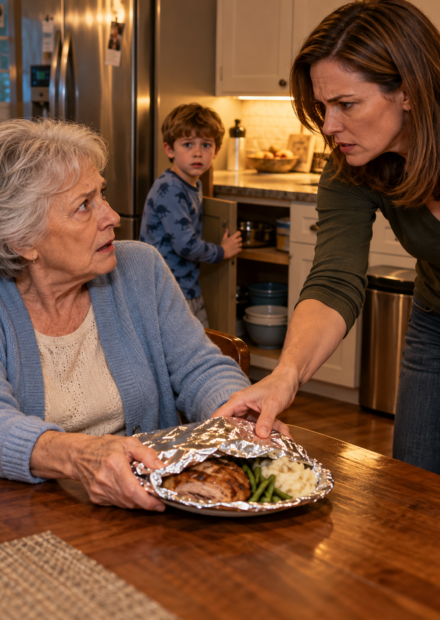
I looked down at the plate on the kitchen table.
Turkey.
Mashed potatoes.
Stuffing.
Green beans.
One spoonful of cranberry sauce.
Daniel had arranged it neatly.
That was almost the worst part.
“You made me a plate,” I said.
His eyes dropped.
“Yeah.”
“So this was planned.”
“Mom.”
“Was it?”
He rubbed the back of his neck.
That gesture had followed him since childhood. He did it whenever he wanted somebody else to rescue him from a sentence he didn’t want to finish.
At eight, it meant he had broken something.
At sixteen, it meant he had failed a test.
At thirty-eight, apparently, it meant he was about to tell his mother she embarrassed his wife too much to be seen at Thanksgiving dinner.
“Claire has been stressed all week,” he said.
I waited.
Daniel sighed.
“She wanted tonight to go smoothly.”
“What does that have to do with me sitting in the kitchen?”
His face tightened.
“It’s not like that.”
“What is it like?”
He glanced at the closed door.
From the dining room came the bright voice of Claire’s mother telling someone how beautiful the centerpiece looked.
The centerpiece was mine.
I had made it from eucalyptus, dried orange slices, candles, and the last bronze chrysanthemums from the garden.
Daniel lowered his voice.
“Claire thinks sometimes you… make people uncomfortable.”
I stared at him.
I had been humiliated before.
Age gives you that much.
You live long enough, somebody eventually talks over you, forgets your name, assumes you can’t hear, assumes you can’t understand, assumes your years have made you stupid.
But humiliation from strangers is different.
A stranger does not know which lullaby you sang to your son when he had croup.
A stranger does not know how many nights you sat beside his hospital bed after his appendix burst.
A stranger does not know you worked overtime for six Christmases because he wanted hockey equipment you could barely afford.
A stranger does not stand in a house whose down payment came from your savings and tell you that you make people uncomfortable.
“What do I do,” I asked, “that makes them uncomfortable?”
“Mom, please.”
“No. You came in here to explain this to me. Explain it.”
Daniel’s jaw worked.
Finally he said, “Claire says you stare.”
“I stare?”
“And sometimes you ask personal questions.”
“What personal questions?”
“You asked Mark how his mother was doing after her surgery.”
Daniel’s friend Mark had spoken to me about his mother’s surgery twice.
“He told me she had surgery.”
“I know.”
“Then how is asking after her personal?”
“It’s just… Claire’s friends are different.”
I laughed once.
It came out colder than I intended.
“Different from people who care whether somebody’s mother survived an operation?”
“Can you not do this?”
“Do what?”
“Turn everything into a fight.”
I felt something shift inside me then.
Not break.
Breaking is louder.
This was smaller.
A quiet internal movement, like the click of a lock turning.
I looked at my son properly.
His blue shirt was one I had bought him the previous Christmas.
His hair had begun thinning above the temples. There were lines around his eyes now. At forty-four, Daniel was no longer the young man I kept seeing when I looked at him.
Maybe that was part of the problem.
I still remembered the boy.
He had learned to forget the mother.
“What did Claire actually say?” I asked.
Daniel’s silence lasted too long.
“Tell me.”
He exhaled through his nose.
“She thinks your table manners have gotten a little…”
He stopped.
“A little what?”
“Mom.”
“What did she say?”
His eyes finally met mine.
“She said watching you eat makes some people lose their appetite.”
I don’t remember taking the chair.
One second I was standing.
The next I was sitting.
The refrigerator hummed behind me.
The oven fan clicked.
Someone in the dining room laughed so hard a glass rattled against the table.
Daniel took one step forward.
“Mom—”
I lifted a hand.
He stopped.
I had arthritis in two fingers of my right hand. Sometimes, when they stiffened, I held my fork differently.
I chewed more carefully than I used to because I had dental work done that spring.
I had once dropped gravy on my blouse at Easter when one of Claire’s friends surprised me from behind.
That was it.
Those were my crimes.
I was old enough that eating had become something my daughter-in-law evaluated.
And my son had agreed to hide me.
“Who complained?” I asked.
Daniel said nothing.
“Which guest told Claire I ruined their appetite?”
“It’s not one specific person.”
“So nobody.”
“Mom, that’s not what I said.”
“Did anyone complain?”
His face flushed.
“Claire noticed.”
Of course she had.
Claire noticed everything about me.
She noticed that my shoes were “very practical.”
She noticed I still mailed birthday cards.
She noticed my blouse was “cute for your generation.”
She noticed I reused gift bags.
She noticed my casseroles were “old-fashioned.”
She noticed the flowers I planted attracted bees.
She noticed that I woke early.
She noticed that I watched the evening news too loudly.
She noticed that I existed.
I looked at the plate in front of me again.
The turkey skin had gone soft.
A thread of gravy was beginning to harden along the edge of the potatoes.
“How long am I supposed to stay in here?”
“Just through dinner.”
“And dessert?”
Daniel looked miserable.
That answered me.
I nodded.
“Your guests might lose their appetite watching me eat pumpkin pie too.”
“Please don’t say it like that.”
I almost smiled.
“How would you like me to say it?”
He lowered his voice further.
“You know how Claire gets when she’s under pressure.”
There it was.
The phrase people use when they want the injured person to carry the responsibility for the person doing the injuring.
You know how she gets.
Keep the peace.
Don’t provoke her.
It’s only one night.
Be the bigger person.
All those phrases mean the same thing when used often enough:
Accept this because resisting would inconvenience everyone.
Daniel looked toward the door again.
“I have to get back out there.”
I stared at him.
Something must have shown on my face because he hesitated.
Then, incredibly, he reached out and squeezed my shoulder.
“Thanks for understanding, Mom.”
He left.
The kitchen door closed behind him.
I sat alone beneath the yellow light over the breakfast table.
For twelve years, I had kept an old photograph on the refrigerator with a sunflower magnet.
Daniel and I were standing in front of this house on closing day.
He was thirty-two then.
I was sixty-one.
He had one arm around my shoulders and a set of keys raised in his other hand.
We were both laughing.
The photograph did not show the cashier’s check I had carried into the closing office.
It did not show the $138,000 that had come out of my savings.
It did not show Daniel sitting beside me three months earlier at my old kitchen table, his head in his hands, saying he had found the perfect house but didn’t have enough for the down payment.
It did not show me promising that we would make it work.
At the time, I had told myself I was not giving money to a house.
I was giving my son stability.
There is a difference.
Or I thought there was.
The arrangement had seemed practical.
Daniel could manage the mortgage with his income, especially if I contributed toward household expenses. I would have the downstairs bedroom and bath. I would not live alone after my husband’s death. Daniel would have help.
Two years later, he married Claire.
The first time she walked through the house, she called it charming.
Six months later, she called the downstairs bedroom “Margaret’s space.”
Two years after that, she referred to the kitchen as “my kitchen.”
By the fifth year, she was asking me before guests arrived if I could “keep my things contained.”
I had let those changes happen one sentence at a time.
That was the terrible genius of it.
Nobody had ever announced that I no longer belonged.
They simply kept removing small pieces of my belonging until one Thanksgiving night I found myself staring at a cooling dinner behind a closed kitchen door.
I picked up my fork.
My hand shook.
Not from age.
From anger.
I put the fork back down.
Outside, Daniel tapped his glass.
“All right, everybody!”
The dining room quieted.
I could hear him through the door.
“Before we eat, Claire and I just want to say how grateful we are that all of you are here.”
A murmur of warm approval followed.
Daniel continued.
“This house has always been about family.”
My throat tightened.
Claire laughed softly.
“And friends who are basically family.”
More laughter.
I stood.
I did not plan it.
My body simply refused to remain seated while they toasted family twenty feet away from me.
I crossed the kitchen.
My hand reached for the doorknob.
Then I stopped.
Not because I was afraid of Claire.
Because for the first time, I understood that whatever I did next would matter.
If I opened that door screaming, Claire would call me unstable.
If I cried, Daniel would comfort me just enough to make me quiet.
If I swallowed the insult, they would know I could be swallowed too.
So I let go of the doorknob.
Not yet.
I returned to the table.
I took out my phone.
And I opened the photograph I had taken three weeks earlier of a folder in the desk upstairs.
The folder contained the closing papers.
I had photographed them after Claire made a remark about converting my downstairs bedroom into a home office “eventually.”
At the time, I had told myself I was being silly.
Old.
Suspicious.
Now I enlarged the first page.
There were the names.
Mine.
Daniel’s.
The house had never become theirs completely.
I had simply stopped acting as if any part of it was still mine.
From the dining room came another burst of laughter.
Then Claire’s voice floated through the door.
“She’s fine. She likes eating early anyway.”
Someone said something I could not hear.
Claire answered.
“No, really. This is better.”
My fingers tightened around the phone.
Then she added, lightly enough to make several people laugh:
“At least now nobody has to watch her work on the turkey for half an hour.”
Something inside me went perfectly still.
I had spent years mistaking silence for kindness.
I had called surrender patience.
I had called disrespect compromise.
I had called humiliation keeping the family together.
I was finished inventing softer words.
I looked at the untouched plate.
Then at the closed door.
And this time, I reached for the knob.
Not to beg for a seat.
To remind them whose table it was.