





















MY SON MADE ME EAT THANKSGIVING DINNER ALONE IN THE KITCHEN—IN THE HOUSE I PAID TO MAKE POSSIBLE
Chapter 4 – What Respect Costs
The strange thing about setting a boundary is that the world does not become peaceful afterward.
It becomes honest.
December was the longest month I can remember.
Claire barely spoke to me.
When she did, her politeness was so sharp it could have cut paper.
“Good morning, Margaret.”
“Your mail is on the counter, Margaret.”
“We’ll be out Saturday, Margaret.”
My name became punctuation.
Daniel tried too hard.
He asked whether I needed groceries.
He carried my laundry basket without being asked.
He invited me to watch television.
He brought me tea.
At first I resented every gesture.
Then I understood why.
He was frightened.
Not only of losing the house.
Of losing me.
There is an important difference between remorse and fear of consequences.
In the beginning, Daniel had both.
It took time for me to see which one would survive.
Two weeks after Thanksgiving, Claire’s parents invited them to stay temporarily.
Claire refused.
She told Daniel she would not be “driven out.”
I heard that through the heating vent.
The phrase almost made me angry.
Then I laughed.
Driven out.
I had been asked to eat behind a kitchen door, but Claire was the one being driven out because she had two months to find another place to live.
Pain is very good at convincing us that our consequences are injustices.
Daniel began looking at rentals anyway.
One Saturday morning, he asked if I would come with him.
“No.”
“Why?”
“Because you need to choose where you live.”
“You’re better at spotting problems.”
“So learn.”
He smiled faintly.
“That sounded like Dad.”
It hurt hearing Robert mentioned.
But it also warmed me.
“He would have made you inspect the water heater.”
Daniel laughed.
“Every house.”
“Every single one.”
We stood quietly for a moment.
Then Daniel said, “He’d be ashamed of me.”
I looked at him.
I could have said yes.
Instead I said, “Your father is dead. Don’t use him to punish yourself.”
Daniel blinked.
“I mean it.”
I folded the dish towel in my hands.
“Shame feels important because it hurts. But if all you do is hurt, it’s useless.”
He leaned against the counter.
“What am I supposed to do?”
“Change.”
That was all.
By Christmas, Claire had found a townhouse twenty minutes away.
Smaller than this house.
No garden.
One-car garage.
The rent was more than either of them expected.
Daniel showed me photographs on his phone.
“It’s nice,” I said.
“Claire hates it.”
“I assumed.”
He gave me a tired look.
“She says the kitchen is tiny.”
I raised an eyebrow.
“Then at least there won’t be room to exile anyone into it.”
Daniel closed his eyes.
“Ouch.”
“I’m seventy-three. Let me enjoy one joke.”
He laughed despite himself.
It was the first easy moment we had shared since Thanksgiving.
Then Claire entered.
The laughter stopped.
She looked from Daniel to me.
Something passed across her face.
Jealousy.
I recognized it now.
I wondered how long she had interpreted every warm moment between Daniel and me as a theft from her.
She opened the refrigerator.
Without turning around, she said, “We signed the lease.”
Daniel looked at me.
“Yesterday.”
I nodded.
“When do you move?”
“January twenty-second.”
Three weeks earlier than the deadline.
“Good.”
Claire turned.
“Good?”
“I’m glad you found somewhere.”
She stared at me.
There had been a time I would have rushed to explain.
Good does not mean I’m glad you’re suffering.
Good does not mean I hate you.
Good does not mean I’m celebrating.
I said nothing.
Finally Claire closed the refrigerator.
“You really don’t care, do you?”
“About what?”
“What this is doing to us.”
Daniel sighed.
“Claire.”
“No. I want to know.”
She faced me.
“We’ve fought every day since Thanksgiving.”
“I’m sorry to hear that.”
“That’s it?”
“What would you like me to do?”
“Admit you’re part of the reason.”
“I am.”
That stopped her.
I continued.
“My refusal to accept disrespect is part of the reason you’re fighting.”
Claire’s eyes narrowed.
“You always phrase everything so you sound reasonable.”
I almost smiled.
“That must be frustrating.”
Her mouth tightened.
Daniel stepped between us.
“Can we not?”
Claire ignored him.
“You act like you’re innocent in all of this.”
“I’m not.”
She blinked.
“You’re not?”
“No.”
I leaned against the counter.
“I should have spoken sooner.”
“That’s not what I meant.”
“I know.”
“I mean you interfere.”
“When?”
“All the time.”
“Give me an example.”
Claire hesitated.
Then she said, “You correct Daniel.”
“About what?”
“You tell him things he already knows.”
“That sounds irritating.”
“It is.”
“I’ll work on that.”
She looked almost suspicious.
“You ask where we’re going.”
“I can stop.”
“You make comments about money.”
I frowned.
“What comments?”
“When we bought the new sofa, you said the old one was perfectly good.”
“That was rude of me.”
Daniel stared at me now.
Claire did too.
They had expected resistance.
I gave them accountability.
I was learning that boundaries work best when they do not depend on pretending you are flawless.
Claire recovered.
“And you judge me.”
“That is possible.”
“Possible?”
“I am sure I have judged you.”
She crossed her arms.
“So there.”
“But none of those things justify what happened at Thanksgiving.”
Her face closed.
“That’s always where you go.”
“Yes.”
“Why can’t you let it go?”
“Because you still cannot say what you did.”
Claire’s eyes flashed.
“I already apologized.”
“No.”
“Yes, I did.”
“You said you handled the evening badly.”
“That is an apology.”
“It is a description.”
Daniel whispered, “Mom.”
I looked at him.
He stopped.
Claire shook her head.
“You want me on my knees.”
“No.”
“What do you want?”
I remembered Daniel asking the same thing.
This time, my answer was ready.
“I want you to be able to say the truth without trying to make yourself smaller than it.”
She stared at me.
“What truth?”
“You were ashamed of me.”
Claire looked away.
I waited.
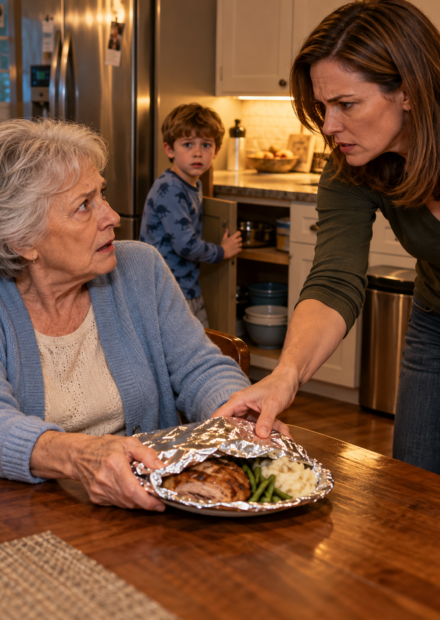
“You thought the way I ate might embarrass you in front of your colleagues.”
Silence.
“You decided your embarrassment mattered more than my dignity.”
Claire’s face had gone pale.
“And instead of telling me yourself, you had my son do it.”
“That wasn’t—”
“Yes.”
She stopped.
I continued.
“You removed my chair.”
Daniel looked at her.
I watched that detail hit him again.
The missing chair.
It had bothered me more than almost anything.
The conversation in the kitchen could have been impulsive.
The chair proved planning.
Claire whispered, “I needed space.”
“For one chair?”
“The table was crowded.”
“There were fifteen settings that morning.”
Claire’s eyes filled.
“I know.”
The words were tiny.
Daniel turned toward her.
“You told me Mom said she might eat downstairs.”
My stomach tightened.
Claire looked at him.
I looked at Daniel.
“What?”
He stared at his wife.
“You told me Thursday morning that Mom had said crowds were tiring for her.”
Claire’s face crumpled for one second.
Then hardened.
“I thought she would be more comfortable.”
Daniel stepped back.
“You told me she had already mentioned it.”
Claire’s eyes flashed.
“And you were happy to believe me.”
That silenced him.
Because it was true.
Daniel had been deceived about one detail.
Not the rest.
Claire had given him a softer story at first.
He had accepted it because it made the final cruelty easier.
He had still come into the kitchen.
He had still delivered the plate.
He had still repeated her words about my eating.
He had still shut the door.
No one was innocent.
That, strangely, made the truth easier to hold.
Claire began crying.
Not elegantly.
Not in the controlled way I had seen at weddings.
Her face folded.
She gripped the edge of the counter.
“I wanted one dinner,” she said.
Daniel stared.
“One dinner where what?”
“Where everything looked right.”
The kitchen was silent.
She laughed through tears.
“That sounds horrible.”
Neither of us answered.
“My boss was coming.”
I remembered the tall man at the end of the table.
Claire continued.
“His wife is… impossible.”
“What does that have to do with Margaret?” Daniel asked.
Claire wiped her face.
“She notices everything.”
I almost said something.
Then I stopped.
Claire looked at me.
“My mother always said if people come into your home, they judge the woman.”
There it was.
Not an excuse.
A root.
“The food,” she continued. “The house. The children. Your husband. Your mother-in-law.”
She shook her head.
“I knew you’d ask questions. I knew you might spill something. I knew you’d tell one of those long stories.”
I felt the old anger rise.
Claire looked at me and said:
“And I was embarrassed.”
Daniel closed his eyes.
Claire kept going.
“I was embarrassed before anything even happened.”
Tears slipped down her face.
“So I made sure nothing could.”
I took a slow breath.
There are moments when receiving the truth is less satisfying than imagining it.
I had wanted Claire to admit it.
Now that she had, I felt no victory.
Only sadness.
“What happened to you,” I asked, “that made you believe a perfect dinner mattered more than a person?”
Claire flinched.
I was not trying to be cruel.
For once, neither was she.
“My mother,” she said.
Then she laughed bitterly.
“Probably.”
I thought of Claire’s mother at Thanksgiving.
Perfect hair.
Perfect smile.
Perfect silence when her daughter humiliated an elderly woman.
Some lessons pass through families like heirlooms.
Daniel sat at the breakfast table.
He looked sick.
“I helped you do that.”
Claire turned toward him.
“You agreed.”
“I know.”
Neither defended themselves.
That mattered.
Not enough to reverse my decision.
But enough to make me hope they might eventually become people who deserved forgiveness.
Claire wiped her cheeks.
“I am sorry.”
This time, she looked directly at me.
“I was ashamed of you for getting old.”
My breath caught.
It was the cruelest thing she had ever said.
Because it was honest.
She continued before I could respond.
“And I acted like your aging was something ugly you were doing to me.”
Daniel whispered, “Claire.”
She shook her head.
“No. She wanted the truth.”
She looked at my hands.
“I hated when your hand shook.”
Instinctively, I curled my fingers.
Claire saw.
Her face changed.
“I’m sorry.”
I forced my hand open again.
She cried harder.
“I’m so sorry.”
I could have comforted her.
The old me would have.
I would have crossed the kitchen.
Taken her hand.
Told her she was forgiven.
That would have ended the discomfort.
Instead, I remained where I was.
“Thank you for telling me the truth.”
She nodded.
“Do you forgive me?”
Daniel looked at me.
I thought carefully.
“I believe your apology.”
Claire swallowed.
“That’s not what I asked.”
“I know.”
Her face fell.
“I don’t know yet.”
The room was very quiet.
“I’m not refusing forever,” I said. “I’m refusing to lie.”
Claire nodded slowly.
For once, she did not argue.
Moving day came cold and clear.
Frank arrived with his truck.
Daniel’s friend Mark came too.
I made coffee.
Real coffee.
A full pot.
Claire packed the last kitchen box herself.
She did not ask for my serving dishes.
Six months earlier, she would have assumed they were shared.
Now she wrapped only the things she and Daniel had bought.
That small respect meant more than it should have.
At noon, Daniel carried the final box to the truck.
Then he came back inside.
The house echoed.
Without their furniture, the rooms looked enormous.
Claire stood by the front door wearing her coat.
For a second, all three of us seemed unsure what came next.
Daniel hugged me.
Hard.
I closed my eyes.
My son smelled like cardboard, cold air, and the same aftershave he had worn for years.
“I love you,” he whispered.
“I love you too.”
“I’m sorry.”
“I know.”
He pulled back.
“I’m going to do better.”
I touched his cheek.
“Do it for yourself too.”
He nodded.
Then Claire stepped forward.
She did not hug me.
I was grateful.
A hug would have been too easy.
She held out the house key.
I looked at it in her palm.
“You can keep one for emergencies until everything is settled,” I said.
She shook her head.
“No.”
She placed it in my hand.
“I need to learn to knock.”
Something tightened in my throat.
“All right.”
She looked toward the dining room.
Then back at me.
“I’m sorry about the chair.”
Of all the things she could have said, she chose that.
I closed my fingers around the key.
“I know.”
She nodded.
Then she left.
I watched their cars disappear down the street.
The house became silent.
For the first time in twelve years, I was alone in it.
I expected triumph.
Instead, I cried.
I cried for the son who had disappointed me.
For the woman I had tried too hard to please.
For Robert.
For lost years.
For the version of myself who had believed keeping peace required becoming smaller.
I sat on the bottom stair and cried until the sunlight moved across the floor.
Then I wiped my face.
I went into the dining room.
The table was bare.
I stood beside the place where my chair had been removed on Thanksgiving.
And I understood something.
Justice does not always feel like winning.
Sometimes it feels like grief with a door finally open.