





















THE BIRTHDAY WISH MY AUNT TRIED TO BURY
Chapter 1 – THE CAKE IN THE TRASH
I was six years old when my aunt threw my birthday cake into a trash bin in front of thirty-two people.
I know there were thirty-two because I counted them later.
For years afterward, whenever I remembered that afternoon, I didn’t remember their faces first.
I remembered their shoes.
Black dress shoes.
Brown heels.
A pair of red pumps near the window.
My cousin’s sneakers beside the drinks table.
My mother’s cream-colored shoes frozen beside the piano.
Everybody had been standing there.
Everybody had seen what happened.
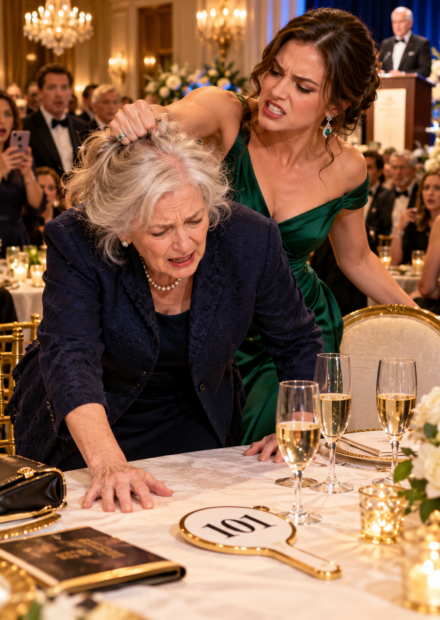
And when Aunt Evelyn turned my chocolate birthday cake upside down over the trash bin, not one of those thirty-two people moved.
The cake had blue icing.
That mattered to me.
For three weeks, I had reminded my mother almost every morning that I wanted blue letters because blue was my father’s favorite color.
“M-A-S-O-N,” I would spell while Claire—my mother—made breakfast.
“All capital letters.”
“I told the bakery.”
“And six candles.”
“I told them.”
“Blue?”
“Yes, Mason.”
“Not light blue.”
“Regular blue.”
“Like Dad’s tie?”
My mother always became quieter when I mentioned Dad.
But that morning she smiled.
“Exactly like Dad’s tie.”
My father, Daniel Carter, had been dead for almost two years.
At six, two years felt like half a lifetime.
I still remembered his hands.
I remembered the smell of sawdust on his coat because he liked repairing old furniture even though he could have paid somebody else to do it.
I remembered the low sound of his laugh.
I remembered that he never called me buddy.
He called me Mr. Mason when he was pretending I was important.
“Mr. Mason,” he would say, opening a door for me. “Your vehicle awaits.”
The vehicle was usually our old SUV.
To me, it might as well have been a limousine.
After Dad died, people stopped pretending things could be funny.
Especially Aunt Evelyn.
She was my father’s older sister.
Technically, she became more present in our lives because she said family had responsibilities after a tragedy.
In practice, she was simply there.
At breakfast.
At family dinners.
At the bank with my mother.
At meetings I wasn’t allowed to understand.
Inside Dad’s study.
At our house when I came home from school.
She started telling people things about me.
At first, I didn’t know.
Children rarely know the version of themselves adults discuss when they think children cannot hear.
I learned by accident.
“Mason has become very manipulative since Daniel died.”
That was Evelyn speaking to my grandmother in the kitchen one afternoon.
I was sitting on the stairs.
“He knows Claire feels guilty,” Evelyn continued. “So he cries when he wants something.”
I remember looking down at my knees.
I had cried that morning because I couldn’t find one of Dad’s old baseball caps.
I wondered whether that counted.
Another time, I heard her say I lied.
Then she said I broke things deliberately.
Then she said I had stolen five dollars from her purse.
I hadn’t.
Mom believed me about the five dollars.
But every accusation left something behind.
A question.
A hesitation.
A moment when someone looked at me just a little too long.
By my sixth birthday, Aunt Evelyn had turned me into a difficult child without ever having to prove I had done anything difficult.
That was why the silence in the party hall felt almost normal.
The party was being held at my grandmother’s old family property outside the city, in a hall attached to the house where Dad and Evelyn had grown up.
There were gold curtains.
White tablecloths.
Balloons tied to the backs of chairs.
And at the center table stood an old oak chair everyone in Dad’s family called the birthday chair.
Every Carter child had supposedly sat in it.
Dad had shown me scratches under one armrest once.
“That one is mine,” he had said proudly.
“You scratched Grandma’s chair?”
“I was nine.”
“You were bad.”
“I was artistic.”
I had laughed so hard I nearly fell out of it.
So when I sat in that chair on my sixth birthday, I felt closer to Dad.
Until Aunt Evelyn told me to get up.
The trouble started less than an hour before the cake.
I had gone looking for the bathroom.
That was true.
I had also stopped outside Dad’s old office.
That was true too.
The door wasn’t locked.
The desk drawer inside was.
I never touched it.
But Evelyn found me in the hallway.
“What were you doing?”
“Nothing.”
“Don’t lie to me.”
“I was going to the bathroom.”
“You were in Daniel’s office.”
“No.”
“I saw you coming out.”
“I didn’t go in.”
Her mouth changed.
That was how I always knew she had stopped asking a question and started creating an answer.
“You opened the drawer.”
I stared at her.
“What drawer?”
“The locked drawer in your father’s desk.”
“I didn’t.”
“Where is the key?”
“I don’t have a key.”
She grabbed my wrist.
Not hard enough to leave a bruise.
Hard enough that I remembered.
“Tell me where you put it.”
“I don’t know.”
“Mason.”
I began crying.
That only made her calmer.
She brought me back into the hall by the hand.
Everyone was there.
Mom saw my face immediately.
“What happened?”
“He was in Daniel’s office.”
Evelyn’s voice carried across the room.
My mother frowned.
“So?”
“He opened the locked drawer.”
“I didn’t!” I shouted.
Thirty-two adults turned toward me.
Evelyn released my wrist.
“There,” she said softly. “That’s exactly the behavior I’ve been talking about.”
My mother walked to me and crouched down.
“Mason, look at me.”
I did.
“Did you go into Dad’s office?”
“No.”
“Did you touch his desk?”
“No.”
“Did you find a key?”
“No.”
That answer was true at the time.
I watched my mother’s face.
I needed her to believe me.
She touched my cheek.
“I believe you.”
Evelyn laughed once.
Not loudly.
That was somehow worse.
“Claire, this is what he does.”
“What does he do?”
“He makes you rescue him.”
“He’s six.”
“He’s old enough to understand consequences.”
I didn’t understand what happened next until years later.
Evelyn hadn’t been angry because she believed I had opened the drawer.
She was terrified that I had.
At six, all I knew was that the adults started speaking in low voices.
I was moved away from Dad’s office.
Then Aunt Evelyn announced that since I had “refused to tell the truth,” there would be a consequence.
Mom objected.
My grandmother told everyone to calm down.
An uncle said maybe the party should continue.
And then Evelyn walked toward the bakery box.
My cake.
I forgot the argument.
I forgot the drawer.
I forgot the way she’d grabbed my wrist.
She lifted the cake from the table with both hands.
Six candles were already pushed into the frosting.
My name curved across the top in blue icing.
MASON.
For one hopeful second, I thought the argument was over.
I actually smiled.
I stepped toward her.
Then she turned away from me.
There was a large trash bin near the catering table.
Evelyn carried my cake toward it.
I remember thinking she was going to move the bin because it looked ugly in the photographs.
Instead, she lifted the cake higher.
Something inside me knew before it happened.
“No.”
She flipped it.
The cake fell upside down.
Chocolate frosting struck the plastic liner with a soft, wet sound.
Two candles disappeared immediately.
The others rolled against the side.
The blue M from my name stuck to the cardboard for half a second before sliding down into the chocolate.
“No cake for spoiled children,” Evelyn said.
I couldn’t breathe.
I ran to the trash bin.
“No. Please.”
I looked inside as if somebody might be able to fix it.
“That was mine.”
Nobody spoke.
Thirty-two people.
No one spoke.
I gripped the front of the little navy suit jacket my mother had bought for me.
The room became blurry.
“Evelyn.”
My mother’s voice sounded different.
I turned.
She was white with anger.
“What did you just do?”
“What someone should have done a long time ago.”
“To a birthday cake?”
“To the behavior.”
“He didn’t do anything.”
“He broke into Daniel’s office.”
“He says he didn’t.”
“Of course he says that.”
“Mason.”
Mom reached for me.
I ran to her.
She wrapped her arms around me.
I buried my face against her dress.
For a moment, I thought she might take me home.
I wanted her to.
I wanted to leave all thirty-two people and the balloons and the gold curtains and the stupid birthday chair.
Then the front doors opened.
Cold afternoon air moved through the hall.
Several people turned.
A man stepped inside wearing a dark gray coat.
Three other men followed him.
I recognized him, although I hadn’t seen him since Dad’s funeral.
Roman Moretti.
Dad used to call him Rome.
He wasn’t actually related to us.
When I was little, I thought he was because he was in so many old photographs.
Dad and Roman at seventeen beside a broken motorcycle.
Dad and Roman at a lake.
Dad and Roman wearing terrible tuxedos at somebody’s wedding.
After Dad died, Roman had come to our house twice.
Then Aunt Evelyn and my mother had argued about him.
After that, he stopped coming.
I hadn’t known he was invited.
Judging by my mother’s face, neither had she.
Roman stopped just inside the room.
He looked at me first.
Then my mother.
Then at the trash bin.
Chocolate frosting was smeared along the black plastic liner.
One blue letter was stuck near the rim.
Roman stared at it.
“What happened here?”
No one answered.
He walked farther into the hall.
Aunt Evelyn stepped in front of him.
“This is a family matter.”
Roman looked at her.
He had a way of becoming very still when he was angry.
I remembered that about him.
At Dad’s funeral, a reporter had tried to photograph my mother while she was crying.
Roman had never raised his voice.
He had only stepped between them and said, “Leave.”
The reporter had left.
Now Roman looked past Evelyn toward me.
“Why is Mason crying?”
“He was disciplined.”
Roman glanced toward the trash bin again.
“For what?”
“He broke into Daniel’s office.”
“I didn’t!” I said.
Roman’s eyes came back to mine.
Evelyn exhaled sharply.
“See? He interrupts adults, he lies, he—”
Roman walked past her.
He came to me and crouched.
We were almost eye level.
“Hey, Mr. Mason.”
My breath caught.
Nobody had called me that since Dad died.
I stared at him.
Roman’s expression changed slightly.
He knew exactly what the words had done to me.
“What happened?”
I tried to answer.
Instead I cried harder.
Mom kept one arm around my shoulders.
Roman waited.
He didn’t tell me to stop crying.
He didn’t tell me to be brave.
Eventually I managed, “She threw my cake away.”
“I can see that.”
“She said I opened Dad’s drawer.”
“Did you?”
“No.”
Roman nodded once.
Behind him, Evelyn said, “You’re encouraging this.”
He ignored her.
Then I felt something sharp against my palm.
I looked down.
I had forgotten what I was holding.
A small brass key.
Roman saw it too.
His entire face changed.
“Where did you get that?”
Every adult near us seemed to move at once.
Evelyn took a step forward.
I closed my hand around the key.
“I found it.”
“Where?” Roman asked.
“Under the chair.”
“What chair?”
I pointed.
“The birthday chair.”
Nobody spoke.
I had found the key twenty minutes before Evelyn accused me of opening Dad’s office.
I had dropped a paper napkin.
When I crawled beneath the old oak chair to retrieve it, I saw something taped to the underside.
A little envelope.
A brass key.
I had pulled them free.
The envelope had my name on it.
Not in Mom’s handwriting.
Not in Evelyn’s.
Dad’s.
MASON.
I knew every crooked line.
Roman’s voice became very quiet.
“Was there anything with the key?”
I nodded.
“A note.”
Evelyn’s face went pale.
“Where is it?”
I pointed toward my jacket.
Mom reached into my inside pocket.
Her fingers shook as she unfolded the small piece of paper.
I watched her read it.
Then she covered her mouth.
Roman stood.
“Claire?”
She gave him the note.
He read it.
I knew the words already.
I had sounded them out under the table.
They were short enough for a child.
If Evelyn tries to stop your birthday, give this key to Roman.
Love always,
Dad.
Roman read it twice.
Then he looked at Evelyn.
For the first time in my life, my aunt looked frightened of someone.
“That’s ridiculous,” she said.
Roman didn’t answer.
“It’s sentimental nonsense Daniel left years ago.”
Still no answer.
“He was sick when he wrote half those notes.”
My mother turned toward her.
“Those notes?”
Evelyn froze.
Roman’s eyes sharpened.
“What other notes?”
“I didn’t mean—”
Roman looked down at the brass key in my hand.
He held out his palm.
“Mason.”
I looked at my mother.
She nodded.
I put the key into Roman’s hand.
The moment it touched his skin, Evelyn moved between him and the hallway leading toward Dad’s old office.
“You are not going in there.”
Roman stared at her.
“This key opens Daniel’s desk.”
“You don’t know that.”
“I watched him have it cut.”
My mother inhaled.
Evelyn’s lips parted.
Roman stepped toward the hallway.
She didn’t move.
“You have no right.”
Roman stopped.
“Then call the police.”
That changed the room.
Someone near the windows coughed.
My grandmother sat down.
Roman continued.
“Tell them Mason broke into the office. Tell them you destroyed his birthday cake as punishment. Then tell them there’s a disputed key and a locked drawer belonging to his deceased father.”
Evelyn said nothing.
Roman tilted his head.
“No?”
“This is none of your business.”
Roman looked at the note in my mother’s hand.
“Daniel made it my business.”
Aunt Evelyn’s voice dropped.
“You don’t know that child.”
Roman looked at me.
I was still crying.
My jacket was crooked.
There was a smear of chocolate frosting on one sleeve where I had touched the trash bin.
“No,” he said.
Then his eyes returned to her.
“But I knew his father.”
He stepped around her.
My mother took my hand.
And I made the first decision that changed the rest of my life.
I followed them.