





















MY MOTHER-IN-LAW FORGOT MY NAME—BUT SHE REMEMBERED EVERY DOLLAR THEY STOLE
Chapter 1 – The First Name She Forgot
The first time my mother-in-law called me by the wrong name, she was holding a knife.
“Anna,” Evelyn said calmly, “could you bring me the blue bowl?”
I stopped in the kitchen doorway.
The knife moved through an apple in slow, neat slices.
My name is Claire.
I had been married to Evelyn Bennett’s son for eleven years. She had attended our wedding, held my hand through two miscarriages, remembered every birthday I had ever mentioned, and once corrected my husband when he bought me lilies instead of peonies.
Evelyn did not forget names.
Not mine.
I looked at Ben.
My husband stood beside the coffee machine with one hand frozen around his mug.
“Mom,” he said carefully, “that’s Claire.”
Evelyn looked up.
For two or three seconds, her eyes rested on me without recognition.
Then she smiled.
“Oh.”
A small laugh.
“Of course.”
She put another apple slice on the plate.
“Claire.”
Ben tried to smile back.
I couldn’t.
Something in my stomach had already tightened.
Evelyn was seventy-two. She had gray hair she kept cut just below her jaw, knees that bothered her when it rained, and a stubborn refusal to let anyone carry her groceries unless she had bought more than one gallon of milk.
But she was sharp.
Sharp enough to do the Sunday crossword in ink.
Sharp enough to remember which neighbor still owed her fourteen dollars from a yard sale three summers ago.
Sharp enough to know exactly when Ben was lying about being “almost there” when she called him.
So when she forgot my name, the room changed.
No one said the word dementia.
Not that morning.
But it entered the house anyway.
It sat with us at breakfast.
It followed Ben and me home.
And three days later, it came back wearing a different face.
Evelyn lost her purse.
We found it in the linen closet.
Two days after that, she accused Ben of moving the sugar even though the sugar was exactly where it had always been.
Then she put the television remote in the refrigerator.
That was the incident that made Ben call his sister.
Melissa arrived twenty minutes later.
My sister-in-law never simply entered a room.
She arrived in it.
Perfume first. Heels second. Opinion third.
She had been that way for as long as I had known her.
Melissa was three years older than Ben and had inherited their father’s confidence without inheriting his patience. After their father died six years earlier, she had slowly appointed herself the practical one in the family.
She knew where Evelyn kept her insurance papers.
She knew the name of her cardiologist.
She knew when the property tax bill was due.
And, increasingly, she liked reminding the rest of us that she knew.
When Ben told her about the remote, Melissa didn’t laugh.
She looked toward the living room where Evelyn sat watching an old black-and-white movie.
Then she lowered her voice.
“This is how it starts.”
Ben flinched.
“Don’t say that.”
“I’m not trying to scare you.”
“You’re doing a good job.”
Melissa folded her arms.
“You both need to stop pretending age doesn’t happen.”
“I’m not pretending anything.”
“You don’t live with her.”
Neither did Melissa.
But Ben didn’t say that.
Evelyn had fallen in her kitchen six weeks earlier. No broken bones, thankfully, but the fall frightened all of us enough that Ben and I had started spending four nights a week at her house.
I worked remotely as an insurance claims coordinator, so I could take my laptop to Evelyn’s dining room. Ben managed a hardware store fifteen minutes away.
Melissa lived across town and came by several times a week.
At least, that was what she told us.
That afternoon, Melissa sat beside Evelyn and touched her arm.
“Mom?”
Evelyn kept her eyes on the television.
“Mm?”
“Do you know who I am?”
I turned so fast I nearly dropped the dish I was drying.
“Melissa.”
“What?”
“You can’t ask her like that.”
“Why not?”
“Because she lost a remote. She didn’t wake up not knowing her own children.”
Melissa ignored me.
“Mom?”
Evelyn finally looked at her.
She stared.
Melissa’s expression changed.
I saw genuine fear there.
Then Evelyn smiled.
“You’re the loud one.”
Ben burst out laughing before he could stop himself.
Even I almost did.
Melissa didn’t.
“Very funny.”
Evelyn went back to her movie.
But as Melissa stood, Evelyn reached for her wrist.
“The house remembers,” she said.
Melissa frowned.
“What?”
“The house remembers who opens the wrong doors.”
For the first time, even Evelyn looked confused by what she had just said.
Then she released Melissa’s wrist.
“Would someone make tea?”
That night, Ben barely slept.
I knew because neither did I.
At two in the morning, I heard him roll onto his back.
“Do you think it’s dementia?”
I stared into the darkness.
“I don’t know.”
“She called you Anna.”
“I know.”
“And that thing about the house.”
“I know.”
He exhaled.
“My grandmother had Alzheimer’s.”
I turned toward him.
Ben almost never talked about his grandmother’s final years.
He had been nineteen when she stopped recognizing him.
“I remember.”
“I don’t want Mom going through that.”
I found his hand beneath the blanket.
“We don’t know that she is.”
“No.”
But his fingers tightened around mine.
We both knew uncertainty was not the same thing as hope.
Over the next two weeks, Evelyn became worse.
Or at least that was what it looked like.
She hid her reading glasses inside a bag of rice.
She left her house keys beneath the sofa cushion.
She asked Melissa whether it was Tuesday when it was Friday.
She called Ben by his father’s name once.
She called me Anna four more times.
The fifth time hurt more than the first.
I wish I could say I handled it with grace.
I didn’t.
I had spent years building something with Evelyn that neither of us had expected.
When Ben first brought me home, she had been polite but cautious. I was the woman taking her youngest son into a life she couldn’t supervise.
For my part, I had entered marriage prepared for the kind of mother-in-law people joke about.
We surprised each other.
After my first miscarriage, it was Evelyn who sat on my bathroom floor at three in the morning because Ben was stuck in another state after a flight cancellation.
She didn’t tell me everything would be okay.
She didn’t tell me I could try again.
She simply sat there.
When I finally whispered, “I feel empty,” she squeezed my hand and said, “Then I’ll sit with you until you don’t have to feel empty alone.”
I never forgot that.
So hearing her look directly at me and say, “Anna, where did you put my sweater?” felt like being erased in inches.
One evening, I went into the laundry room and cried where no one could see me.
That was where Evelyn found me.
I wiped my face immediately.
“Claire?”
My head snapped up.
Not Anna.
Claire.
Her eyes were clear.
Focused.
She looked like herself.
“You know my name.”
A pause.
Then her expression loosened.
“Of course I know your name.”
My heart began beating harder.
“Evelyn, you’ve called me Anna five times.”
“Have I?”
“Yes.”
She tilted her head.
“Oh, honey.”
She stepped toward me.
Then she stopped.
For one second, something strange happened.
Her eyes flicked toward the hallway.
Not randomly.
Deliberately.
As if checking whether we were alone.
Then she leaned closer and lowered her voice.
“People show you who they are when they think you can no longer remember it.”
I stared at her.
“What does that mean?”
The dryer buzzed.
Evelyn jerked as if startled.
Then her face changed again.
Softened.
Clouded.
“Did you wash the blue towels?”
I stood frozen.
“Evelyn.”
She opened the dryer.
“Blue towels, Anna.”
Cold moved across my skin.
The next morning, I began writing things down.
At first, I told myself I was documenting symptoms for a doctor.
Date.
Time.
What Evelyn forgot.
What she said.
Who was present.
September 3. Called me Anna at breakfast. Ben present.
September 4. Couldn’t find purse. Melissa found it in hall closet.
September 6. Said house remembers who opens wrong doors. Melissa present.
September 8. Called me Claire while alone with me. Immediately switched to Anna after checking hallway.
That last sentence bothered me.
I read it three times.
Then I closed the notebook.
A reasonable person would have assumed I was looking for a pattern because I was frightened.
Maybe I was.
But once I began paying attention, I noticed things that didn’t fit.
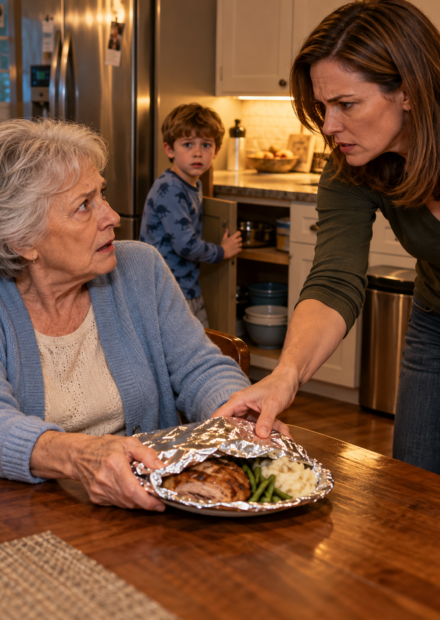
Evelyn forgot the day of the week but remembered exactly how long her chicken had been in the oven.
She misplaced her keys but reminded Ben that the car registration expired on October seventeenth.
She forgot the neighbor’s name but noticed that the pharmacy had charged her two dollars more than usual.
She called me Anna in front of Melissa.
Never when we were completely alone.
Not after the laundry room.
And whenever she said something that sounded meaningless, Melissa reacted more strongly than anyone else.
“The attic gets cold when papers disappear.”
Melissa dropped her fork.
“Some people count money backward.”
Melissa stopped talking.
“You can change a lock without changing a door.”
Melissa went pale.
Each time, Evelyn looked vague and confused afterward.
Each time, Melissa tried to change the subject.
I told myself I was imagining things.
Then money disappeared.
Evelyn kept emergency cash in a small wooden box in her bedroom closet.
Everyone knew about it.
Not how much.
Just that it existed.
Her late husband had believed every household should have enough cash on hand to survive three days without banks, electricity, or common sense.
On a Wednesday afternoon, Evelyn came downstairs holding the empty box.
“I’ve been robbed.”
Ben stood from the dining table.
“What?”
“My money.”
Melissa, who had arrived fifteen minutes earlier, turned from the kitchen counter.
“What money?”
Evelyn shook the box.
“My emergency money.”
“How much?”
“Eight hundred.”
Ben stared.
“You had eight hundred dollars in cash upstairs?”
“It was twelve hundred last month.”
The room went still.
Melissa spoke first.
“So four hundred was already missing?”
Evelyn looked at her.
“Was it?”
“You just said—”
“I don’t know.”
She pressed a hand to her temple.
“I don’t know anymore.”
Ben went upstairs.
I followed.
The closet door was open.
Nothing looked broken.
No window forced.
No drawers dumped.
Someone who knew the house could have walked into that room, taken the box, removed the money, and left.
Ben checked the windows.
I checked beneath clothing and behind shoes, hoping Evelyn had moved the cash and forgotten.
Nothing.
When we came downstairs, Melissa was holding Evelyn’s hand.
“This is exactly what I’ve been afraid of.”
Her voice was gentle.
Almost too gentle.
“We need to talk about somebody helping with your finances.”
Evelyn looked frightened.
“Why?”
“Because things are going missing.”
“I didn’t lose my money.”
“I’m not saying you did.”
“You think I did.”
“No.”
“You think I’m stupid.”
Melissa looked at Ben.
“See?”
I hated the way she said it.
Not because she was necessarily wrong.
Because she sounded prepared.
Ben crouched beside his mother.
“No one thinks you’re stupid.”
“Anna does.”
All three of them looked at me.
I swallowed.
“My name is Claire.”
Evelyn blinked.
“Of course.”
Melissa exhaled and stood.
“We need a doctor.”
“I have a doctor.”
“A specialist.”
“I’m not crazy.”
“No one said crazy.”
“You always say things without saying them.”
For the first time, anger sharpened Evelyn’s voice.
Melissa’s face tightened.
Then Evelyn suddenly laughed.
A bright, almost girlish laugh.
“I hid it.”
Ben frowned.
“What?”
“The money.”
“Where?”
She looked around the room.
Her smile vanished.
“I don’t remember.”
Melissa closed her eyes.
Ben looked devastated.
I looked at Evelyn’s hands.
They were resting on her lap.
Completely still.
Evelyn’s hands were never still when she was frightened.
She rubbed her wedding ring.
Picked at her thumbnail.
Twisted tissues.
I knew because I had watched those hands tremble in a hospital waiting room when Ben had emergency surgery nine years earlier.
Now they did nothing.
She wasn’t frightened.
She was watching us.
I knew it before I understood what I knew.
Later that evening, after Melissa left and Ben went to take a shower, Evelyn passed me in the hallway.
She did not look at me.
She said only six words.
“Did you see who wanted control?”
Then she kept walking.
I stood there listening to her footsteps disappear upstairs.
That night, I opened my notebook again.
Under the list of forgotten names and missing objects, I wrote one new sentence.
Evelyn is not losing her memory.
Then, after a long hesitation, I added another.
She wants us to think she is.
And suddenly the question that terrified me wasn’t what was happening to my mother-in-law.
It was why she believed pretending to lose her mind was the safest way to find out what was happening inside her own family.