MY DAUGHTER-IN-LAW SLAPPED ME FOR DRINKING MILK. THEN MY SON CAME HOME EARLY.
Chapter 1 – THE GLASS ON THE FLOOR
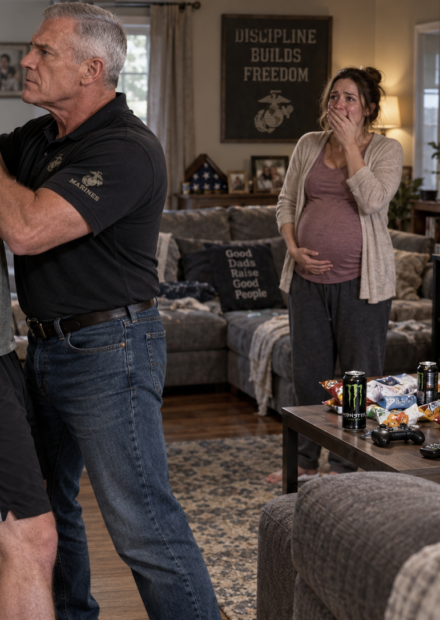
The first slap knocked the glass from my hand.
It struck the white tile beside my left slipper and exploded into bright pieces.
Milk spread through the cracks between the tiles.
For a second, that was all I could look at.
The milk.
The broken glass.
My own hand still curled around something that was no longer there.
Then my cheek began to burn.
“You were told not to touch anything in this refrigerator.”
Jessica stood in front of me with one hand still raised.
My daughter-in-law.
My son’s wife.
The woman who had spent the last three months telling everyone that I was forgetting things.
I stared at her.
I had known Jessica for nine years.
I had watched her marry my only child.
I had bought the pearls she wore at her wedding.
I had sat beside her in a hospital waiting room when her father died.
I had defended her when old family friends whispered that Daniel had married too quickly after meeting her.
And now she had struck me because I poured myself a glass of milk.
I wish I could say I slapped her back.
I wish I could say I shouted.
I wish I could tell you that seventy-six years of living had taught me never to lower my head to cruelty.
But fear changes you.
Not all at once.
It does not walk through the front door wearing a monster’s face.
Sometimes it arrives quietly.
It moves your car keys.
It hides your phone.
It opens your mail before you can reach it.
It tells the neighbors you are tired.
Then forgetful.
Then confused.
And one morning you wake up and realize you have started asking permission to eat in your own house.
Jessica stepped closer.
“What did I say?”
My voice sounded weak when I answered.
“I was hungry.”
“What?”
“I said I was hungry.”
She pointed toward the milk on the floor.
“That was the last carton.”
“I only wanted one glass.”
She laughed.
It was not a pleasant laugh.
“You live here for free, Margaret.”
I looked at her.
The words were absurd.
This was my house.
Arthur and I had bought it thirty-eight years earlier when Daniel was still in grade school. We had replaced the kitchen twice. I had chosen those white tiles myself. I had planted the maple tree outside the breakfast window with my own hands.
But Jessica had repeated that sentence so many times over the previous weeks that part of me no longer reacted.
You live here for free.
You do not buy the groceries.
You do not pay the bills.
You should be grateful.
It did not matter that the property taxes still came from my account.
It did not matter that my name remained on the deed.
Truth can become strangely fragile when the person standing three feet away from you is willing to lie every day.
Jessica snatched the empty carton from the counter and threw it into the sink.
“You do not buy the groceries. You do not pay the bills. Stop acting like everything in this house belongs to you.”
My eyes moved toward the back door.
The movement was automatic.
She noticed.
She always noticed.
“You thinking about going somewhere?”
“No.”
“Good.”
My car keys had disappeared six weeks earlier.
Jessica claimed I had misplaced them.
When I asked where the spare set was, she told me Daniel had asked her to keep them because he was worried I might drive while confused.
When I asked Daniel about it during one of our brief calls, she was standing beside me.
I did not ask twice.
My phone disappeared soon after that.
According to Jessica, I had left it somewhere.
Maybe in the garden.
Maybe upstairs.
Maybe in the trash.
“Do you remember where you put it?” she would ask me with that sympathetic little smile.
I remembered exactly where I had left it.
On my bedside table.
Charging.
But every time I insisted, she sighed as though I had disappointed her.
Eventually, even Mrs. Patterson stopped coming over.
Linda Patterson had lived across the street for twenty-two years.
We had buried husbands within eighteen months of each other.
We drank coffee on Tuesday mornings.
We complained about our knees.
We watched the same ridiculous game show and pretended we did not.
Then Jessica met Linda at the door one morning and told her I had not been sleeping well.
The next week, she said I had become agitated.
The week after that, she said I sometimes did not recognize people.
That lie hurt more than I admitted.
Because once people think you are losing your mind, everything you say begins to sound suspicious.
Every disagreement becomes confusion.
Every objection becomes agitation.
Every fear becomes paranoia.
Jessica knew that.
She had learned how to use it.
So that morning, standing barefoot in my own kitchen with milk soaking into the hem of my robe, I did what I had taught myself to do during the previous three months.
I lowered my eyes.
Jessica picked up a dish towel.
“Clean it.”
I looked at the shards.
“My hands shake.”
“Then be careful.”
“I could cut myself.”
“That sounds like a you problem.”
I bent slowly.
My right knee protested.
My fingers had barely touched the towel when Jessica spoke again.
“And you are not having breakfast.”
I froze.
“You already had something.”
“No, I didn’t.”
Her expression changed immediately.
Not anger.
Something worse.
Concern.
Artificial, patient concern.
“Margaret.”
“I didn’t eat.”
“You had toast.”
“No.”
“At seven.”
“No, Jessica.”
“You seriously don’t remember?”
My stomach tightened.
“I was in my room at seven.”
“You came downstairs.”
“I did not.”
“You ate two pieces.”
For one terrible second, I wondered whether I had.
That was the worst part.
Not believing her.
Wondering.
I knew who I was.
I knew the year.
I knew the president.
I knew Daniel’s birthday.
I knew exactly how much cinnamon I put into my apple pie.
But after weeks of being told I had forgotten conversations that had never happened, moved objects I had never touched, and eaten meals I had never seen, a small crack had opened inside me.
A crack where doubt lived.
Jessica watched my face.
I saw satisfaction pass through her eyes.
Then a suitcase hit the floor behind us.
The sound was so sudden that Jessica spun around.
I did too.
Daniel stood in the kitchen doorway.
For a moment, my mind refused to understand what my eyes were seeing.
My son was supposed to be in Seattle.
He had been there nearly three months, overseeing the largest business deal Cole Manufacturing had attempted since his father died.
The trip was supposed to last another week.
He had told me so himself.
Thursday, Mom.
I’ll be home next Thursday.
But there he stood.
Navy travel jacket.
Wrinkled white shirt.
Dark circles under his eyes.
His suitcase lying sideways behind him.
Jessica’s face lost all color.
“Daniel?”
He did not answer her.
He was staring at me.
No.
Not at me.
At my cheek.
I lifted one hand to cover it.
Too late.
His eyes followed the movement.
Something changed in his face.
Daniel had his father’s temper, but he had spent years learning to bury it under boardroom manners and carefully measured sentences.
What I saw then was not temper.
It was horror.
He walked toward me.
Slowly.
Past Jessica.
He stopped close enough that I could smell airport coffee and cold September air on his jacket.
“Mom.”
I swallowed.
His eyes moved to the milk on the floor.
The broken glass.
The towel in my hand.
Then back to my face.
“How long?”
I looked down.
“Mom.”
Jessica moved first.
“Oh, for God’s sake. She is making this look worse than it is.”
Daniel did not turn.
“She dropped a glass,” Jessica continued. “I was trying to stop her from stepping on it.”
My heart started beating harder.
There it was.
The lie.
Instant.
Smooth.
Practiced.
Daniel looked at me.
“Did she hit you?”
I could not answer.
Not because I wanted to protect Jessica.
Because three months of fear does not disappear when a door opens.
Jessica stepped forward.
“She has been impossible lately. Daniel, you have no idea what I have been dealing with. She forgets things. She eats food and then says she hasn’t eaten. She tries to go outside alone. She loses things.”
Daniel finally turned toward his wife.
His face was completely still.
Jessica kept talking.
“She is not safe by herself anymore.”
Daniel said one word.
“Safe?”
“Yes.”
“Is that what you call this?”
“Call what? A broken glass?”
He pointed at my cheek.
Jessica’s eyes flickered.
“She got upset.”
Daniel stared at her.
“That mark has fingers in it.”
Silence.
Jessica looked at me.
I flinched.
I hated myself for it.
But Daniel saw.
And that tiny movement changed everything.
He stepped between us.
Jessica’s mouth tightened.
“What are you doing?”
Daniel reached into his jacket.
He pulled out his phone.
My breath caught.
Not because of the phone.
Because of his eyes.
They were wet.
“Two weeks ago,” he said, “Mom borrowed Mrs. Patterson’s phone across the street and called me.”
Jessica turned toward me so quickly that I took a step backward.
Daniel moved with her.
One step.
Blocking her.
“She cried for eleven minutes.”
His voice cracked.
“My mother does not cry.”
“Daniel—”
“No.”
“She was confused.”
“No.”
“You were three states away. You don’t know what has been happening.”
“I know more than you think.”
Jessica went very still.
Daniel unlocked his phone.
“So I had cameras installed.”
I stared at him.
Jessica blinked.
“What?”
“The insurance company was supposedly updating the security system.”
Her lips parted.
Daniel nodded toward the small black sensor above the pantry door.
“You signed the installer in yourself.”
“That was for insurance.”
“No. It wasn’t.”
For the first time since Daniel walked into the room, I watched genuine fear move across Jessica’s face.
He continued.
“I had cameras installed in the kitchen, the hallway, the study, the garage entrance and the back patio.”
Jessica looked around the room.
As if the walls had suddenly grown eyes.
“I have been watching this house every night from Seattle.”
I covered my mouth.
Daniel looked at me.
“I saw her lock the pantry.”
My chest tightened.
“I saw her take your mail.”
Jessica whispered, “You recorded me?”
“I saw you tell Mom she couldn’t have dinner because she had already eaten lunch.”
“That is not—”
“I saw you take her phone from her bedroom.”
I closed my eyes.
So I had been right.
Of course I had been right.
The knowledge should have comforted me.
Instead, I wanted to sit down and weep.
Daniel’s voice shook now.
“I saw you tell my mother that nobody would believe an old woman who was losing her mind.”
Jessica backed toward the counter.
“That is not the whole story.”
Daniel nodded.
“No.”
He looked at his phone.
“It isn’t.”
Something about the way he said it made me cold.
He touched the screen.
A video appeared.
The date at the bottom showed three nights earlier.
The kitchen.
My kitchen.
After midnight.
Jessica entered first.
Then a man in a gray coat followed her.
My fingers closed around the edge of the table.
Daniel paused the video.
Jessica looked as if breathing had become painful.
“Play it,” I whispered.
Daniel glanced at me.
“Mom.”
“Play it.”
He did.
The man turned toward the hidden camera.
And my heart seemed to stop.
Grant Mercer.
Daniel’s oldest friend.
The chief financial officer of Cole Manufacturing.
A man who had eaten Thanksgiving dinner at this table.
A man my late husband had once called practically family.
A man who had personally arranged Daniel’s three-month assignment in Seattle.
On the screen, Grant placed a thick folder on the counter.
Jessica looked toward the hallway.
Even in the recording, I could see her nervousness.
Grant did not look nervous at all.
He leaned toward her.
Daniel raised the volume.
Grant’s voice filled the kitchen.
“By Friday, Margaret Cole will not be legally capable of stopping us.”
He smiled at Jessica.
“After that, the house, the company, all of it is ours.”
Jessica closed her eyes.
I stared at the man on the screen.
Then at my son.
And suddenly I understood something far worse than hunger.
Far worse than the bruises.
Far worse than the locked pantry.
Jessica had not been trying to convince me that I was losing my mind.
She had been preparing everyone else to believe it.
And Friday was only four days away.