MY DAUGHTER-IN-LAW SLAPPED ME FOR DRINKING MILK. THEN MY SON CAME HOME EARLY.
Chapter 5 – WHAT THEY COULD NOT TAKE
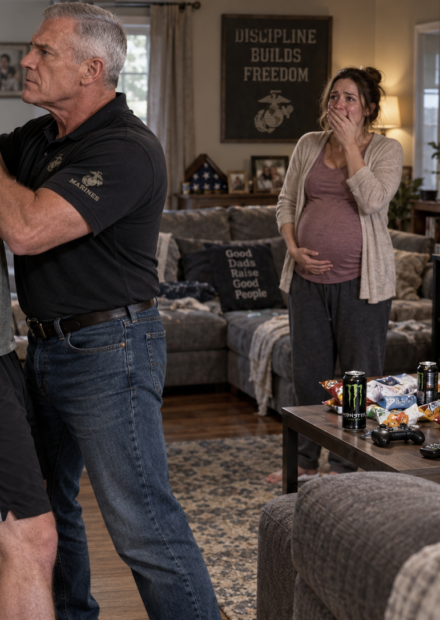
Linda Patterson stood on the porch with a police officer.
Beside them was a woman from adult protective services.
I stared through the window.
For one terrible second, I almost told Daniel not to open the door.
That is another thing abuse does.
It teaches you to fear the moment someone finally sees it.
Because once other people know, the private humiliation becomes real.
Daniel rested one hand on the doorknob.
He looked at me.
“Your choice.”
Those two words mattered.
My choice.
Not Jessica’s.
Not Grant’s.
Not Daniel’s.
Mine.
I walked toward the door.
“Open it.”
He did.
Linda saw my cheek.
Her eyes filled.
“Oh, Margaret.”
I shook my head.
“Please don’t pity me.”
“I don’t.”
“Good.”
She reached for my hand.
“I’m angry.”
That I could accept.
Jessica stayed in the kitchen.
The officer spoke with Daniel first.
Then with me.
I told him about the slap.
He asked whether it was the first time Jessica had hit me.
I hesitated.
“No.”
Daniel turned.
I had not told him.
Jessica spoke from the kitchen.
“She is lying.”
The officer raised a hand.
“Ma’am, please let her finish.”
The second time had been three weeks earlier.
Not a slap.
Jessica had gripped my arm after I tried to take back a letter she had removed from the mail.
Her fingers left bruises.
I had worn long sleeves for five days.
Daniel looked sick.
“Why didn’t you tell me?”
I looked at him.
“Because by then I was starting to think maybe I was causing it.”
His face crumpled.
I regretted the sentence only because it hurt him.
Not because it was false.
The woman from protective services sat with me in the living room.
She asked questions slowly.
My name.
My age.
The date.
Where I was.
Who owned the house.
What medications I took.
Whether I handled my own finances.
Whether anyone had pressured me to sign documents.
I answered every question.
Jessica paced in the kitchen.
Whenever she tried to interrupt, the officer stopped her.
Finally, he asked Daniel to provide copies of the recordings.
Daniel already had them stored somewhere secure.
He had also contacted the company’s outside attorney from the airport.
Grant’s access to certain corporate approvals had been temporarily suspended that morning pending investigation.
Daniel had not warned him why.
That was when his phone rang.
He looked at the screen.
Grant.
The room became very quiet.
Jessica stopped moving.
Daniel stared at the name.
Then looked at me.
I nodded.
He answered.
“Grant.”
I heard Grant’s voice faintly.
“Where the hell are you?”
Daniel said nothing.
Grant continued.
“I just got locked out of the authorization system. Legal says it came from you.”
“It did.”
A pause.
“Why?”
Daniel looked directly at Jessica.
“Because I watched the kitchen recording.”
Silence.
Long enough that I heard the hum of the refrigerator.
Then Grant laughed.
It sounded forced.
“What recording?”
“The one where you explained how you planned to have my mother declared incapable.”
No answer.
Daniel continued.
“The one where you told my wife that once Mom was out of the way, the house and company would belong to you.”
Jessica closed her eyes.
Grant’s voice changed.
“Daniel, do not do anything stupid.”
The officer looked up.
Daniel almost smiled.
“Interesting choice of words.”
“You do not understand the situation.”
“I understand enough.”
“Margaret is not stable.”
I stood.
Daniel looked at me.
I held out my hand.
“Give me the phone.”
“Mom—”
“Please.”
He gave it to me.
“Grant.”
Silence.
Then, “Margaret.”
His voice sounded almost normal.
That angered me more than if he had shouted.
“You came into my house.”
“Margaret, I think we should discuss this when everyone is calmer.”
“You came into my house after midnight.”
No answer.
“You stood in my kitchen and talked about taking away my right to make my own decisions.”
“That is not what happened.”
“I watched it.”
He exhaled.
“You’re being manipulated.”
I almost laughed.
“By whom?”
“Daniel is emotional.”
“My son is emotional because he discovered his best friend was plotting against his mother.”
“Plotting is a dramatic word.”
“So is theft.”
“I never stole anything.”
“Then perhaps you should explain to the police exactly what you intended to do.”
Silence again.
When Grant finally spoke, the warmth had vanished.
“You don’t understand the business consequences.”
“There it is.”
“What?”
“The company.”
“Margaret—”
“You never cared whether I was confused.”
“That isn’t fair.”
“You cared whether I could say no.”
He said nothing.
I looked toward the portrait of Arthur above the fireplace.
For years, Grant had called my husband his mentor.
Arthur had helped pay for Grant’s graduate degree.
Had given him his first senior position.
Had defended him when older executives said he was too ambitious.
If Arthur could have heard that conversation, his heart would have broken.
Mine already had.
“You should be ashamed,” I said.
Grant replied quietly, “You’re making a mistake.”
“No.”
My hand stopped trembling.
“I made the mistake years ago when I believed loyalty could be inherited just because someone had benefited from it.”
I handed the phone back to Daniel.
Grant was still talking.
Daniel ended the call.
Jessica stared at him.
“What happens now?”
Daniel looked at the officer.
“Now?”
Her voice rose.
“Yes, now.”
“You assaulted my mother.”
“She is my family too.”
“No,” I said.
Jessica looked at me.
I had not intended the words to sound cruel.
They simply sounded true.
“Family does not make you afraid to open your own refrigerator.”
Her eyes filled again.
“Margaret…”
“No.”
She began to cry.
For months, Jessica had used my tears as evidence that I was weak.
I refused to do the same to her.
Crying did not make her guilty.
What she had done made her guilty.
“I was angry,” she whispered.
I said nothing.
“You always had everything.”
“No.”
“The house. The company. Daniel’s loyalty.”
“Daniel is not property.”
“You know what I mean.”
“I really don’t.”
She wiped her face.
“Grant said the shares should have passed to Daniel years ago.”
There it was.
Grant.
Again.
“He said you were holding the company back.”
“That was his opinion.”
“He said Daniel would never challenge you.”
“He didn’t need to.”
“He said if you were no longer legally in control, everything could finally move forward.”
“Toward what?”
Jessica looked at the floor.
I waited.
She did not answer.
Because there was no noble answer.
There was only more.
More money.
More control.
More ownership.
Grant had given greed the language of efficiency.
Jessica had given cruelty the language of caregiving.
Together they almost succeeded.
The officer asked Jessica to step outside with him.
She resisted at first.
Then Daniel looked at her.
“Go.”
One word.
She went.
I watched through the front window as she stood beside the patrol car.
I expected to feel victorious.
I did not.
I felt tired.
Old, suddenly.
Not confused.
Not helpless.
Just tired.
Daniel sat beside me.
For several minutes neither of us spoke.
Then he said, “I’m sorry.”
I looked at him.
He was staring at his hands.
“I left you here.”
“You went to work.”
“I should have seen something.”
“How?”
“She’s my wife.”
“That does not make you a mind reader.”
“I should have come home when you called.”
“You did.”
“Two weeks later.”
“You needed proof.”
“I needed an excuse.”
I frowned.
He looked at me.
“I believed you immediately. But part of me wanted evidence because evidence meant I could act without blowing up my marriage over an accusation.”
“That is understandable.”
“No.”
“Yes.”
“Mom—”
“Daniel.”
He stopped.
“If I had called you three months earlier and told you Jessica was taking my food and hiding my mail, what would you have thought?”
His jaw tightened.
“I would have believed you.”
“All of it?”
He did not answer.
“That is what I thought.”
His eyes filled.
“I hate that.”
“So do I.”
“I’m sorry.”
I took his hand.
“Then learn from it.”
He looked at me.
“Do not spend the rest of your life punishing yourself because someone you loved became someone you did not recognize.”
“That sounds impossible.”
“It isn’t.”
“How do you know?”
I thought of Arthur.
Of cancer.
Of funerals.
Of empty bedrooms.
Of every terrible thing age had failed to kill me with.
“Because impossible things are usually just things we have not survived yet.”
Daniel laughed through his tears.
“That sounds like Dad.”
“No. Your father would have added a swear word.”
That made both of us laugh.
It was the first time I had laughed in weeks.
Linda heard from the doorway and smiled.
The sound felt strange inside the house.
But good.
The weeks after that were not simple.
Real life rarely ties itself into a clean ribbon after the villain is exposed.
Jessica retained an attorney.
So did Grant.
The recordings were reviewed.
The documents Grant had brought into my kitchen were examined.
The capacity proceeding they had planned never reached the point they expected.
Their own recorded conversations showed why the sudden concern about my mental state had appeared.
I gave a formal statement.
So did Daniel.
Linda told investigators what Jessica had said about my supposed confusion.
The bruising on my arm was no longer visible, but the cameras had recorded later incidents clearly enough.
The slap that broke the glass had been captured too.
I watched it once.
Only once.
Seeing myself on that screen was harder than experiencing it.
On the video, I looked smaller than I remembered.
My shoulders were rounded.
My eyes stayed on the floor.
When Jessica raised her hand the second time, I flinched before she touched me.
I asked Daniel to turn it off.
“I don’t want to see her anymore.”
He did.
The legal consequences took months rather than days.
Jessica faced charges connected to the assault and elder abuse.
The attempted financial exploitation was investigated through the documents and recordings.
Grant was removed from his position at Cole Manufacturing while the company and authorities examined his conduct.
Daniel never asked me to protect either of them.
That mattered.
Grant sent one letter through his attorney claiming his actions had been misunderstood as an aggressive attempt to address succession planning.
I returned it unopened.
Jessica wrote me too.
I read hers.
Once.
She apologized.
Then she explained.
Then she apologized again.
Then she explained some more.
She wrote about pressure.
Money.
Fear.
Her marriage.
Grant’s influence.
Her resentment of living in a house that never felt like hers.
Some of it may even have been true.
But an explanation is not the same as an excuse.
I did not reply.
The first thing I changed in the house was the pantry lock.
I did not merely remove it.
I asked Daniel to bring me a hammer.
“What are you doing?”
“Something childish.”
He handed it to me.
I placed the padlock on the back patio.
Then I hit it.
Once.
Twice.
Three times.
Daniel watched.
“Feel better?”
“No.”
I hit it again.
Then I did feel better.
My phone came back.
So did my keys.
Daniel found them in the locked drawer of Jessica’s desk.
I held the keys for almost a minute.
They weighed almost nothing.
Yet my hands shook.
The next morning, I drove to the grocery store.
Daniel insisted on coming.
“You don’t trust my driving?”
“I trust your driving.”
“Then why are you coming?”
“I need milk.”
I looked at him.
He grinned.
“Fine.”
We bought four cartons.
I told him he was being ridiculous.
He bought a fifth.
Linda started coming over on Tuesdays again.
The first time she arrived, she stood on the porch as though waiting for permission.
“What?” I asked.
“I didn’t know if—”
“Coffee is in the kitchen.”
She smiled.
We resumed complaining about our knees.
It was surprisingly easy.
Other things were harder.
For months, every time I forgot where I had placed something, panic returned.
Once I spent ten minutes searching for my glasses before realizing they were on my head.
I sat down and cried.
Not because I was confused.
Because I was seventy-six.
Seventy-six-year-old women misplace glasses.
Twenty-six-year-old women misplace glasses.
But Jessica had poisoned ordinary forgetfulness.
She had turned every natural mistake into evidence against me.
It took time to make mistakes without fearing them.
Daniel helped.
Sometimes too much.
“Mom, did you take your—”
I would look at him.
He would stop.
“Sorry.”
“I can manage.”
“I know.”
He moved out of the house three weeks after returning from Seattle.
Not far.
Six blocks.
He rented a small furnished place while his marriage entered the legal process neither of us discussed very much.
The first night I was alone again, I stood in my bedroom and listened to the silence.
For three months, I had dreamed of being alone.
Then it frightened me.
I nearly called Daniel.
Instead I went downstairs.
I opened the refrigerator.
No one stopped me.
I took out the milk.
My hand trembled as I poured it.
I filled the glass nearly to the top.
Then I carried it to the table.
The same table I had gripped when Grant’s face appeared on Daniel’s phone.
I sat down.
And drank.
It tasted like milk.
Nothing more.
Nothing less.
I laughed at myself.
Then I cried.
Then I finished the glass.
Six months later, I returned to Cole Manufacturing for the annual shareholders’ meeting.
I had not planned to speak.
Daniel asked me to attend because several long-time employees wanted to see me.
I wore a navy dress Arthur used to like.
When I entered the conference room, people stood.
I hated that.
“Sit down,” I told them. “I haven’t died.”
Someone laughed.
The tension broke.
I took my place beside Daniel.
Grant’s chair was empty.
I looked at it only once.
Near the end of the meeting, Daniel discussed new governance procedures.
Independent review.
Stronger protections around family-held assets.
Clearer reporting.
No one person could again use corporate influence to isolate a shareholder privately.
I listened.
Then Daniel said, “Mom, do you want to add anything?”
I almost said no.
Then I looked around the room.
Some of the people there had known me thirty years.
Others only knew my name from documents.
For months, Jessica and Grant had built their plan around one belief.
That age had made me easy to erase.
I stood.
“I will keep this short.”
Daniel smiled.
“You never keep anything short.”
“Then fire me.”
Laughter moved around the table.
I waited.
Then I said, “I have learned something I wish I had learned earlier.”
The room became quiet.
“Losing power does not always feel like losing power.”
I looked at the younger faces.
“Sometimes it feels like someone helping you.”
A few people shifted.
“Someone offers to hold your keys. Someone says they will take care of your mail. Someone tells your friends you need rest. Someone answers a question for you because it is faster.”
I looked at Daniel.
He listened without moving.
“Sometimes every individual act sounds reasonable.”
I thought about the pantry.
The phone.
The glass.
“But one day you realize no one asks what you want anymore.”
Silence.
“That is the day help becomes control.”
I sat down.
Daniel did not say anything for a moment.
Then he reached over and squeezed my hand.
After the meeting, an employee I barely knew approached me.
Her name was Caroline.
She was perhaps forty.
“My mother lives with my sister,” she said quietly.
I waited.
“She’s been telling me some things.”
My chest tightened.
Caroline looked embarrassed.
“I kept thinking there were probably two sides.”
“There usually are.”
She nodded.
“But that doesn’t mean both sides are equally true.”
“No.”
She swallowed.
“I think I should call her tonight.”
I touched her arm.
“Yes.”
That was the moment I finally understood that what happened to me did not have to remain only humiliation.
It could become a warning.
Not a dramatic warning.
Not a speech carved in stone.
Just one woman calling another woman.
One neighbor crossing a street.
One son listening when his mother says something is wrong.
One person asking another, Do you actually want this?
The house is quieter now.
I kept it.
For a while, people asked whether I wanted to sell.
Too many memories, they said.
I understood.
There are mornings when I still see shattered glass on the kitchen tile even though the tile is clean.
There are nights when a sound downstairs makes my heart race.
But Arthur planted his life in this house.
So did I.
Fear does not get the deed simply because it stayed here for three months.
I changed the kitchen eventually.
Not much.
New cabinet handles.
A brighter light above the sink.
And I replaced the white tile where the glass broke because one piece had chipped it.
Daniel wanted to redo the entire floor.
I refused.
“One tile.”
“Why?”
“Because the rest of the floor did nothing wrong.”
He shook his head.
“You know you’re strange.”
“I am old. We are allowed.”
I still have the milk every morning.
One glass.
Sometimes two.
And whenever I open the refrigerator, I remember Jessica standing beside it, telling me I owned nothing.
She was wrong.
Not because the house was legally mine.
Not because the shares were mine.
Not because my name remained on papers she wanted to control.
She was wrong because there are things no signature should ever give another person the right to take.
My hunger.
My memory.
My choices.
My voice.
For three months, they tried to turn all four against me.
They nearly succeeded.
But the truth had been there the entire time.
In the missing keys.
The vanished phone.
The locked pantry.
The opened mail.
The neighbor kept away from my door.
The documents Grant did not want me to read.
The midnight voice I almost recognized.
The strange certainty with which Jessica described a decline that existed only when she needed someone else to believe it.
And finally, in one broken glass on a white kitchen floor.
People sometimes ask what would have happened if Daniel had arrived five minutes later.
I never answer.
Because I know the truth.
Daniel saved me from what was supposed to happen Friday.
But he was not the first person who fought back.
I was.
I crossed the street in my slippers.
I borrowed Linda Patterson’s phone.
I called my son.
And even while part of me wondered whether I was losing my mind, another part whispered the one thing Jessica could never completely silence.
Something is wrong.
Believe yourself.
So I did.
And that was the thing they never planned for.