





















THEY TOOK MY WALKER TO MAKE ME SIGN. THEY FORGOT THE PROPERTY WAS STILL MINE
Chapter 1 – YOU’RE NOT LEAVING THIS TABLE
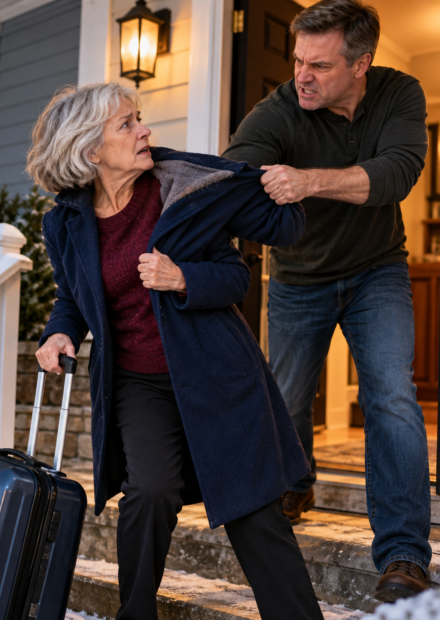
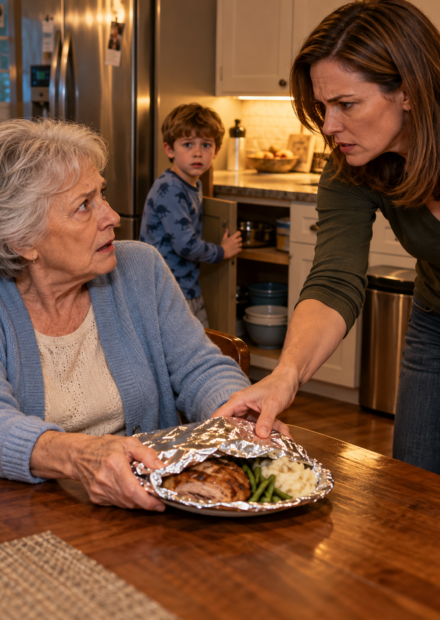
My son took my walker away and said I wasn’t leaving the table until I signed.
For a few seconds, I thought I had misunderstood him.
Daniel was standing six feet from me in my own dining room, one hand wrapped around the silver bar of my walker, the other resting on his hip like an impatient father dealing with a stubborn child.
Except I was his mother.
And I was seventy-eight years old.
“Put that back,” I said.
My voice came out quieter than I intended.
Daniel glanced at his sister.
Rebecca was sitting across from me with a stack of papers arranged neatly in front of her. She had brought her reading glasses, a yellow legal pad, three pens, and little colored tabs already stuck along the edges of the documents.
She had come prepared.
I was the only person at the table who apparently had not understood what kind of meeting this was.
“Mom,” Rebecca said, “nobody is trying to upset you.”
I looked at her.
Then I looked at my walker again.
Daniel had moved it farther away.
Near the china cabinet now.
Too far for me to reach.
“Then tell your brother to bring that back.”
Rebecca sighed.
Not sadly.
Not with guilt.
With irritation.
It was the sound people make when a printer jams or traffic moves too slowly.
“Can we please not turn this into something dramatic?”
I stared at her.
“I asked for my walker.”
“And you’ll get it,” Daniel said.
“When?”
“When we finish.”
My stomach tightened.
The papers in front of me suddenly looked different.
Ten minutes earlier, they had been documents my children wanted me to “take a look at.”
Now they looked like bars on a cage.
I placed both hands flat on the table.
The wood beneath my palms was cool and smooth. My husband, Thomas, had refinished that table himself almost thirty years ago.
He had sanded it in the garage for three weekends.
I could still remember the dust in his hair.
He had come inside looking ten years older, white powder on his eyebrows, and said, “Mary, if I ever volunteer to refinish furniture again, have me examined.”
I had laughed until I cried.
Thomas had been dead for six years.
Sometimes I still heard his voice in the house.
That afternoon, I would have given anything to hear it.
I looked back at Daniel.
“Bring me my walker.”
His jaw hardened.
“We have been talking about this property for months.”
“No. You have been talking about it for months.”
“Because something has to be done.”
“Something is being done. I own it. I pay the taxes. The tenants pay their rent. The roof was replaced two years ago. What exactly is the emergency?”
Rebecca pushed one of the papers toward me.
“The emergency is that you can’t manage everything forever.”
There it was.
Not money.
Not paperwork.
Me.
My age.
My knees.
My balance.
My walker.
The slow way I lowered myself into chairs.
The extra seconds it took me to answer the front door.
The fact that I no longer drove after dark.
In the eyes of my children, every small surrender my body forced on me had somehow become proof that my mind should surrender too.
The property they wanted me to sell was a small two-unit house on Cedar Street.
Thomas and I had bought it when Daniel was eleven and Rebecca was eight.
It had never been glamorous.
The porch leaned a little until Thomas rebuilt it. The kitchen cabinets were old even when we bought it. For years we did repairs ourselves because hiring someone would have eaten every dollar we made from rent.
That property helped pay for braces.
It helped pay tuition.
It helped us through the year Thomas was laid off.
And after he died, the rent became part of what allowed me to remain independent.
It was not a fortune.
That was precisely why I could not understand my children’s obsession with selling it quickly.
Or at least, I had not understood.
Not until that afternoon.
“Mom,” Daniel said, “the offer is good.”
“I know what the offer is.”
“You said yourself the place is becoming a burden.”
“I said the furnace repair was annoying.”
“Exactly.”
“No, Daniel. Not exactly.”
Rebecca rubbed her forehead.
“We’re talking in circles.”
“No. I’m saying no, and the two of you keep pretending I haven’t answered.”
Daniel dragged a dining chair backward and sat across from me.
My walker stayed beside the china cabinet.
He leaned toward me.
“What are you waiting for?”
“I want Harold to review the documents.”
Daniel’s face changed.
Only slightly.
But I saw it.
Harold Mills had handled our family’s legal paperwork for more than twenty years.
He had helped Thomas and me update our wills.
He had reviewed the Cedar Street lease when a former tenant caused trouble.
He had prepared the documents when I gave Daniel limited authority to speak to contractors during my hip surgery three years earlier.
Daniel had been perfectly comfortable with Harold then.
Now he sat back.
“Why does Harold need to be involved?”
“Because I’m selling real estate.”
“The attorney for the buyer already prepared everything.”
“That attorney does not work for me.”
Rebecca glanced at Daniel.
A tiny glance.
Fast.
But I caught it.
I had raised two children.
I knew what it looked like when they had already discussed something without me.
“Mom,” Rebecca said carefully, “if you send this to Harold, he’s going to slow everything down.”
“Then it gets slowed down.”
“We have a deadline.”
“You have a deadline.”
She exhaled sharply.
“It’s a very strong offer.”
“Then maybe they’ll wait forty-eight hours.”
“They might not.”
“Then they might not.”
Daniel slapped his palm lightly on the table.
Not hard enough to frighten a stranger.
Hard enough to frighten his mother.
“You always do this.”
I blinked.
“Do what?”
“Make everything harder than it needs to be.”
I felt a strange coldness move through me.
Not fear exactly.
Recognition.
I had heard that tone before.
When he was sixteen and I told him he could not take the car because he had been drinking.
When he was twenty-four and wanted us to cosign a loan.
When he was forty and asked Thomas for money for a business expansion Thomas thought was too risky.
You always do this.
Meaning: You refuse to give me what I want.
But this time Daniel was fifty-two.
His hair had gray at the temples.
His father was dead.
And he had my walker on the other side of the room.
“Bring it back,” I said again.
Nobody moved.
I looked at Rebecca.
“You too?”
Her eyes flickered.
For just one moment, I saw discomfort.
Then she gathered it away.
“We’re trying to help you.”
“By keeping me in my chair?”
“Nobody is keeping you—”
“Then give me my walker.”
Daniel stood abruptly.
“Fine. You want to walk away from every difficult conversation? Go ahead.”
He took the walker.
For one foolish second, relief washed through me.
Then he rolled it past the dining-room doorway.
Across the living room.
And left it beside the far wall.
At least twelve feet away.
He returned empty-handed.
I stared at him.
He did not look ashamed.
That was the part that hurt most.
He looked certain.
Certain that he knew what was best.
Certain that my dependence on four metal legs gave him the right to decide what I could and could not do.
Certain I would eventually give in.
“Daniel.”
“No,” he said. “We are finishing this.”
My fingers trembled on the table.
I pulled them into my lap so neither of them would see.
Rebecca slid the papers closer.
“There are three places you need to initial and one signature.”
“I am not signing.”
“Read it first.”
“I have read enough.”
“Mom.”
“No.”
Silence fell over the dining room.
The grandfather clock in the hallway ticked.
Once.
Twice.
Three times.
I suddenly became aware of the smell of coffee growing cold in my cup.
The remains of the lunch Rebecca had brought were still on the kitchen counter.
Chicken salad.
Rolls.
Cut fruit.
She had arrived carrying it all in a wicker basket, smiling.
I had thought my children were coming to spend an afternoon with me.
I had even put on the blue blouse Rebecca once told me made my eyes look brighter.
How pathetic that felt now.
“How long have you planned this?” I asked.
Rebecca looked away.
Daniel said, “Planned what?”
“This.”
“We came to talk.”
“You brought a contract.”
“You knew we were discussing the sale.”
“I knew you wanted to discuss it. I did not know you were going to trap me at my own table.”
“Trap you?” Rebecca said. “Mom, please listen to yourself.”
I looked straight at her.
“That door is behind you.”
Her face changed.
“What?”
“The front door.”
“What about it?”
“When I said I wanted to leave the table, you got up and stood in front of it.”
“I was trying to keep you from storming off.”
I almost laughed.
Storming.
At seventy-eight years old.
With arthritis in both knees and a walker I needed after my fall the previous winter.
I could barely storm across a bathroom.
But apparently I was dangerous enough to require guarding.
“I want both of you out of my house,” I said.
Rebecca went pale.
Daniel’s expression hardened.
“Not until this is settled.”
“It is settled.”
“No, it isn’t.”
“I own Cedar Street.”
“We know.”
“I decide whether it is sold.”
“We know.”
“Then what are we still discussing?”
Neither of them answered.
That frightened me more than Daniel raising his voice had.
Because suddenly I understood.
They did know.
They knew perfectly well it was mine.
They knew perfectly well they could not sell it without me.
That was why they were still there.
That was why my walker was across the room.
That was why Rebecca had blocked the door.
They needed one thing.
My signature.
I pushed my chair backward.
The legs scraped loudly against the hardwood.
Rebecca stood.
“Mom.”
“I’m done.”
Daniel turned toward the living room, following my eyes to the walker.
“Sit down.”
“No.”
“Mom, don’t.”
I put both hands on the edge of the table.
My right knee was already beginning to ache.
I rose slowly.
The room shifted for a second, the way it sometimes did when I stood too quickly.
I waited.
Breathed.
Straightened.
Without my walker, there was nothing between me and the living room except open floor.
Maybe ten steps.
Twelve at most.
I had walked farther than that without assistance during physical therapy.
With a therapist beside me.
With parallel bars.
With someone ready to catch me.
This was my house.
I knew every board.
Every doorway.
Every piece of furniture.
I told myself I could do it.
Daniel stared at me.
“Mom, sit down before you hurt yourself.”
I looked at my son.
Then at my walker.
Then back at him.
“You don’t get to take away the thing that keeps me safe and then pretend you’re worried about me.”
Something moved in his face.
But he still did not bring it back.
So I took one step.
Then another.
Behind me, Rebecca said my name.
I ignored her.
A third step.
My left leg felt steady.
The right one less so.
I reached toward the back of a chair.
My fingers brushed it.
I kept going.
“Stop,” Daniel said.
Four steps.
Five.
My walker seemed much farther away now.
That is the strange thing about fear.
It stretches rooms.
It makes a familiar distance feel like a field.
Six steps.
My right knee buckled.
It happened fast.
One instant I was upright.
The next, the floor tilted violently.
My hand struck the edge of the coffee table.
My shoulder twisted.
A cry tore out of me before I could stop it.
Daniel lunged forward.
Rebecca screamed.
I caught myself with one hand on the arm of the sofa, but my body folded halfway down, my bad knee bending beneath me.
Pain shot through my leg.
For a terrifying second, I thought I was going to hit the floor.
Daniel grabbed my upper arm.
“Mom!”
“Don’t touch me!”
The words came out louder than I had shouted in years.
Everyone froze.
My chest heaved.
My hand shook against the sofa.
Daniel’s fingers loosened.
“Get,” I said, breathing hard, “my walker.”
He did.
Immediately.
He rolled it toward me and locked the brakes.
I pulled myself upright, gripping the handles.
The moment my weight settled safely behind it, something inside me changed.
Not softened.
Changed.
The fear was still there.
So was the pain.
But beneath both was a hard, clean anger.
I looked at my son.
Then at my daughter.
“You almost made me fall.”
Rebecca’s eyes filled.
“Mom, we didn’t—”
“You moved my walker.”
“Daniel moved it.”
“And you let him.”
She flinched.
Daniel opened his mouth.
I raised one hand.
“No.”
He stopped.
For the first time that afternoon, he stopped because I told him to.
I turned my walker toward the small desk beside the living-room window.
My telephone sat there.
So did the card with Harold Mills’s office number, tucked beneath the glass top where I had kept it for years.
Daniel saw where I was going.
“Who are you calling?”
I looked at him over my shoulder.
“My lawyer.”
And suddenly, both of my children were silent.